How to Deal with Scratches and Dents in Timber Flooring

Timber flooring, with its natural beauty and durability, is a popular choice for many homes and businesses. However, it’s not immune to scratches and dents, which can mar its appearance. Understanding how to effectively deal with these imperfections is crucial for maintaining the aesthetic and longevity of the flooring.


Understanding the Type of Timber Flooring

Before addressing the repairs, it’s essential to identify the type of timber flooring you have, as the repair process can vary significantly. The two main types are oiled and lacquered floors.

  • Oiled Floors: These floors have an oil finish that penetrates the wood, offering a natural look. They’re easier to repair at a small scale because the oil can be reapplied locally.
  • Lacquered Floors: These have a protective coating that sits on top of the wood, creating a glossy and hard finish. While they’re more resistant to damage, repairs often require refinishing a larger area to blend in seamlessly.

Dealing with Scratches

For superficial scratches, a simple DIY solution can often be effective. You can use a wood marker or wax crayon that matches the floor’s color to fill in the scratches.

For small scratches in oiled floors, treating scratches can be as simples as applying a small amount of maintenance oil with a clean cloth, then buffing until dry.

For deeper scratches, especially in oiled floors, sanding the affected area and reapplying oil may be necessary.

Lacquered floors with deep scratches might require the damaged plank to be sanded down and then refinished with lacquer. It’s crucial to ensure the new lacquer matches the rest of the floor.


Fixing Dents

Dents are trickier as they represent actual damage to the wood. For minor dents in oiled floors, steaming the area can raise the grain, but this should be done by a professional, as steaming a timber floor can damage the protective finish.

In lacquered floors, larger dents usually necessitate the replacement of the affected plank. This process can be complex and might require professional help, especially to ensure the new plank matches the existing floor in terms of colour and finish.

Smaller dents can be treated with wax repair.


Professional Help and Maintenance

For significant damage, seeking professional help is advisable. Professionals can assess the extent of the damage and suggest the best course of action, whether it’s repair or replacement.

Regular maintenance can prevent scratches and dents. Use furniture pads, regularly sweep or vacuum the floor, and immediately clean up spills. Placing rugs in high-traffic areas can also be beneficial.  If the floor has an oil finish, then regular maintenance can ensure longevity.


Online Resources

For more detailed guidance, you can refer to the following online resources:

  1. Oiled Floor Care Guide
  2. Lacquered Floor Care Guide 

Maintaining timber flooring requires knowledge of the type of flooring and appropriate repair techniques. Regular maintenance, coupled with timely repairs, can ensure the longevity and beauty of your timber floors. For extensive damage, professional services are recommended.

Comparing Solid Wood vs Engineered Timber Flooring: A Technical Insight

The choice between solid wood and engineered timber flooring is vital for homeowners and professionals. This article integrates technical details from recent industry manuals to offer a deeper understanding of these two popular flooring options.

1. Composition and Structural Differences:

  • Solid Wood Flooring: Made from single pieces of hardwood, solid wood flooring is known for its robustness and susceptibility to environmental changes like humidity.
  • Engineered Timber Flooring: Comprises a hardwood veneer over a core layer, often plywood or fibreboard. Engineered flooring offers enhanced stability against humidity changes due to its cross-laminated structure.

2. Installation and Environmental Adaptability:

  • Solid Wood: Requires careful installation, taking into account factors like moisture content and subfloor conditions. It’s sensitive to environmental changes and needs acclimatisation before installation.
  • Engineered Timber: Adaptable to various subfloor conditions and can be installed as floating floors. Its layered construction minimises dimensional changes due to humidity.

3. Durability and Maintenance:

  • Solid Wood: Can be sanded and refinished multiple times, extending its lifespan. It requires regular maintenance to counteract environmental effects.
  • Engineered Timber: The ability to refinish depends on the veneer thickness. It typically requires less maintenance and is more resistant to moisture and heat.

4. Aesthetic Variations and Customisations:

  • Solid Wood: Offers a timeless, natural look with inherent grain and colour variations.
  • Engineered Timber: Provides a wide range of aesthetic options and can mimic rare woods. Veneer quality and construction type can influence its appearance and performance.

5. Environmental Impact and Sustainability:

  • Solid Wood: Utilises more hardwood, impacting forests unless sustainably sourced.
  • Engineered Timber: More sustainable, using less hardwood. The impact depends on core materials and the manufacturing process.

Both solid wood and engineered timber flooring have unique attributes and technical considerations. Your choice will depend on factors like installation environment, maintenance preferences, and sustainability concerns.

Understanding Tolerances for Timber Flooring in New Zealand

Understanding tolerances in engineered timber flooring is crucial for both quality results and adherence to New Zealand building standards. Tolerances refer to the allowable variations in measurements and alignments during construction and installation processes. These guidelines ensure that while perfection might not always be attainable, the quality and integrity of the construction are maintained.

The Building Code

In New Zealand, the standards for timber flooring tolerances are well-defined. For instance, the NZS 3604:2011, a key standard for timber-framed buildings, outlines specific tolerances relevant to various aspects of construction, including timber quality and framing. This standard ensures that timber used in buildings, including flooring, meets certain criteria for dimensions and alignment to maintain structural integrity and aesthetic quality.

The Measures for “Flatness” of Overlay Flooring

Specifically, for timber flooring, tolerances include allowances for variations in dimensions, straightness, and levelness. These tolerances are critical to ensure that the flooring not only looks good but also performs well over time. For instance, there are set limits for how much a floor can deviate from being level or how straight the timber must be. These limits are measured in millimeters and are based on the length of the timber used.  Often the tolernces related to “flatness” are expressed by manufacturers of timber flooring.  These are usually represented as a tolerance of devation of 2 or 3mm over 2 or 3 meters.  However standards and tolerances do differ.

Tolerance Tables for Timber Flooring

The Building CodeHub’s “Tolerances tables – Build 184 (2021)” also provides comprehensive information on construction tolerances. It includes details on the permitted variations from given dimensions, the range of variation in maintaining a specified dimension, and variations from location or alignment. Adhering to these tolerances ensures that subsequent trades can achieve quality results and that the final construction meets the desired standards.

Tolerance Tables NZBC Wood Flooring

These tolerances are not just about the technical aspects of construction; they are also about the end-user experience. Floors that are not level or have significant variations can lead to discomfort and even safety issues. Therefore, understanding and applying these tolerances is not just a matter of regulatory compliance but also about delivering a product that meets the highest standards of quality and comfort.

For more detailed and specific information regarding the tolerances in timber flooring, professionals in the industry often refer to the NZS 3604:2011 standard and resources provided by Building CodeHub and BRANZ.

When it comes to engineered timber flooring in New Zealand, adhering to the set tolerances is key. These guidelines ensure that the flooring is not only aesthetically pleasing but also structurally sound and safe for use. By following these standards, builders and installers can provide quality flooring solutions that stand the test of time.

You may also be interested in the impact of E3 on using wood flooring in kitchens (read more here).

What is Engineered Timber Flooring?

At Vienna Woods we often find that there are some misunderstandings about what is commonly called Engineered Flooring.  In the following article we will outline exactly what engineered flooring is and clear up any misconceptions.

The concept of engineered timber has been around for some time.  It wasn’t until the early 20th century when engineered timber began to be used for flooring.  See our article on The History of Engineered Flooring for more information.

Engineered flooring is term used to describe a flooring board comprising of layers of timber glued together to form a robust “engineered” plank.  The top layer is usually a species of hard wood.

Fusing the layers together in this way is also called laminating.  builders frequently work with laminated timber for everything from various ply wood application through to ceiling beams.  Laminated timbers are often used for their added spanning properties (think thick laminated beams) and also their structure stability (think of sheets of plywood).  However, some confusion  exists when using the term “laminated” with flooring.  There is a category of flooring named “laminated” which refers to a synthetic top layer laminated to a high density fibreboard backing.  Engineered timber flooring is technically laminated, but it does not fall under the category of laminated flooring.  Even builders (who commonly use and discuss laminated products) will sometimes refer to engineered timber flooring as “laminated”.

The Key Features of Engineered Timber Flooring:

  1. Layers: The typical engineered timber floor plank is made up of three or more layers. These layers are laid at right angles to each other to improve strength and resilience.
  2. Top Layer (Wear Layer): The topmost layer is a veneer of the desired hardwood. This could be oak, maple, or any other type of wood. This layer provides the look and feel of solid hardwood flooring. The thickness of this layer can vary, but it’s generally between 2mm to 6mm. This layer can be sanded and refinished, depending on its thickness.
  3. Core Layers: Beneath the top layer are several core layers, usually made from plywood, hardwood, or high-density fiberboard. These layers provide stability, reducing the wood’s natural tendency to expand and contract with changes in humidity and temperature. This makes engineered wood flooring more suitable for areas with varying climate conditions or for installation over underfloor heating systems.
  4. Bottom Layer: The bottom layer of engineered wood flooring is usually made from the same material as the core layers. It helps balance the board and prevent warping.

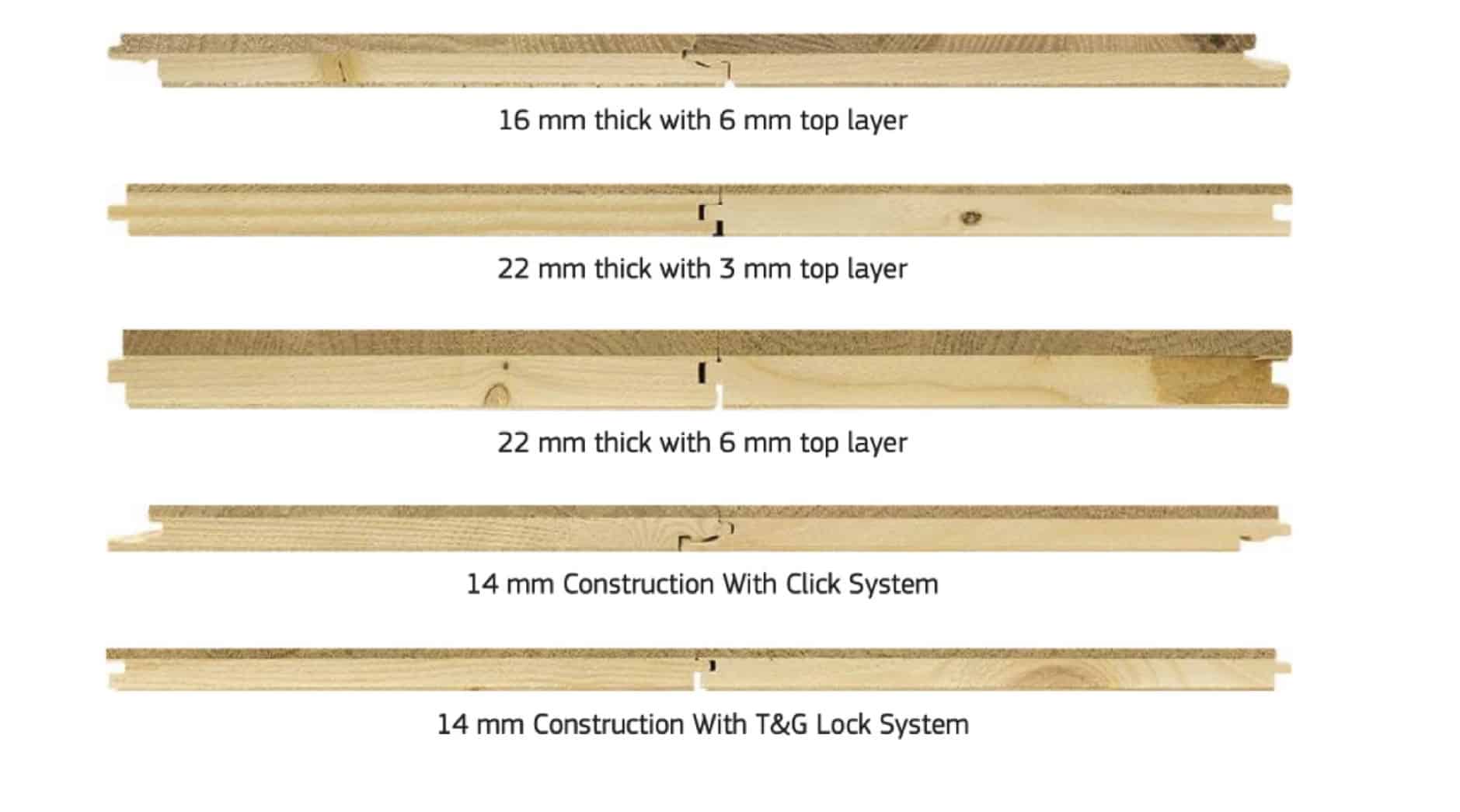
Engineered timber floors include a top layer of hardwood; typically 2.5 to 6mm, and a backing board which will sometimes be multi layered ply and some times solid core.  The backing board is usually made from a fast growing softwood.  The benefits of this construction are;

  • Stability: The cross-layer construction provides high stability compared to solid wood, making it less prone to changes caused by humidity and temperature.
  • Versatility: Engineered wood can be installed over various types of subfloors, including concrete.
  • Sustainability: Since the top layer is a thin veneer, less hardwood is used compared to solid wood flooring. This can be more sustainable if the wood is sourced responsibly.
  • Compatibility with Underfloor Heating: The construction of engineered wood makes it suitable for use with underfloor heating systems.

There are a number of different engineered timber types with connection systems, thicknesses and construction types varying a great deal.  The more common architypes are pictured below;


Engineered wood can last as long as solid hardwood, but its lifespan can be shorter if the top layer is too thin to be refinished.

An additional consideration is variability in quality.  Since engineered timber planks are manufactured, there can be a wide variety in qualities.  Everything from the quality of the manufacturing through to the width and thickness of the flooring and the wear layer.  Because of this variability, it is important to select an appropriate supplier if you are considering engineered flooring for your home.

Engineered timber flooring offers the beauty of hardwood with added stability and versatility, making it a popular choice for various settings, including residential and commercial spaces.


A Comprehensive Guide to Glue-Down Wood Floor Installation

Installing a glue-down wood floor is a method that combines stability, durability, and timeless appeal. This process involves adhering the timber directly to the subfloor using a specialised adhesive, creating a seamless and firm finish underfoot. To ensure success, you need careful preparation and precise execution.

Why Choose a Glue-Down Wood Floor?

Glue-down installation offers significant advantages over floating methods. It reduces movement, provides excellent acoustics, and enhances the solid feel of your floor. If you’re weighing your options, check out our comparison of floating and glue-down installationsto decide which method suits your space.

Steps for Installing a Glue-Down Wood Floor

To achieve a flawless result, follow these steps:

  1. Prepare the Subfloor: Ensure the subfloor is level, dry, and free from debris. Subfloor preparation is critical to avoid issues like warping or gapping. For detailed guidance, BRANZ provides excellent resources tailored to New Zealand building standards.
  2. Acclimate the Timber: Allow the timber to acclimatise to the room’s environment before installation. This step reduces movement caused by temperature and humidity changes.
  3. Select the Right Adhesive:  Use a high-quality, low-VOC adhesive to ensure strong bonding while maintaining indoor air quality. Learn more about adhesives that meet health and sustainability standards on the Healthy House Institute.  (Consider Parabond 440 as a suitable eco-friendly timber floor adhesive)
  4. Install with Precision:  Lay the boards meticulously, ensuring even spacing and alignment. Expansion gaps should be left around the room’s perimeter to accommodate natural wood movement.
  5. Finishing Touches:  Many glue-down wood floors come pre-finished, but if you opt for an unfinished floor, you’ll need to sand, stain, and seal it after installation. Visit our floor care guide for maintenance tips post-installation.

Enhancing Your Floor with Design Options

The glue-down method is ideal for complex patterns like herringbone flooring, where stability is paramount. If you’re considering a unique design, our team can help you bring your vision to life.

Maintaining Your Glue-Down Timber Floor

Proper maintenance is key to keeping your floor looking its best. For tips, read our article on oiled timber floors and explore products from trusted brands like Bona for cleaning and care.

By following these steps and using high-quality materials, you can enjoy a durable and beautiful glue-down wood floor that will last for years. For expert advice or inspiration, explore our completed projects showcasing glue-down installations in various settings.