
How Much Does Timber Flooring Cost in NZ? Complete Price Guide
Timber flooring is one of the most significant finish investments in any NZ build or renovation — and one of the most misquoted. Prices range widely across the market, and published figures often leave out what matters most: wastage allowances, installation method, subfloor preparation, and the quality differences that separate a floor that lasts 30 years from one that needs replacing in 10.
This guide covers engineered European oak — the most widely specified timber floor type in New Zealand, and the category Vienna Woods has focused on exclusively since 2009. We’ve written it to give you the most honest, practical picture of what timber flooring actually costs so you can plan your project with confidence.
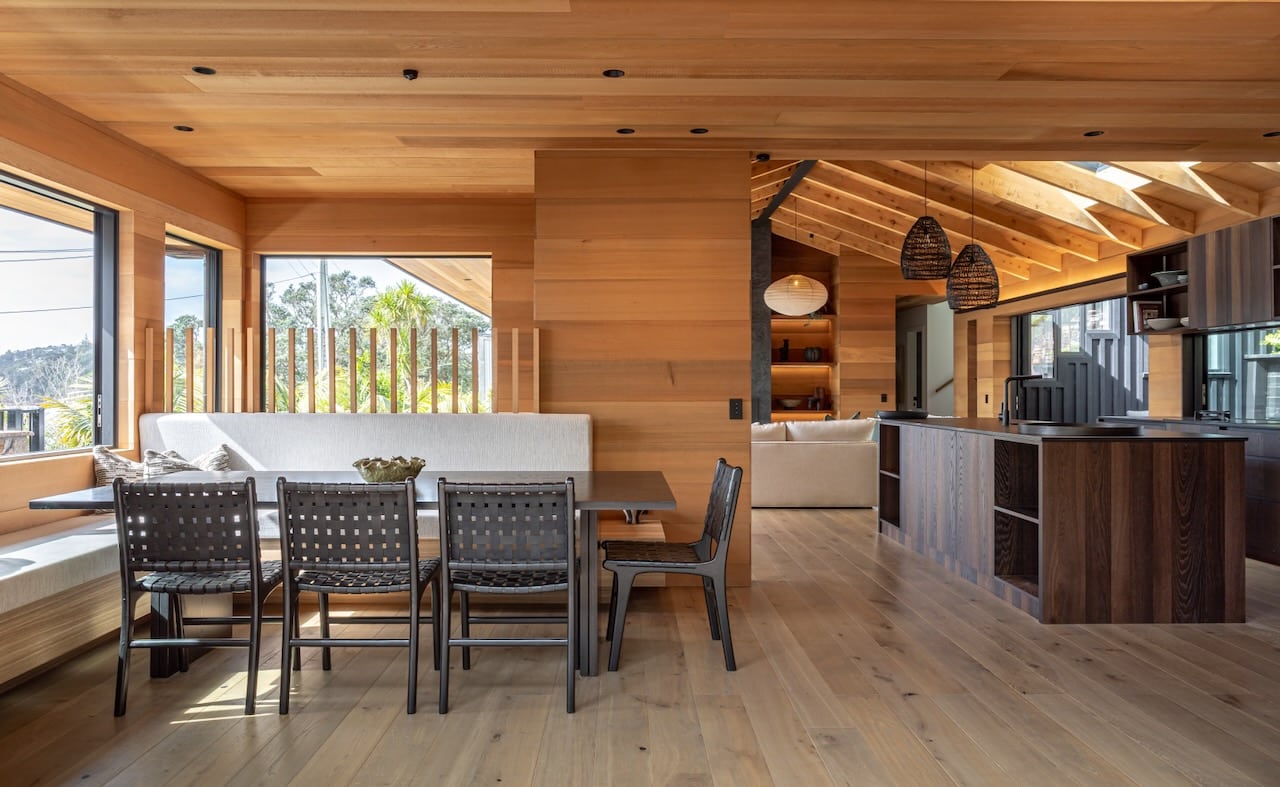
Engineered oak timber flooring NZ — Vienna Woods
Timber Flooring Cost in NZ — At a Glance
The table below shows typical NZ market supply tiers for engineered European oak, with installation costs based on glue-down method (the recommended standard for most NZ projects). Supply prices are incl GST. Installation is quoted +GST. The indicative total combines both including GST, and includes a 10% wastage allowance on the timber.
| Price tier | Supply (incl GST/m²) | Material budget incl 10% wastage | Glue-down install (+GST/m²) | Indicative total (incl GST/m² floor) |
|---|---|---|---|---|
| Entry | $99–$139 | $109–$153 | $85–$110 | ~$205–$280 |
| Mid-range | $140–$189 | $154–$208 | $85–$110 | ~$250–$335 |
| Upper mid | $190–$259 | $209–$285 | $85–$110 | ~$305–$415 |
| Premium / Custom | $260–$320+ | $286–$352+ | $85–$110 | ~$385–$480+ |
Indicative totals assume glue-down installation over a prepared concrete slab, include 10% wastage on timber, and convert installation to incl GST for comparison. Herringbone and chevron require more wastage and higher installation costs — see Sections 4 and 5 below. Floor preparation (levelling, grinding, moisture remediation), removal of existing flooring, and acoustic underlay are additional costs not included above.
What Drives the Price of Engineered Timber Flooring?
Understanding what separates a $99/m² floor from a $289/m² floor helps you make a better decision — not just for your budget, but for the 20–30 year life of your floor. There are six key quality variables.
| Factor | What to know |
|---|---|
| Country of origin | European-made engineered oak carries a premium for good reason — manufacturing standards, quality controls, and the finishing systems used in European mills are world-leading. Non-European manufactured floors can be excellent value, but require scrutiny of specification. |
| Grade of timber | Oak is graded by the visual character of the top layer — from select (minimal knots, consistent grain) through character and rustic grades (more natural variation, knots, colour range). Higher grades aren’t necessarily better aesthetically — character grades are popular in NZ — but they are a pricing factor. |
| Wear layer thickness | The top hardwood layer is the most critical specification. A 4mm wear layer can be lightly sanded and refinished to restore the surface — a 1–2mm layer cannot. This single factor has the biggest impact on floor lifespan and long-term value. |
| Plank dimensions | Wider and longer planks require higher-grade timber and more complex manufacturing. A 220mm wide, 2400mm long plank will cost more than a 150mm wide, 1200mm long plank — and will look more premium on the floor. Shorter planks and higher proportions of end-joins within a board are a sign of cost-cutting. |
| Finishing system | The surface finish — whether lacquered or oiled, matt or satin, natural or stained — has a major cost impact. Smoked oak (where the entire board is fumed, not just surface-stained), hand-scraping or brushing, and multi-layer oil systems all add to the production cost and the price. |
| Board thickness | Total board thickness (15mm vs 20mm) affects stability, subfloor tolerance, and acoustic performance. Thicker boards generally perform better in commercial environments and over imperfect subfloors. |
What Does Entry-Level Timber Flooring Actually Mean?
Engineered oak at $99–$139/m² (incl GST) exists in the NZ market — but it’s worth understanding why it’s at that price before buying.
In our experience, floors in this range are almost always a combination of the following:
- End-of-line or excess stock — quality product sold at clearance pricing to clear warehouse space. This can be excellent value if the specification is right for your project, but availability is limited.
- Thin wear layer (1–2mm) — the most common cost-cutting point. A thin top layer means the floor cannot be sanded or refinished. Once surface wear becomes visible, the floor needs replacing. Over a 20-year period, a cheaper floor with a thin wear layer will cost more — not less — than a quality floor bought at a higher entry price.
- Higher proportion of short planks — industry standards allow a certain percentage of short or jointed planks within a box. Lower-price products often push toward the maximum allowable, which affects the look of the installed floor.
- Lower-grade backing boards — the structural plywood beneath the top layer matters for stability and acoustic performance. Economy grades can affect long-term floor movement and acoustic quality.
- Non-European manufacture — not automatically a problem, but requires more due diligence on the specification.
Timber Flooring Installation Costs NZ
Installation is a significant part of your total project cost — and the method matters. All prices below are +GST and are based on Auckland market rates for professional installation including consumables. Subfloor preparation, if required, is additional.
| Method | Typical cost (+GST/m²) | Notes |
|---|---|---|
| Glue-down | $85–$110/m² | Includes adhesive and consumables. The recommended method for concrete slabs, underfloor heating, and commercial environments. Provides the most stable, durable result. Excludes subfloor preparation if required. |
| Floating | ~$45/m² | Lower installation cost but a different product category — floating floors require a very flat subfloor, additional trims and transitions at doorways and walls, and suitable acoustic underlay. Not directly comparable to glue-down. Best suited to situations where a fully bonded floor isn’t practical. |
| Herringbone / parquet | $120–$150/m² | More complex installation requiring a specialist herringbone installer — setting out, cutting angles, maintaining consistent joints, and managing the pattern across the full room. Do not skimp on the installer for herringbone. See also: herringbone wastage (Section 5). |
| Stair installation | $120–$250 per step | Priced per step including treads, risers, and nosings. Varies significantly based on stair profile and access. |
What affects your installation cost
- Subfloor preparation — concrete grinding, levelling compounds, or moisture barrier application are additional and necessary if the subfloor isn’t within tolerance. Vienna Woods includes moisture testing in all supply-and-install quotes.
- Acoustic underlay (glued down) — adding a quality acoustic underlay layer beneath a glue-down floor adds approximately $50/m² +GST. Often required in multi-storey residential and commercial buildings to meet NZ building code acoustic requirements. This is a fully adhered underlay system — not the same as the foam underlay used under a floating floor.
- Room complexity — irregular rooms, multiple doorways, alcoves, and built-in cabinetry increase labour time and waste.
- Acclimation time — boards need 3–7 days on site before installation. Factor this into your project programme.
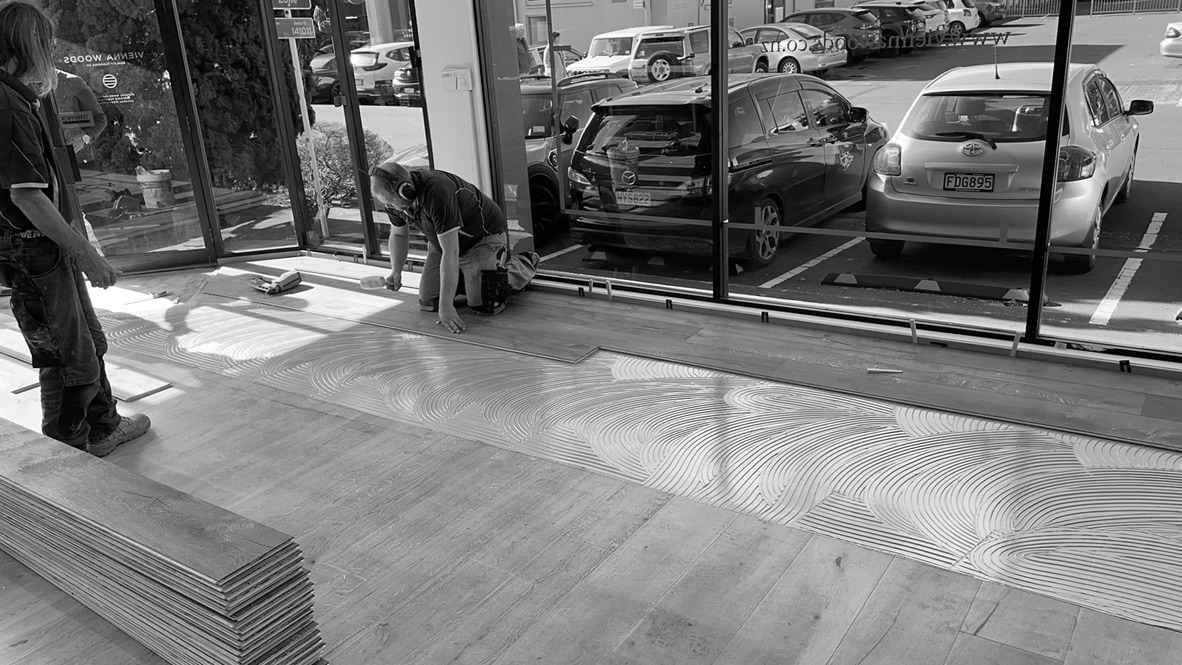
Engineered oak timber flooring installation Auckland — Vienna Woods
Format Premiums: Herringbone, Chevron and Versailles
The pattern you choose affects both the supply price and the installation cost — primarily through material wastage and installation complexity.
| Format | Supply price vs plank | Wastage allowance | Installation |
|---|---|---|---|
| Straight plank | Base price | 10% | $85–$110 +GST/m² |
| Herringbone | Same as plank equivalent | 15% (more cutting waste) | $120–$150 +GST/m² (specialist installer essential) |
| Chevron | ~25% more than plank | ~20% (precision angle cuts) | $120–$150 +GST/m² (specialist installer essential) |
| Versailles panels | From ~$300/m² incl GST | Allow 10–15% | Specialist — POA. Often supplied on special order with minimum quantities. |
Additional Project Costs to Budget For
Your total timber flooring project cost includes more than just supply and installation. The following are common additional items — all +GST unless noted.
| Item | Typical cost | Notes |
|---|---|---|
| Carpet removal | ~$15/m² +GST | Includes removal and disposal. |
| Existing timber removal | $80–$100/m² +GST | Significantly higher than carpet — especially for glue-down timber, which requires mechanical removal and adhesive grinding. Allow toward the top of this range for existing glue-down floors. |
| Subfloor preparation | POA | Levelling compounds, concrete grinding, and moisture barrier work are quoted per project based on subfloor condition. Vienna Woods assesses subfloor condition as part of all supply-and-install quotes. |
| Acoustic underlay (glued) | ~$50/m² +GST | For glue-down floors where acoustic performance is required (multi-level residential, commercial). This is a fully adhered underlay system — not foam sheet underlay. |
| Floating floor underlay | ~$10/m² +GST | Standard 3mm foam underlay for floating installations. Usually included in the floating installation quote — confirm with your installer. |
| Trims and transitions | Varies by project | T-bars, end caps, scotia, and threshold strips at doorways and floor level changes. Quoted per linear metre — more complex in older homes with multiple level transitions. |
Typical NZ Project Costs — What to Budget
The following are indicative all-up costs for common project types in Auckland, including supply with 10% wastage and glue-down installation. Subfloor preparation, existing floor removal, and acoustic underlay are not included unless noted. All prices incl GST.
| Project type | Area | Tier | Indicative total (incl GST) |
|---|---|---|---|
| Single bedroom — quality upgrade | 15m² | Mid-range | ~$3,750–$4,800 |
| Open-plan living and dining | 60m² | Mid-range | ~$15,000–$20,000 |
| Herringbone feature area (living room) | 40m² | Upper mid | ~$18,000–$24,000 |
| Full home — new build (Auckland villa scale) | 100m² | Upper mid | ~$31,000–$42,000 |
| Premium full home or executive specification | 120m² | Premium | ~$46,000–$58,000+ |
| Commercial office fit-out | 200m² | Mid to upper mid | ~$60,000–$90,000 |
Indicative ranges only. Contact Vienna Woods for a project-specific quote based on your floor area, subfloor condition, and product selection. We provide fully itemised supply-and-install quotes for Auckland projects.
Walnut, NZ Native Timber and Solid Oak — How Do They Compare?
Engineered European oak is the most widely specified timber floor in New Zealand — but it’s worth understanding how it sits in the context of other timber options buyers sometimes ask about.
| Option | Typical cost range | Key considerations |
|---|---|---|
| Engineered European oak | $99–$320+/m² supply (incl GST) | Dimensionally stable, compatible with underfloor heating and concrete slabs, wide design range, sustainably manufactured. The recommended choice for most NZ residential and commercial projects. |
| Engineered walnut | From ~$280–$350+/m² (incl GST) | A premium alternative for clients wanting a darker, richer hardwood character. Walnut is a beautiful option — darker tones, fine grain — but the supply is more limited and the price premium is significant. Available to order through Vienna Woods. |
| NZ native timbers | $400+/m² supply only | Native NZ species (rimu, kauri, heart totara) are not sold by Vienna Woods. They are typically available as reclaimed solid boards — sourced from old buildings, requiring nail removal, gap filling, and site sanding and finishing. Supply is limited and expensive. Total installed cost typically $500–$800+/m² incl GST. Best suited to restoration projects where the timber has cultural or historic significance. |
| Solid oak (European) | From ~$500/m² supply and install (incl GST) | Solid oak requires site sanding, staining, and multi-coat finishing — adding significant labour and time to the project. It moves and expands more than engineered timber (especially over concrete slabs or with underfloor heating) and is generally not recommended for NZ conditions. From a sustainability perspective, solid oak uses approximately three times the hardwood resource to produce a floor that performs no better — and often worse — than engineered oak over its lifetime. Vienna Woods does not supply solid timber flooring. |
Get an Accurate Quote for Your Project
The most reliable way to cost your timber flooring project is to talk to the Vienna Woods team directly. In a showroom consultation or on-site visit we can:
- Assess your subfloor and identify any preparation required before installation
- Recommend the right product and installation method for your space, usage, and budget
- Show you full-length boards in the showroom — not just small samples — so you can see how the floor will actually read at scale
- Provide a fully itemised supply-and-install quote (Auckland) or supply-only quote (nationwide)
Order sample packs by tone — Light/Natural, Medium, Grey, or Dark — to view boards in your own home before committing. Order samples online or collect from our Newmarket showroom.
Vienna Woods showroom: 2 Roxburgh Street (cnr Roxburgh & Melrose), Newmarket, Auckland.
Mon–Fri 8am–4pm | Sat 10am–1pm | 0800 843 662
Timber Flooring Cost NZ — Frequently Asked Questions
How much does timber flooring cost per m² in NZ?
Engineered timber flooring in NZ typically costs $99–$320+/m² for supply (incl GST), depending on the collection, plank dimensions, origin, and finish. Most quality residential projects use flooring in the $140–$259/m² supply range. Add glue-down installation at $85–$110/m² +GST, plus a 10% wastage allowance on the timber, and most quality installed floors land between $250 and $415/m² all-up (incl GST).
Why is there a 10% wastage allowance on timber flooring?
When installing timber flooring, boards must be cut to fit at walls, around obstacles, and to maintain the correct stagger pattern between rows. This cutting generates off-cuts that cannot be reused. A 10% wastage allowance is standard for straight-lay plank installation — meaning for a 50m² room you need to purchase approximately 55m² of flooring. Herringbone requires 15% wastage, and chevron approximately 20%, due to the angle cuts involved.
What is the difference between cheap and expensive engineered timber flooring?
The key differences are wear layer thickness, plank dimensions, manufacturing origin, and finishing quality. Entry-level flooring under $139/m² (incl GST) typically combines some or all of: a thin wear layer (1–2mm) that cannot be refinished, shorter planks, a higher proportion of end-joints within each board, and economy backing boards. Quality flooring from $159/m² upward typically offers a 4mm+ wear layer, longer planks, lower short-board ratios, and a superior European finishing system — factors that translate directly to floor lifespan and long-term value.
Is glue-down or floating installation better for engineered timber flooring?
Glue-down installation is generally recommended for quality engineered timber floors in NZ, particularly over concrete slabs, with underfloor heating, or in commercial environments. It provides greater dimensional stability, better acoustic performance, and a more solid underfoot feel. Floating installation has a lower labour cost (~$45/m² +GST) but requires a very flat subfloor, additional perimeter trims, and suitable underlay — and the floor is not as stable underfoot. The two methods are not directly interchangeable and suit different applications.
Why does herringbone installation cost more?
Herringbone and chevron installation requires a specialist installer, more complex setting-out (establishing the centre-point and working lines), continuous angle cuts, and careful management of the pattern across the full room. Installation costs $120–$150/m² +GST compared to $85–$110/m² +GST for straight-lay glue-down. Herringbone also requires 15% wastage rather than 10% for straight lay. The supply price of the timber itself is typically the same as the plank equivalent — the premium is entirely in the installation.
What is the difference between herringbone and chevron flooring?
Both are parquet patterns but they differ in how the planks are cut. Herringbone uses standard rectangular planks laid in a broken zigzag — the plank ends meet at 90° angles. Chevron uses planks that are cut at a precise angle in the factory so that the ends meet in a clean pointed “V” shape. Chevron typically costs around 25% more to supply than herringbone because of the angled factory cuts and higher material wastage (~20% vs 15%), and requires the same specialist installation approach.
How much does it cost to remove existing flooring before installing timber?
Carpet removal typically costs around $15/m² +GST including disposal. Removing existing timber flooring is significantly more involved — typically $80–$100/m² +GST, with costs toward the top of that range for glue-down timber where the adhesive must be mechanically ground off the concrete slab. Subfloor preparation (levelling, moisture testing and remediation) is quoted separately based on the condition of the subfloor once the existing floor is removed.
Does engineered timber flooring work with underfloor heating?
Yes — engineered timber is compatible with both hydronic and electric underfloor heating systems, and is significantly better suited to UFH environments than solid timber. Key requirements are: glue-down installation over the heated substrate, surface temperatures maintained below 27°C, and ambient humidity kept between 35–55%. Vienna Woods can confirm UFH compatibility for specific products and provide the technical documentation required by your installer.
How does engineered timber flooring compare to solid oak in cost and performance?
Solid oak flooring typically costs $500+/m² installed (incl GST) in New Zealand — significantly more than quality engineered oak. Solid timber also requires on-site sanding, staining, and multi-coat finishing, adding labour time and cost. In NZ conditions — particularly over concrete slabs or with underfloor heating — solid timber is more prone to movement, cupping, and gapping than engineered timber. From a sustainability perspective, solid oak uses approximately three times the hardwood resource to produce a floor with no significant performance advantage over a well-specified engineered alternative.
Can I get a quote for timber flooring without visiting the showroom?
Yes. Vienna Woods provides indicative quotes via the online quote request form based on your floor area, product preference, and subfloor type. For a fully itemised supply-and-install quote for Auckland projects, a showroom consultation or site visit is recommended. Sample packs are available online so you can review boards in your own home before committing.
What Three Real Projects Actually Cost in 2026
Pricing per m² only takes you so far — what most clients want is a sanity check on what their full project will land at. The three examples below are real Vienna Woods projects from the last 12 months, with the actual numbers reproduced (figures rounded to the nearest $500 for readability). Use them as benchmarks for your own project size and spec.
| Project | Mt Eden bungalow extension | Remuera villa restoration | Newmarket apartment fit-out |
|---|---|---|---|
| Coverage | 78m² | 280m² | 112m² |
| Format | 180mm wide plank, straight lay | 120 x 600mm herringbone | 190mm wide plank, straight lay |
| Product | Mid-range engineered European oak (Distilled Collection) | Premium engineered European oak, hardwax oil finish | Mid-range engineered European oak, lacquered finish |
| Supply cost | $15,500 (~$199/m²) | $72,500 (~$259/m²) | $22,000 (~$196/m²) |
| Wastage allowance applied | 10% | 15% | 10% |
| Installation | $7,000 ($90/m² +GST, glue-down) | $36,500 ($130/m² +GST, herringbone glue-down) | $10,000 ($89/m² +GST, glue-down) |
| Acoustic underlay | Not required | $14,000 (Mapesonic CR system) | $5,500 (body corp acoustic spec) |
| All-up project total (excl. GST) | $22,500 ($288/m²) | $123,000 ($439/m²) | $37,500 ($335/m²) |
| Lead time start to handover | 5 weeks | 14 weeks | 8 weeks |
Notes: All figures exclude GST. Supply prices include freight to Auckland. Installation rates assume a sound, level subfloor; subfloor remediation is quoted separately if needed. Premium ranges (slow-grown European oak, walnut, very wide plank) push supply 30–60% higher than the mid-range examples above.
What changes the number most
- Format choice. Herringbone or chevron parquet adds 30–60% to total project cost vs straight lay (higher supply premium, higher install rate, higher wastage). For a 100m² floor the difference is typically $8,000–$15,000.
- Acoustic requirements. Apartment and body corp work usually mandates an acoustic underlay (~$50/m² +GST). On a 200m² floor that’s $10,000 you don’t need on a standalone house.
- Subfloor condition. A self-levelling screed to fix a wonky concrete slab can add $30–$60/m² on top of the supply and install rates.
- Tier of European oak. Entry-tier engineered oak ($99–$150/m²) and premium slow-grown European oak ($220–$320/m²) look similar in a small sample but read very differently across a full floor — the premium tier shows tighter grain, more colour consistency, and a more forgiving ageing pattern.
For the full breakdown of why engineered makes sense for most NZ projects vs solid or laminate, our engineered timber flooring guide compares the three side by side. For format choices, the herringbone parquet guide walks through patterns and the wide plank guide covers the modern open-plan look.
The DIY Budget Option — Real Engineered Oak Under $200/m² Installed
The three real projects above all use trade installation. If you’re handy and willing to lay the floor yourself, the cost drops sharply. Our clearance range starts at $99/m² supplied — the same engineered European oak boards we install commercially, just end-of-run colours, discontinued grade lots, or one-off batch overruns. They’re real product with a real wear layer, not a downgrade.
Worked example: a 60m² lounge + hallway, DIY install
| Line item | Qty | Cost |
|---|---|---|
| Engineered European oak from clearance range | 66m² (60m² + 10% wastage) | $6,534 ($99/m²) |
| Acoustic / moisture barrier underlay (floating install) | 60m² | $420 (~$7/m²) |
| Floor leveller / latex skim (if needed for concrete) | 2 bags | $120 |
| Spacer wedges, tapping block, pull bar (one-time tool kit) | 1 set | $80 |
| Skirting / scotia (if not reusing existing) | ~25 lineal m | $300 |
| Hire of mitre saw + flooring nail gun (3 days) | 1 hire | $180 |
| All-up DIY total (excl. GST) | 60m² | $7,634 (~$127/m²) |
Same project with full Vienna Woods supply + install would land around $17,500–$19,500 for a comparable mid-range engineered oak with glue-down installation. DIY saves roughly $10,000 on a 60m² floor, with the trade-off of 4–6 weekends of your own time and the risk of getting it wrong on a substrate you haven’t worked with before.
What you can DIY safely — and what you really shouldn’t
- Good DIY candidates: Floating click-lock engineered planks over a flat plywood or particleboard subfloor in a single-room or simple rectangular space. Straight lay only. Skirting boards already removed or being replaced.
- Hire it out: Glue-down installation (the adhesive working time and substrate prep is unforgiving), herringbone or chevron parquet (pattern accuracy is professional-only), apartment installs requiring acoustic compliance certificates, anything over a heated slab where moisture testing is critical, or any floor over 100m². The cost of a botched lay on a $6,500 floor is the floor itself.
- Read first, lay second: Manufacturer specifications for your specific board, NZBC E2 (moisture in subfloors), and the engineered flooring guide for what differentiates a good lay from a bad one.
How to find clearance stock
Our clearance range turns over weekly — specific colours and sizes available change as batches sell through. The honest version: if you’re not flexible on colour, clearance won’t work for you and you should price the standard range. If you’re open to whatever’s in stock at lay date, you can typically save 35–55% on supply. Browse the current clearance range or call the showroom (0800 843 662) to ask what’s landing in the next 4 weeks. We’ll also tell you honestly if a particular clearance line isn’t suited to DIY install — some run-out batches have less-forgiving tongue-and-groove tolerances and need a trade hand.
Related Guides
- What is Engineered Timber Flooring? Complete NZ Guide
- Commercial Timber Flooring NZ — Offices, Hospitality & Retail
- Herringbone & Chevron Timber Flooring NZ — Patterns, Cost & Inspiration
- Browse Vienna Woods Flooring Collections
- Information for Architects & Specifiers
- Engineered vs Solid Timber Flooring NZ — when each is right for NZ projects, with cost, stability and refinishing compared.