Wood cutting techniques: which is best for timber flooring?
Timber is cut from the log three main ways: plain (flat) sawn, quarter sawn and rift sawn. Plain sawn shows the most figure and yields the most board, so it costs least. Quarter and rift sawn give a straighter, calmer grain and generally hold their shape better through the seasons, but yield less board and cost more.
It comes down to the angle to the growth rings
Every board starts as a log ringed with annual growth. The angle the saw takes to those rings decides three things at once: the grain pattern you see, how much the board moves with the seasons, and how much usable timber comes off each log. That last point is why the cut drives cost. Same species, same tree, a very different floor.
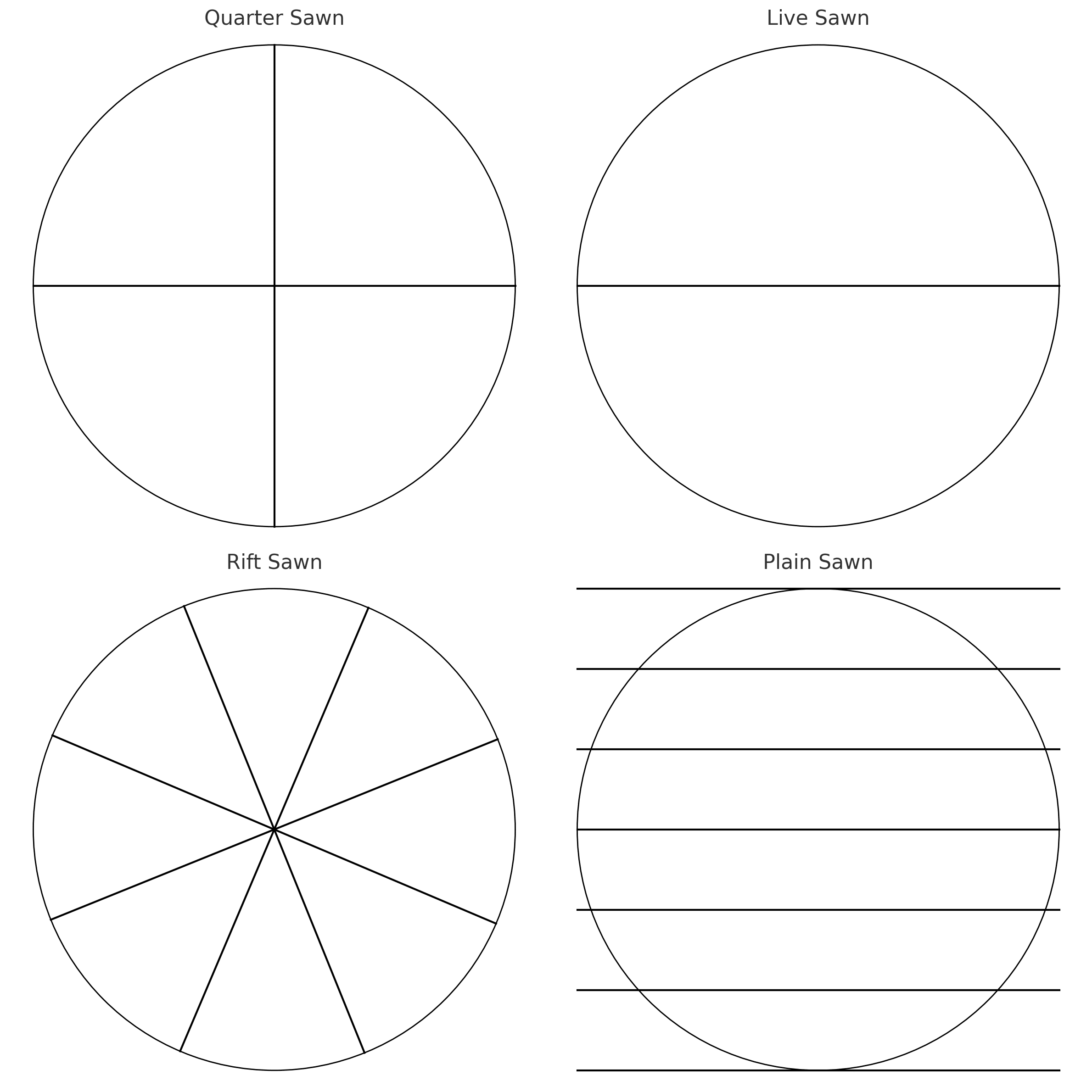
Plain, quarter and rift sawn at a glance
An honest read on the three cuts most timber floors come from. Grain look is down to taste; stability and cost are where they really split.
| Cut method | Grain & look | Stability | Yield & cost |
|---|---|---|---|
| Plain / flat sawn (live sawn) | Cathedral peaks, loops, plenty of figure | Moves most across the grain; more prone to cupping when humidity swings | Best yield, lowest cost |
| Quarter sawn | Straight, even grain with ray fleck in oak | Generally holds its shape better than plain sawn | Lower yield, dearer |
| Rift sawn | Very tight, uniform straight grain, little fleck | Generally the steadiest of the three | Lowest yield, most waste, highest cost |
One more you may hear about: end grain. The log is cross-cut into blocks that show the ring ends, a bold cobble-like pattern. It is a hard, characterful surface used mostly in feature or heavy-duty commercial settings, but it is slow and costly to lay, so it rarely suits a home.
Which cut suits your floor
You want warmth and character
Plain (flat) sawn. The cathedral figure is the classic timber-floor look, and it is the best value because it yields the most board per log.
You want a calm, tailored look
Quarter or rift sawn. The straight grain reads quiet and modern, and quarter-sawn oak throws a silvery ray fleck that many people prize.
You are chasing maximum steadiness
Rift sawn, then quarter sawn. Worth considering for humid rooms or over underfloor heating if the budget allows, though no cut removes timber movement entirely.
You want the look without the trade-off
Engineered oak. The face is chosen for grain alone because a bonded core does the stabilising. More on that below.
Where engineered oak changes the maths
Most of the cut-versus-stability debate is a solid-timber problem, where the whole board is one piece and moves as one. Vienna Woods floors are engineered: a European oak wear layer bonded to a cross-laminated core. The core does the stabilising, so the face can be selected purely for how it looks, and an engineered board generally holds its shape better through humidity swings than a solid board of the same oak.
Our boards are European oak, engineered overseas to Vienna Woods’ specification, and the wear layer is graded (Feature or Prime) so the grain reads consistent across a room. That is the real premium-look lever, more than the sawing method alone. See the engineered timber flooring range, browse the full collections, or start with Petit Château.
Common questions
What are the three main ways to cut timber for flooring?
Plain (flat) sawn, quarter sawn and rift sawn. They differ by the angle the saw takes to the growth rings, which changes the grain look, how the board moves, and how much usable timber comes off each log.
Which cut is the most stable?
Rift sawn is generally regarded as the steadiest, with quarter sawn close behind and plain sawn the most active. No cut removes seasonal timber movement completely.
Which cut is most affordable?
Plain (flat) sawn. It yields the most board from each log, so it is the cheapest and by far the most common flooring cut.
Does the cut matter as much for engineered flooring?
Less than for solid timber. In an engineered board the stabilising is done by the bonded core, so the oak face is chosen mainly for its look. It is a big reason engineered oak is a practical choice for New Zealand homes.
What grain does oak show when it is quarter sawn?
A straight grain plus a distinctive ray fleck, the silvery medullary marking many people prize in oak.
Take the next step
Engineered oak flooring
See how our European oak boards are built and why the construction, not the cut, governs stability.
Browse the collections
Grades, colours and formats across the Vienna Woods range, from Petit Château to Foundation.
Engineered vs solid
The other decision worth getting right before you order. A plain-English comparison.
Feel the grain before you decide
Order free samples and see how our engineered European oak reads in your own light, or tell us about your project for a quote.