
Timber Flooring in Kitchens NZ
Quick answer: Engineered European oak is the right timber for an NZ kitchen — lacquered finish, glue-down install, and within 1.5m of any sink or dishwasher the joints get D3 PVA adhesive plus a flexible perimeter sealant. That’s the NZBC E3 install detail; ISO 4760 moisture testing on Vienna Woods boards confirms no substrate penetration over 24 hours. Solid timber and oiled finishes are higher-risk in kitchens. Below: the compliance, the spec, and what we’ve learned from real Auckland kitchen installs.
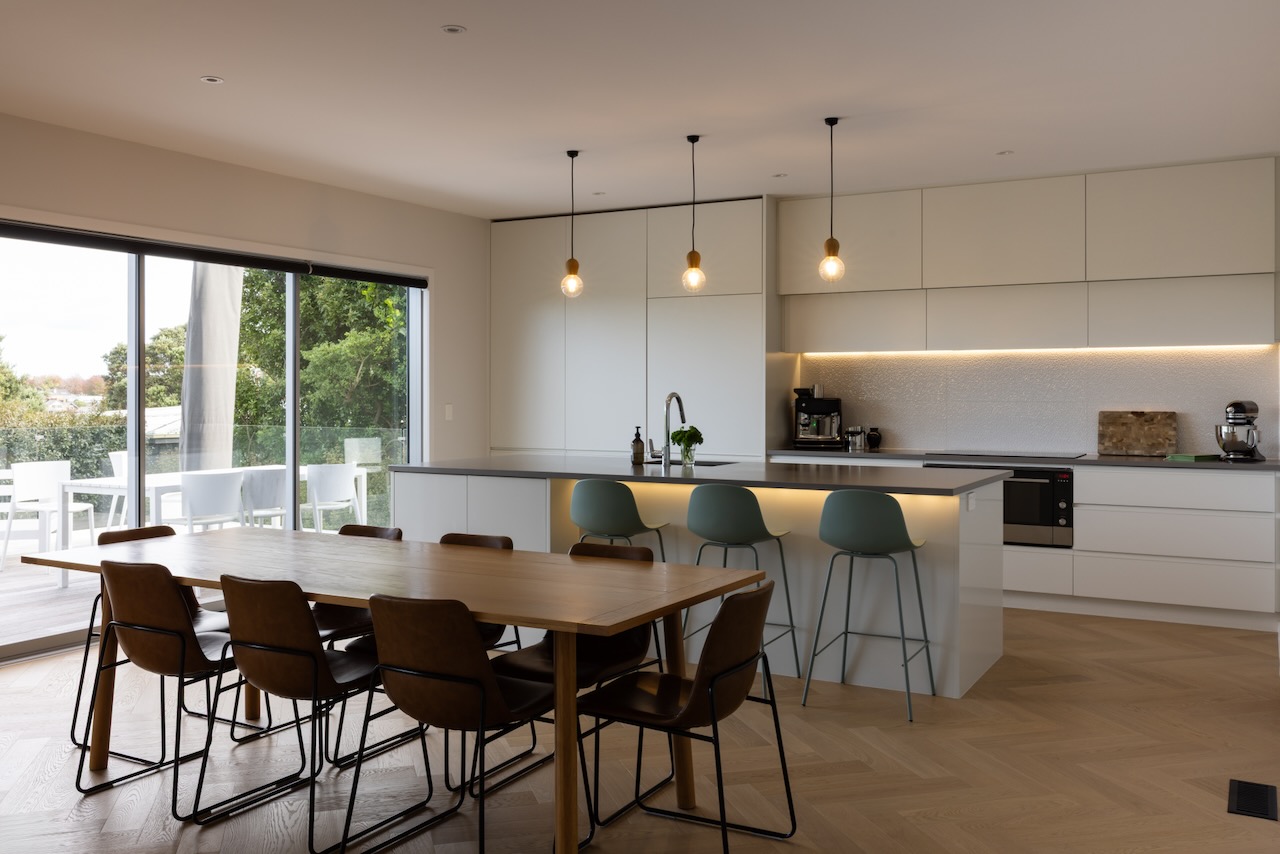
At a Glance — Timber Flooring in NZ Kitchens
| Decision | Vienna Woods recommendation | Why |
|---|---|---|
| Construction | Engineered European oak — never solid | NZ humidity swings + concrete subfloors + UFH = solid moves too much; engineered moves about a third as much |
| Wear layer | 3–4mm | Survives 25+ years of kitchen traffic and refinish cycle if ever needed |
| Finish | Lacquered (UV-cured) | Sealed surface — water beads rather than soaks; cleans with damp mop |
| Format | Wide plank or herringbone | Both work; herringbone reads beautifully in classic kitchens, wide plank in modern open-plan |
| Install | Glue-down to subfloor | No movement, no hollow spots, acoustic-compatible |
| Within 1.5m of sinks/dishwasher | D3 PVA in T&G + flexible perimeter sealant | NZBC E3 install detail per Vienna Woods Compliance Guide |
| Cost (supply) | $150–$320/m² | Premium European oak — see cost guide for full tiers |
NZBC E3 — What Compliance Actually Requires in a Kitchen
The New Zealand Building Code clause that governs timber flooring in kitchens is E3 — Internal Moisture. E3 requires that floor surfaces in spaces with sanitary fixtures (kitchens, bathrooms, laundries) are impervious and easily cleaned, and that joints and perimeters are sealed against water that splashes or drips from those fixtures.
For Vienna Woods engineered oak flooring, the install detail per the Vienna Woods NZBC Compliance Guide (verified Petit Château Collection, current testing) is:
- Within 1.5m of any sanitary fixture — sink, dishwasher, fridge with plumbed water supply — the tongue & groove joints are bonded with D3 PVA adhesive. D3 is the moisture-resistant grade specified in EN 204 for joints exposed to occasional water.
- Flexible perimeter sealant at junctions where the flooring meets walls, cabinetry, kickboards, or appliance plinths. This stops splashed water tracking down behind the kickboard and into the subfloor.
- Glue-down install to the subfloor (not floating). Glue-down eliminates the cavity beneath the boards where moisture could accumulate, and the bond holds the floor flat over time.
That’s the literal NZBC E3 install detail. It’s also the difference between a kitchen floor that lasts 25+ years and one that cups, gaps, or fails at the sink edge within a few seasons. Specifiers can cite this in PS3 documentation as an Alternative Solution.
Independent test results that back the compliance claim
| NZBC clause | Test | Result |
|---|---|---|
| E3 — Internal Moisture | ISO 4760:2022 (Topical Moisture Resistance) | Passed — no penetration to substrate over 24-hour exposure |
| D1 — Access Routes (slip) | AS/NZS 4586:2014 (Wet Pendulum) | COF 0.65 (minimum 0.40) |
| C3 — Fire Safety | EN 14342:2013 CE assessment | Dfl-s1 (suitable for all internal building risk groups) |
| F2 — Hazardous Materials (formaldehyde) | EN 717-1 | Below limit of detection — E1 standard met |
| F2 — Hazardous Materials (PCP) | Chemical residue test | 3.8 mg/kg (below 5 ppm threshold) |
| F2 — Chemical safety | CARB Phase 2 + TSCA Title VI | Certified compliant |
| B2 — Durability | Vienna Woods install + care | Expected service life >50 years; meets B2/VM1 for >15-year serviceable life |
Independent test reports are available on request for specifiers. Full E3/ASI Amendments are published for the Petit Château, Distilled, Raftwood, Admonter, Baltic, ESTA, Chateau, and Grand Oak collections.
Why Engineered, Not Solid, in NZ Kitchens
This is the single most consequential spec decision in a kitchen floor. We stopped supplying solid timber for NZ residential projects in 2009. Kitchens are exactly where solid timber fails first.
- NZ kitchen humidity swings are larger than most rooms. Cooking generates steam. Dishwashers vent moisture. Open windows in summer push relative humidity to 75%+; winter heating drops it to 30%. A solid 19mm oak board moves about 3× more across this range than a 14mm engineered board with a multi-ply core. Cupping at the sink edge, gaps between boards in winter, lifting at the dishwasher in summer — all are predictable solid-timber failures in kitchens.
- Concrete subfloors are common in NZ kitchens. Slab-on-grade construction, ground-floor extensions, apartments — all use concrete. Solid timber over concrete needs a vapour barrier, plywood underlay, and acclimatisation that few residential builders execute correctly. Engineered glue-down skips the failure modes.
- Underfloor heating (UFH) and solid timber don’t mix. Most modern NZ kitchens with concrete subfloors have hydronic UFH or are pre-piped for it. Solid timber over UFH cups, gaps, and degrades the heat transfer. Engineered handles UFH cleanly up to the 27°C surface temperature limit.
- Cost of solid is higher than engineered for worse performance. Solid oak supply costs $200–$340/m² in NZ. Engineered European oak in the equivalent tier is $150–$220/m². The buyer pays more for a material that’s more likely to fail in this room.
If a designer or architect specifies solid timber for an NZ kitchen, we’ll have the conversation about why engineered is the credible alternative. See the full engineered vs solid comparison for the technical depth.
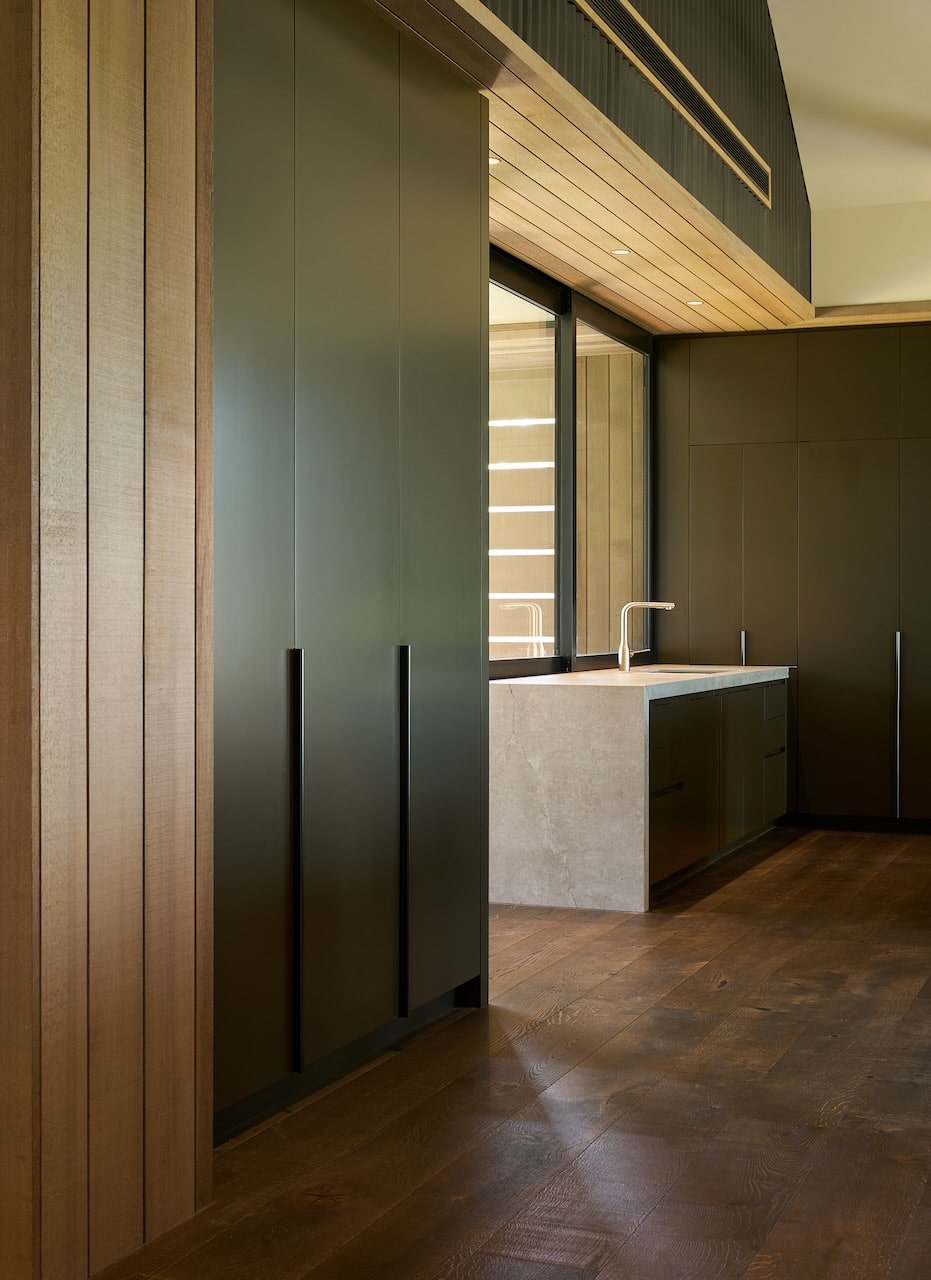
Lacquered or Oiled in a Kitchen? Lacquered.
This is the second consequential decision and the one customers most often arrive with the wrong answer to. Oiled floors look beautiful in the showroom; in a kitchen over 10 years, lacquered wears better.
What each finish actually does in a kitchen
| UV-cured lacquer | Hardwax oil | |
|---|---|---|
| Water resistance | Sealed surface — water beads, wipes off without absorbing | Soaks into the wood; left long enough, leaves a mark |
| Splash from sink/dishwasher | Tolerates daily splashes when wiped within minutes | Tolerates occasional splashes; cumulative wear visible faster |
| Olive oil / cooking oil drops | Wipes off cleanly | Penetrates the finish; may leave a darker spot |
| Scratches from chair scrapes / dropped utensils | Resistant; visible damage rarer | Visible scuffs more readily; easier to spot-repair |
| Long-term maintenance | Damp mop with neutral cleaner (Bona, Ciranova) | Re-oil every 2–4 years; spot-oil heavy-wear zones sooner |
| Wear pattern over 10 years | Uniform; minor scratches in high-traffic lanes | Visible patina around sink, stove, doorway thresholds |
| Refinishability | Full sand and re-coat possible at 15–25 years | Re-oil indefinitely if maintained correctly |
The summary: lacquered is the durable, low-maintenance choice for the kitchen-specific risks — water, oil, daily traffic, scratches from kitchen furniture. Oiled is the better choice in heritage living rooms, bedrooms, and feature spaces where character and spot-repairability matter more than waterproof daily performance.
Full decision matrix in the lacquered vs oiled guide.
What we tell customers who insist on oiled in kitchens
It’s possible — the moisture compliance still works (ISO 4760 test result applies to the board, not the finish). But the finish wears faster and shows wear earlier. Expect to re-oil the sink/dishwasher zone at the 2-year mark and the rest of the kitchen at 4–5 years. Some customers value the look enough to make that trade. Most who go in with that plan switch to lacquered before install.
What 15 Years of NZ Kitchen Installs Have Taught Us
We’ve supplied and installed engineered European oak in Auckland kitchens since 2009. Three things hold up across every project:
1. Westmere — Bordeaux Herringbone in a kitchen-led open-plan home
A homeowner from the timber industry chose Petit Château Bordeaux Herringbone for an open-plan kitchen, dining, and living area. The kitchen island sits in the middle of the herringbone — sink and dishwasher on one side, cooktop on the other. We specified D3 PVA in the joints within 1.5m of both wet zones, flexible perimeter sealant at the cabinetry and island plinth, and the standard glue-down install over the concrete subfloor. Four years in, no movement, no joint failure, no visible wear pattern in the high-traffic lane around the island.
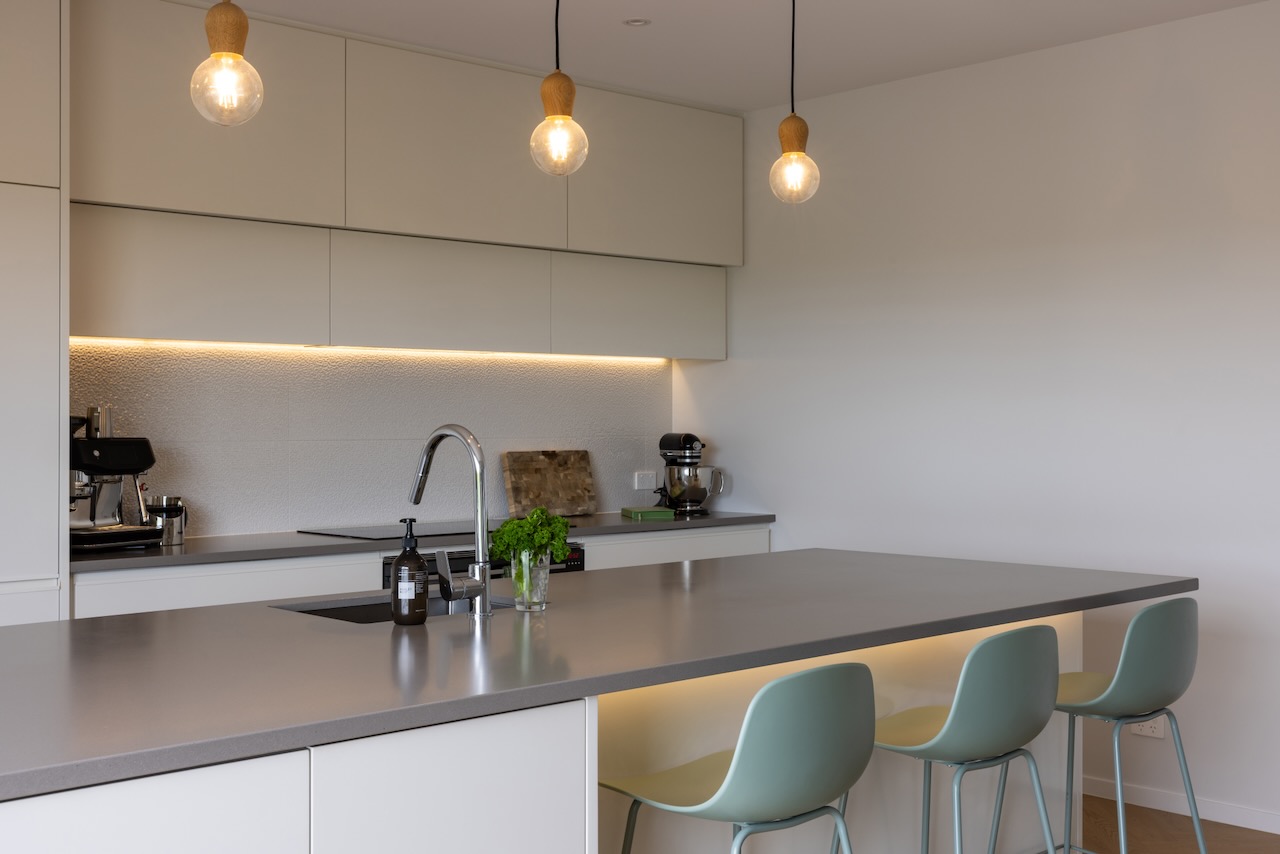
Read the full Westmere Bordeaux Herringbone case study.
2. Coromandel — Distilled Bandsawn Oak in a coastal architectural kitchen
A Coromandel coastal retreat by Sumich Chaplin specified a custom Vienna Woods Distilled bandsawn oak. The kitchen sits at the indoor-outdoor seam — sliding doors open straight to the deck, salt air through the room daily, full sun on the floor in the afternoon. We specified the lacquered finish over a 14mm engineered board, with the 1.5m sanitary-fixture rule applied around the sink. The bandsawn texture has the practical advantage of hiding the very small scratches you can’t avoid in a coastal kitchen — sand from outside, beach gear, daily traffic. Three years in, the floor looks the same as install day.
Read the full Pohutukawa House Coromandel case study.
3. What customers actually experience over 10+ years
Across kitchens we installed in 2014–2016 that we’ve revisited:
- The wet-zone install detail holds. Where we did the D3 PVA + perimeter sealant correctly, we’ve seen zero joint failure or perimeter water tracking after a decade. Where contractors (not Vienna Woods) installed without those details, we’ve been called back to remedial work on those exact failure points.
- Lacquered surface wears uniformly. No “ring” of wear around the sink. No darker patch under the dishwasher. Some light scratching in the chair pull-out zone at the kitchen island — visible only under raking light.
- The kitchen looks the same as the rest of the floor. Customers expect kitchens to age faster. With this spec, they don’t. That’s the actual point.
For more project examples across NZ kitchens, see the Vienna Woods projects gallery — Westmere, Coromandel, Auckland CBD, and recent residential builds.
Daily Care, Long-Term Maintenance
The single biggest determinant of how a kitchen floor looks at year 10 is the maintenance regime in years 1–9. None of it is hard.
Daily and weekly
- Sweep or soft-vacuum daily. Grit (especially in coastal homes and city apartments with shoes-on culture) is what scratches a lacquer finish. Vacuum with the hard-floor setting, not a beater bar.
- Wipe up spills as they happen. Lacquered floors tolerate a few minutes of standing water; an hour starts to test the perimeter seals. Cooking oil should be wiped within an hour to keep the finish absolutely clean.
- Damp mop weekly with a neutral wood-floor cleaner — Bona Floor Cleaner or Ciranova equivalent. Damp, not wet — the mop should be wrung out so the floor dries within 30–60 seconds.
What to avoid
- Steam mops. The heat plus moisture degrades the lacquer over time and forces moisture through joints.
- Vinegar, ammonia, or general-purpose floor cleaners. They strip the lacquer over years.
- Leaving wet bath mats / dog water bowls / boiling pots on the floor for extended periods. Not a daily hazard; the long-term risk is the perimeter seal at the cabinetry edge.
The 5-year and 10-year maintenance picture
- Year 5: light traffic-lane scratching may be visible under raking light, especially around the kitchen island. No action required.
- Year 10: some lacquer wear-through possible at the threshold from kitchen to outdoor area if not protected by a mat. Local re-coating (not a full sand) is the fix — typically a half-day per zone.
- Year 15–25: full sand-and-recoat available if needed. The 4mm wear layer gives 2–3 refinish cycles.
Detailed care instructions per finish: lacquered floor care and oiled floor care.
What an NZ Kitchen Timber Floor Costs in 2026
| Tier (supply only) | $/m² | What you get |
|---|---|---|
| Entry European oak | $99–$150/m² | 14mm engineered, 3mm wear layer, lacquered, narrower planks (140–180mm). Solid kitchen choice on budget. |
| Mid-range European oak | $150–$220/m² | 14mm engineered, 3–4mm wear layer, wider planks (180–220mm), broader colour and texture range. Sweet spot for most kitchens. |
| Premium European | $220–$320+/m² | Slow-grown European oak, 4mm wear layer, wide long plank or herringbone, premium finishes. Heritage projects and feature kitchens. |
Install adds $85–$110/m² + GST for glue-down (the spec for kitchens). Acoustic underlay where required is ~$50/m² + GST. Herringbone install premium is roughly $120–$150/m² + GST due to the layout complexity.
All-up budget for a typical NZ kitchen — 25m² engineered European oak, mid-range, lacquered, glue-down installed: roughly $7,000–$9,000. Allow 10% wastage for straight-lay, 15% for herringbone.
For the full pricing breakdown including commercial and herringbone tiers, see the 2026 timber flooring cost guide.
Kitchen Timber Flooring FAQ
Is timber flooring NZBC E3 compliant in a kitchen?
Can I install solid timber flooring in a kitchen?
Lacquered or oiled finish for the kitchen?
What's the install detail within 1.5m of a sink or dishwasher?
Can timber flooring go over underfloor heating in a kitchen?
How is timber flooring in a kitchen cleaned?
How long does a kitchen timber floor last in NZ?
Will timber flooring in the kitchen affect the resale value of an NZ home?
Related Vienna Woods guides
- Engineered vs Solid Timber Flooring NZ — the full technical case for engineered construction.
- Lacquered vs Oiled Timber Flooring NZ — decision matrix by use case.
- Timber Flooring with Underfloor Heating NZ — the 27°C rule and how to specify.
- Timber Flooring Cost NZ 2026 — full pricing breakdown.
- Commercial Timber Flooring NZ — for specifier, hospitality, and fit-out projects.
- Sustainable Timber Flooring — FSC chain-of-custody and Green Star context.
- CAB Residences Case Study — how engineered European oak handled a Category A heritage conversion.
Specifying timber flooring for your kitchen?
Order samples to see the lacquered finish in your own light. Book a Newmarket showroom consultation to talk through your kitchen layout, subfloor type, and finish options. We can issue collection-specific E3/ASI Amendment documentation for your specifier or building consent.