
Timber flooring with underfloor heating in NZ
Yes, with the right board and the right install.
Engineered timber can go over underfloor heating, with conditions. Engineered European oak suits it best, because its cross-layered core holds the board steady through the daily heating cycle where solid timber tends to move. The floor is glued down, the surface temperature is kept in check, and the details are confirmed with your board manufacturer and installer.
Why engineered oak, not solid timber
Underfloor heating puts a floor through a temperature swing every day it runs, and that cycling is what moves timber. Solid boards expand and contract as a single piece, so over a heated slab they are prone to cupping and gapping within a season or two.
A typical Vienna Woods board, for example our Petit Chateau range, is 15mm with a 4mm European oak wear layer over a multi-ply core, engineered overseas to our specification. Each ply runs across the next, so the layers restrain each other and the board stays much closer to its milled shape as the heat comes and goes. That cross-layered construction is why engineered oak is generally the suitable choice over underfloor heating, and why solid timber usually is not.
It is the same reason engineered is the standard call for NZ apartment, commercial and architect work. Read how the layers work on our engineered timber flooring guide, or compare the two builds on the engineered vs solid timber flooring deep-dive.
What suits underfloor heating, and what usually does not
Suits UFH
Engineered European oak
Multi-ply construction can help keep board movement small through heating cycles, so engineered European oak is the usual specification for heated floors in NZ apartments, new builds and architectural work.
- Glued down for even heat transfer and a floor that stays put.
- Surface temperature kept within the maker's limit.
- ATFA: a floor-system thermal resistance up to about R 0.15 m²K/W works well, and engineered boards are generally kept to 20 mm or under so the heat gets through.
- The exact board confirmed as rated for underfloor heating.
Usually not
Solid and unstable boards
Solid hardwood, most softwoods such as pine, rimu and matai, and non-engineered reclaimed boards move as one piece and are far more likely to gap or cup over a heated slab. ATFA does allow solid timber over heating, but only within limits that rule out most of what people actually want today.
- ATFA: solid boards 19 mm thick, cover width not exceeding 130 mm, with 80 to 85 mm preferred, and supplied at a tighter 9 to 10 per cent moisture content.
- Softwoods tend to open joints through a heating season.
- Bamboo and laminate vary widely, so only if the maker rates them.
The rules that matter over underfloor heating
Four things decide whether a timber floor lives happily over heating. Get them right and the floor is stable for the long run. Miss one and the failures show up in the second winter.
1. Keep the surface temperature in check
The board is held to a maximum floor surface temperature, commonly cited around 27°C across the flooring industry, but the exact figure is set by your board manufacturer and heating system, so confirm it before you commission. It is measured at the floor surface by a sensor, not the room air on the thermostat, and the controller should enforce it.
2. Commission the heating gradually
There are two jobs here, not one, and they belong to different trades. The heating installer commissions the system and dries the slab before the timber arrives. Then, once the floor is laid, it is brought up to temperature by no more than 2°C a day over about ten days, and never past 27°C at the surface. The full sequence is below.
3. Prepare and test the subfloor
A concrete slab over ground needs a damp-proof membrane to meet NZ Building Code clause E2 (External moisture), and the slab is moisture-tested before the floor goes down. Parabond 440 is a flexible adhesive, not a standalone damp barrier, so where the slab still reads damp on a carbide (CM) moisture test a separate barrier primer, chosen by that reading, goes down first.
4. Glue it down
Glue-down is the recommended method: the board sits in direct contact with the slab for even heat transfer and cannot move independently through the cycling. A floating floor on foam underlay insulates against the heat you are paying for. See our timber flooring installation guide.
How to commission underfloor heating under a timber floor
This is the step that gets argued about on site, usually because two trades are describing two different jobs. The heating installer commissions the heating system. The flooring installer then works the floor up to temperature. They happen at different times, they are measured on different things, and skipping either is a common cause of cupping and gapping that shows up in the second winter.
The sequence below follows the Australasian Timber Flooring Association's guidance for floors over underfloor heating, which is written for timber specifically. Your board manufacturer and heating supplier set the figures for your job and their instructions take precedence.
Why the heating spec says 45 degrees when the floor is limited to 27
Two different temperatures get confused constantly. The water temperature is what circulates in the pipes buried in the slab. The floor surface temperature is what the timber and your feet actually meet, and that is the one held to 27°C. The water runs hotter than the floor because it is heating a slab through concrete. As ATFA puts it, water temperatures may be around 45°C to give an underfloor temperature of up to 27°C. So a heating spec quoting 45°C is not a hot floor, and nothing in a house ever reaches it. Every temperature on the rest of this page is a floor or subfloor temperature, never a water one.
First, the heating installer commissions the system
This is the heating trade's job, not the floor layer's, and it happens before the timber is anywhere near the site. A new slab is left to cure first, for a minimum of 5 to 6 weeks in BRANZ's guidance, then the system is taken up and back down through a full heating cycle to drive out construction moisture and relieve stress in the screed, switched off, and the slab moisture-tested once cool. That cycle runs on water temperature and it belongs to whoever installed the heating. Ask them for the commissioning record. ATFA's own procedure starts from the point where the system is already fully commissioned, so if nobody can tell you it was done, the floor should not be going down yet.
If you are retrofitting heating into an existing concrete floor
Adding hydronic heating to a floor that is already there is a different job, and the usual route is to build up over the old slab rather than break into it: a vapour barrier, insulation, the pipes, then a new topping screed over the top. BRANZ puts that screed at a minimum of 65 mm for a dry-mix cement screed, or typically up to 50 mm for a self-levelling one.
That topping is new wet construction, so it resets the clock rather than shortening it. It carries its own construction moisture and needs the same drying and commissioning a new slab would, and the two-week subfloor run before laying still applies. The variance is not in the heating sequence. It is in everything underneath it.
| On a retrofit | What it means |
|---|---|
| Insulate between old and new | Without insulation between the existing slab and the topping you are heating the old slab and the ground beneath it. BRANZ also requires the combined R-value of slab plus topping to meet H1/AS1, and notes councils treat this differently, so confirm it with your building consent authority at design stage. |
| Test the old slab first | A vapour barrier goes over the existing slab as part of the build-up, which matters because you cannot add a damp-proof membrane underneath a slab that was poured decades ago. Moisture-test what is there before anything goes on it. |
| Allow for the height | The floor rises by the screed plus the insulation. Exterior door thresholds need design consideration, and bracing hold-down fixings may need to be longer to reach the structural slab. |
| Mark up the plan | Give the heating supplier the position of walls, kitchen and bathroom fittings, fireplaces, any slab control joints and the electrical controls at design stage, while it can still be designed around. |
A thin electric system set in levelling compound under the floor covering is the other retrofit route, and it adds far less moisture because there is no screed. Follow the system maker's instructions for that one. Nothing else changes: the slab is still tested, the surface is still capped at 27°C, and the floor still comes up slowly.
Stage one: dry the subfloor and prove the conditions
Now the flooring procedure begins, and from here every figure is capped at 27°C.
| Step | What happens |
|---|---|
| Run it two weeks | The heating runs for two weeks before the floor is laid, to pull moisture out of the subfloor. Ventilate as it dries, because the humidity in the room will rise. |
| Cap the subfloor at 27°C | The subfloor temperature must not exceed 27°C with in-slab heating. This is the ceiling for the whole job, not a target. |
| Check the room | Toward the end of the two weeks, relative humidity should sit between 45 and 60 per cent at a temperature of about 20°C. |
| Check the boards | Boards should be at 9 to 10 per cent moisture content, checked again before laying rather than taken on trust. |
| Then switch off | The heating goes off and stays off for about two days before the floor is laid. |
Stage two: lay it, then bring it up slowly
This is the cycle people mean when they talk about raising the temperature a degree at a time.
| Step | What happens |
|---|---|
| Lay it cool | Our installation documents call for about 15°C at the floor surface during installation and for 48 hours after. ATFA keeps the heating off for a further two days once the floor is down. A warm slab also cures the adhesive too quickly. |
| Then raise slowly | Increase from that low level by no more than 2°C a day, over about ten days, until the floor reaches its normal operating temperature. One degree a day is the safer choice and the one we would give a homeowner. |
| Hold two weeks | Keep it there for a further two weeks so the boards settle at their working moisture content. |
| Never exceed | 27°C at the floor surface, read by a floor sensor rather than the room air on the thermostat, with the limit enforced by the controller. |
| In normal use | Room temperature of about 18 to 24°C with relative humidity between 40 and 60 per cent year round. On an underfloor-heated floor, keep indoor humidity at 45% or above, within the same 40–60% band. This is in line with ATFA’s guidance for floors over underfloor heating. |
| Coming off heat | Bring it back down in the same small steps at the end of the season. Abrupt change in either direction is what moves a floor. |
Some gapping across a heating season is normal on any timber floor and usually closes again over summer. Heating dries the air, and dry air shrinks timber, which is why the humidity range matters as much as the temperature.
Tell the heating designer there is timber going down
A heated slab is often designed to run warmer than 27°C, because tile and vinyl tolerate more than timber does. If nobody tells the heating designer that a timber floor is being specified, the system can be designed and commissioned to a temperature the floor above it is not rated for. That conversation belongs at design stage, not on the day the system is switched on.
Sources: Australasian Timber Flooring Association, Floors with underfloor heating; BRANZ Bulletin 688, Embedded floor heating, January 2024; NZ Building Code E2/AS1; and the Vienna Woods installation guide. Your heating supplier and board manufacturer set the figures for your job.
Hydronic or electric under timber
Both work with engineered timber when they are specified correctly. They behave differently.
| Factor | Hydronic (water) | Electric (mat) |
|---|---|---|
| Heat profile | Lower, smoother, easier on timber | Higher peak, faster swings |
| Best for | Whole-home new builds | Single rooms, retrofits, bathrooms |
| Response time | Slow, relies on thermal mass | Fast, direct radiant |
| Running cost (NZ) | Lower, especially with a heat pump | Higher per kWh, smaller zones help |
| With timber | Gentle, even heat | Fine with a floor sensor and enforced limit |
For a whole main living area, hydronic's slow, even, low-temperature heat is the easier match for timber. Electric suits single rooms and retrofits, as long as the floor sensor and temperature limit are set and enforced, not left as a setting the user can override.
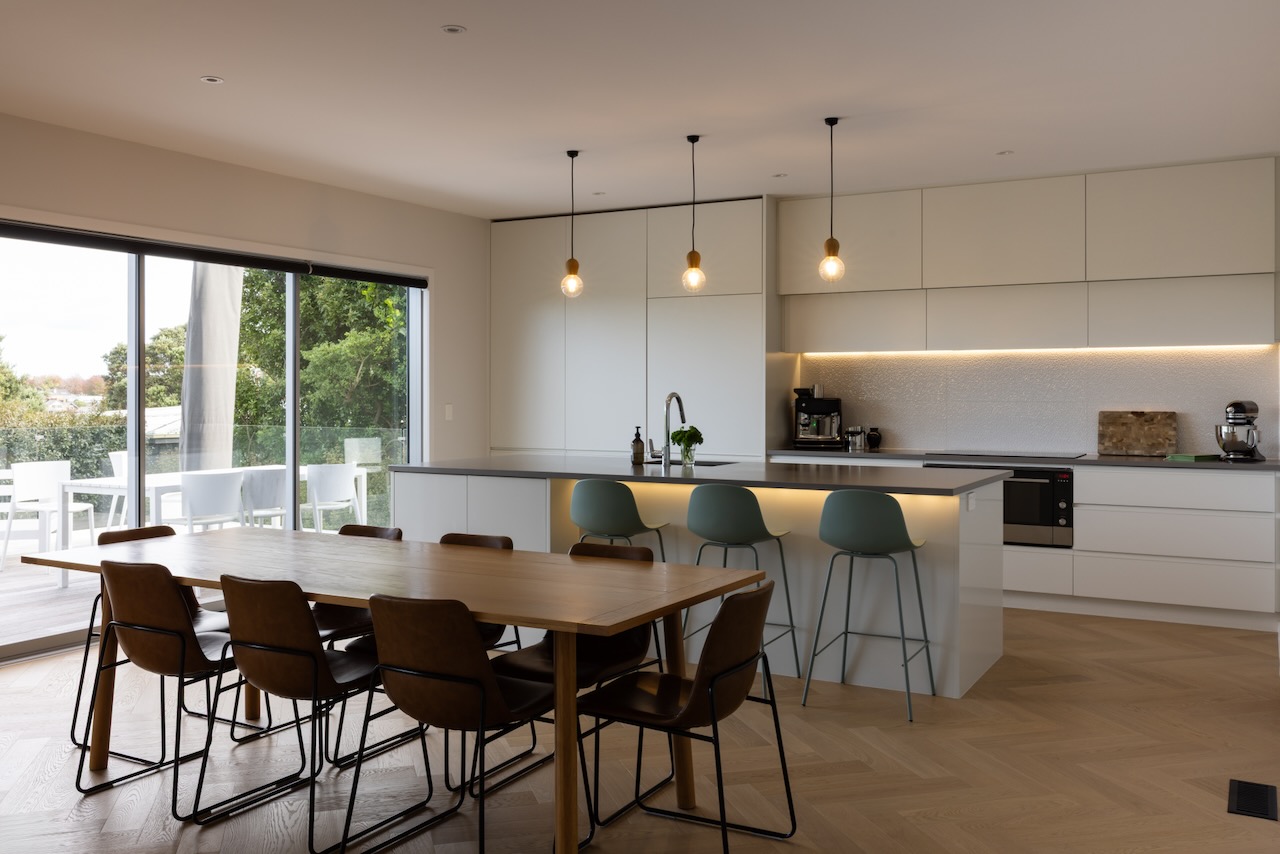
Lacquered or oiled over underfloor heating
Both are fine over a heated floor. A lacquered, UV-cured surface is sealed and hard-wearing and does not move with the timber underneath. An oiled finish penetrates the wood and can be re-oiled in place in worn areas, and it likes a little more attention to indoor humidity when the heating is running.
Choose by how the floor will be used and cared for, not by the heating. The two finishes are compared in full on our floor finishes explained guide.
What to confirm with the manufacturer and installer
Underfloor heating is a specify-it-once decision, so pin these down before the order goes in.
Ask the board maker
Product and limits
- That the exact board is rated for underfloor heating.
- Its maximum floor surface temperature.
- Any extra conditions for wide-plank or parquet formats.
Ask the installer
Slab and install
- The commissioning sequence for your screed and heating.
- The adhesive and any barrier primer for your slab's moisture reading.
- The wastage allowance for straight lay versus parquet.
Wide planks and herringbone or chevron parquet all work over underfloor heating in engineered oak, typically glued down, but confirm the maker's conditions for the exact format and width. Costs by range are set out on our timber flooring cost NZ guide.
Common questions
Can you lay a wooden floor over underfloor heating?
Yes, engineered timber can. Engineered European oak is the usual choice, because its cross-layered core keeps movement small through heating cycles. Solid timber is generally not recommended over a heated floor. Glue it down, keep the surface temperature within the maker's limit, and confirm the exact board is rated for underfloor heating.
Can I install solid timber over underfloor heating?
ATFA allows it, but within limits that rule out most of what people actually want. It asks for 19 mm boards, a cover width not exceeding 130 mm with 80 to 85 mm preferred, and boards supplied at a tighter moisture content than a standard batch. A wide solid board over a heated slab is exactly where the gapping and cupping complaints come from. Engineered European oak is the more stable construction and transfers heat better, so it is what we supply for heated floors and what your board maker will need to have rated for the job.
What is the maximum floor surface temperature for engineered oak over UFH?
A maximum floor surface temperature applies, commonly cited around 27°C across the industry, but the exact figure is set by your board manufacturer and heating system, so confirm it before commissioning. It is measured at the floor surface by a sensor, not the room air on the thermostat, and the controller should enforce it.
Do I have to glue the timber down or can it float?
Glue-down is the recommended method over underfloor heating. A glued board sits in direct contact with the slab for even heat transfer and stays put through the cycling, and it is usually needed for wide planks. Floating floors on foam underlay insulate against the heat, so they are better avoided over UFH. Use a flexible polyurethane adhesive such as Parabond 440.
How long should I run the heating before installing the timber?
Longer than most people expect, and it is two separate runs. The heating installer commissions the system first, and a new slab is cured for a minimum of 5 to 6 weeks before that even starts. Then for the floor itself the heating runs for two weeks before laying, to dry the subfloor, with the subfloor held at or below 27°C and the room settling to 45 to 60 per cent relative humidity. It then goes off for about two days before the boards go down. Skipping this is a common cause of cupping later.
Is it true you raise underfloor heating one degree a day?
Broadly yes, once the floor is laid. BRANZ Bulletin 688 records raising the heating by 1°C every 24 hours as one of the accepted ways to commission a system, and the Australasian Timber Flooring Association caps the increase under a timber floor at 2°C a day. Our installation documents call for about 15°C at the floor surface while the floor is being laid and for 48 hours after, so starting at 15°C and adding a degree a day reaches normal operating temperature in about ten days. That is the conservative reading of the guidance rather than the only correct number, and it applies to the finished floor. The slab itself is commissioned earlier, on a different schedule.
Can I add underfloor heating under timber in an existing house?
Yes, and the usual way is to build up over the existing slab: a vapour barrier, insulation, the pipes, then a new topping screed, which BRANZ puts at a minimum of 65 mm for a dry-mix screed or typically up to 50 mm for a self-levelling one. Plan for the floor height to rise by the screed plus the insulation, and for exterior door thresholds to need rethinking. The topping is new wet construction, so it needs the same drying and commissioning as a new slab rather than less, and the existing slab underneath should be moisture-tested before anything goes on it. A thin electric system in levelling compound is the lower-build alternative.
Is hydronic or electric underfloor heating better for engineered timber?
Both work if specified correctly. Hydronic runs lower, smoother temperatures and suits whole-home new builds. Electric is simpler to retrofit and suits single rooms and bathrooms, provided the floor sensor and temperature limit are set and enforced.
Bathrooms are the most common underfloor heating room in New Zealand, and the hardest room to put a timber floor in. We cover why in bathrooms, the most common UFH room.
Will my timber floor gap with seasonal heating cycles in NZ?
A correctly specified engineered oak floor, glued down with the surface temperature kept within the maker's limit, is built to handle normal seasonal cycling in NZ conditions. Hairline gapping in winter usually points to overheating or very dry indoor air rather than the floor itself. This is general guidance, not a guarantee: outcomes depend on the product, the install and site conditions.
Related guides
Engineered timber flooring
Why the multi-ply core is the standard for NZ floors, heated or not.
Read the guide →Engineered vs solid
The construction comparison in full, including performance over heated slabs.
Compare the two →Installation guide
How an engineered floor goes down, from subfloor prep to glue-down.
See how it is laid →Specifying timber over underfloor heating?
Order free samples to see the oak in your own light, then talk to us about the right specification for your heating system and slab.