
What Does Timber Flooring Cost in New Zealand?
In this article we have compiled years of customer questions and our knowledge of the market around what a timber floor in New Zealand typically costs and what the main factors are that influence the price. European oak is the most common species of hardwood in the NZ market, so much of this information relates to oak. There are several factors that can impact the cost of European timber flooring for the consumer.
How is timber flooring sold?
In New Zealand timber flooring has a number of channels to market including through flooring installers, builders, architects, interior designers, flooring retailers, timber merchants and the timber flooring specialists. Each of these groups can add value to your purchase in a number of different ways. Some trades may add a margin to the materials before selling on to you, others will earn their revenue in other ways, but typically the consumer will pay a similar price for timber flooring no matter how it is procured.
Timber flooring is available most popularly now as engineered flooring (see our article on What is Engineered Timber Flooring), however there are a number of installers, timber flooring specialists and more usually, timber merchants who will source solid timber flooring.
Timber flooring is usually sold by the square meter (m2) to work as a direct comparison to the floor area to cover. There will always be an element of wastage to factor in to the purchase which allows for a practical cutting waste and the odd undesirable board (a factor to consider since timber is featured with a number of characteristics that can be a personal preference). Typical wastage allowance is 10%, but depending on the complexity of flooring, this may be up to 20%.
Usually a reseller will require a deposit to hold the product, this is an important step in reserving your material. For the reseller it gives them certainty that they can hold the product for you without loosing the potential to sell it to someone else should you cancel. 50% is typical.
The seller may require you to take delivery of the flooring within a timeframe and this is because storing material comes at a cost. A cost of warehousing and finance and also space to store other products for other customers.
Some sellers can arrange special orders for customers. This is where you may arrange a custom treatment, a unique width/ length or other special timber flooring that isn’t typically held in stock.
Who can you buy from?
Resellers; these are people or stores who have purchased usually from an importer. They add value by having a broad variety of flooring options. The right reseller will have expertise in recommending the most suitable product.
Tradespeople (usually builders or timber flooring installers); They add value by having experience with suppliers and installers. When they procure for your project they also take on responsibility for ensuring the right product arrives in the correct quantity, at the right time and is installer to specification.
Interior Designers; they add value by having experience with suppliers and installers. They are considering the suitability of the flooring recommendations for the entire project aesthetic.
Timber Flooring Specialist; they add value in their specialisation. A timber flooring specialist will be able to recommend product to suit budget, design and technical specification.
Do tradespeople have access to different pricing?
In most industries, tradespeople have access to lower pricing and timber flooring is no different. This is for a few reasons;
- The tradesperson will buy many times more than a consumer and so the seller incentivises their business.
- The tradesperson will take on a responsibility of procuring the product
- They will take responsibility for managing the materials and any issues that may arise
- They take responsibility for the specification
Factors that influence the price:
Standard planks of European engineered timber flooring are usually between $120 and $250 +GST /m2. There may be good reason for timber flooring to be less or more than this price, but if it is, we recommend asking why. The majority of our flooring is in this range, but we have sourced specialised timber flooring for projects at a much higher price due to the customer requirements. These prices relate to the product only, the installation costs can also vary.
Solid hardwood is much higher price than engineered timber; this is mainly due to the fact that engineered timber uses about 70% less hardwood by comparative overall thickness.
Herringbone, Chevron or standard plank
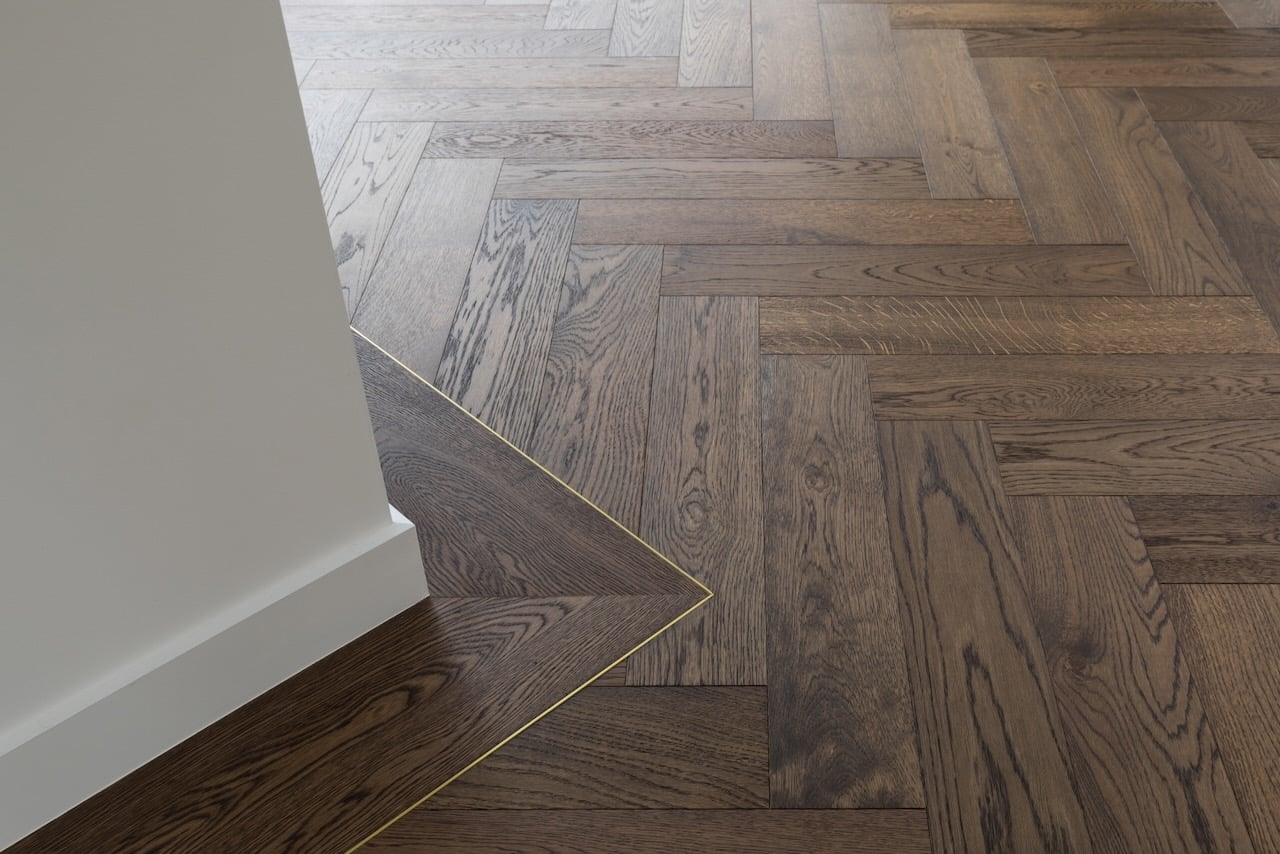
Herringbone and chevron parket style flooring is usually a similar price as standard planks (sometimes a little more per m2), however the installation requires a higher level of skill and more time to lay. Note that the installation of these parket styles can be up to twice as much as standard plank installation. In addition, the wastage is usually higher for these parket styles. Typical wastage is 10%, whereas the wastage for herringbone and chevron can be 15 to 20%.
Renovation or new build
A new build is usually easier to manage for flooring. A renovation often requires extra work to adapt to the existing features of the building (eg. Skirting boards, floor removal, balustrades in place). As such, you will usually pay a little more for preparation and installation on renovation works.
The origin of the timber flooring
When timber flooring is sourced from Europe, it has been made to a high European standard, which covers environmental impact, sustainability, VOC’s, human safety and durability.
However, European oak floorboards are often constructed outside of Europe. This is where the oak “wear layer” or “lamella” is shipped to another part of the world before being stained, treated and made in to floor boards. Many floor boards are made in China. In spite of the additional shipping and logistics costs, these boards are still considerably less to buy compared to European-made flooring. The benefit is price. The potential issues are; higher carbon footprint, questionable sourcing, a lack of clear standards. This is not to say that quality product can’t be sourced outside of Europe, but the quality is less standardised. Chinese-made European oak will often be in the low hundreds per m2.
The width and length of the boards
The dimensions of timber flooring is largely constrained by the yield available in the trees. You can increase the amount of usable timber from a tree by using small planks. As such, a general rule is that wider and longer planks demand a premium price. The standard dimensions of a plank in New Zealand is 180mm wide and around 2m long. Narrower and shorter planks are usually a lower price. Longer and wider planks are usually a higher price.
The species of timber
Timber species has an impact on price; some species are more scarce and some take longer to reach maturity. Native New Zealand timbers are usually reclaimed and fetch a premium price. Walnut is a slow-growing dense timber and also fetches a premium. Pine is a softwood; it grows quite fast and has a lower price. Oak is a mid to upper range product. It is quite hard-wearing, but also forested effectively. The price of engineered oak flooring is less than solid NZ natives and more than soft woods.
Installation method
Some engineered timber can be installed using a floating method, this is typically an inferior installation, but is a lower cost. Floating installations usually range between $45 and $60/ m2, including underlay and trims. However, the subfloor usually requires more work since it the timber overlay will be more sensitive to imperfections in the subfloor when floating. This can add a cost.
Standard planks glued down will usually cost $90 to $150/ m2 for installation including consumables. Learn about the difference between floating and glue-down installation here.
As mentioned previously, herringbone and chevron installs require more time and skill from the installer and often we see the cost up to twice as much as standard planks.
Preparing the subfloor
The purpose of subfloor preparation is primarily to ensure that the timber flooring has an even surface to lay on. However, in addition, an important part of floor preparation is to ensure that the finished floor level works with other features in the building, such as joinery and transitions in to other flooring types (eg tiles in the bathroom).
Floor preparation is usually quoted as a variable cost since the amount of time and materials required is very difficult to determine prior to beginning. As a very general guide; most homes require between $500 and $1,000 of floor preparation cost, but this is largely variable. If the flooring requires waterproofing, there is an additional cost to this as well.
Preparing the subfloor correctly is critical to achieving a good finish, so this is an important cost.
What about stairs?
Stairs are often priced separately from timber flooring in the main areas. They’re more complex to install and more time-consuming. This means the timber flooring cost for stairs is higher per square metre.
The total cost depends on the stair layout and design. A straight staircase is simpler and more affordable. Curved stairs, landings, and winders add cost due to extra labour and precision work.
Here’s what can affect the cost of timber flooring on stairs:
-
The number of steps
-
If the stairs are straight or curved
-
Whether you want nosings or solid treads
-
The type and finish of timber
-
If you need matching risers and stringers
For engineered timber, expect around $250 to $400 +GST per step. That includes the step, nosing, and installation. If you’re using solid timber, or adding custom elements, this can be higher.
The final price is always project-specific. It’s best to get a tailored quote based on your plans. That way, you know exactly what the timber flooring cost will be—stairs included.
Access to the space
Access to the rooms is an important consideration since machinery, tools and long heavy flooring materials will need to be transported. In a standard scenario, materials are walked in to the home easily. In more difficult access scenarios such as apartments; it can take a lot more time to transport materials from loading bays and up lifts. In these situations, the cost will increase.
Freight or pick-up
Freight is becoming an larger component of the overall cost of construction. With regards to flooring, the materials can be quite long and heavy and also susceptible to damage along the edges. If the company will allow, picking up your own flooring can save many hundreds of dollars, but it’s not for the feint-hearted. Palletised freight is the lowest cost, but requires machinery to offload on site. Furniture movers are the most convenient; they delivery within a time window and hand deliver to the room required, so the chances of damage are lower. They are also the highest cost.
Product warranties
Product sourced from Europe is mandated to be fit for purpose and as a result, it will have the most comprehensive warranty documentation. Product backed by comprehensive warranties is usually a little higher cost.
Sustainability
Sustainability of hardwoods is challenging. By their nature, hardwoods take many decades to reach maturity and such, maintaining sustainable forestry practices come at a cost. If your timber flooring carries a sustainability certification, it will have cost more to source and will likely be a higher cost.
Wastage
The industry standard wastage allowance is 10% on standard planks for the average floor. However, there are factors that will require an increase in wastage allowance and in turn, an increase in cost. These factors include:
- Unusual shaped rooms
- Herringbone or chevron designs
- Special order product (If you are ordering in product from off-shore, getting more of that product will be onerous and time consuming. In those instances, it may be a good idea to increase a wastage allowance.
All in, we typically see the price of quality engineered timber flooring that is sourced from a reputable seller, at between $120 and $250 +GST/m2.
For a total budget estimate, we typically see the total installed cost of European engineered timber flooring, with a quality tradesperson, at between $260 and $350 /m2 +GST at retail price.
Our advice is that if you are seeing prices below this, you should ask questions to understand why. Likewise if you are seeing pricing above this range, there could be very good reason, but you should understand why.
Overall, there are many factors that can impact the cost of European timber flooring for the consumer. While it may be more expensive than other types of flooring, the benefits of European timber, such as durability, quality, and sustainability, may make it a worthwhile investment. It is important to do research, compare prices from different suppliers and take into account all the factors mentioned to make an informed decision.
If you are looking for advice regarding timber flooring, we have people that can help at Vienna Woods. info@viennawoods.co.nz // www.viennawoods.co.nz // 0800 843 662