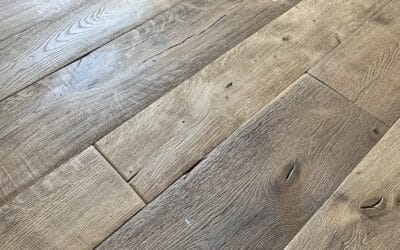

European oak vs NZ native timber: which floor for a NZ home?
A straight comparison of hardness, stability, look and supply.
For a modern New Zealand home, both native timber and engineered European oak make a good floor. Most new floors we supply land on European oak, and it is rarely about hardness alone. It comes down to supply, dimensional stability, a consistent look and the engineered format. Here is the honest comparison.
The short answer
People often start with the oak hardness rating, and it does matter, but it is only one factor. On widely published Janka figures European oak sits around 1,350 lbf: mid-range, and shown here as an indicative guide only, not a Vienna Woods measurement. NZ natives vary a lot by species. Totara rates high, while rimu, matai and kauri are softer and tend to mark sooner. For the full species table, see our guide to how hard-wearing NZ native timber floors are.
What usually decides a new floor is everything around hardness: whether you can get the timber in the width and volume you need, how stable it stays across a big open-plan area, the look you are after, and whether the board format suits a modern subfloor. That is where engineered European oak tends to earn its place.
NZ native timber vs European oak
Neither is simply better. They are different trade-offs. Here is how they compare for a typical New Zealand home.
| What matters | NZ native timber | Engineered European oak |
|---|---|---|
| Hardness | Varies widely by species. Totara is hard; rimu, matai and kauri are softer. | Mid-range on indicative Janka figures, around 1,350 lbf. Above rimu, matai and kauri on published data. |
| Dimensional stability | Solid boards move more with heat and humidity, especially across a large area. | An engineered core is designed to stay stable across wide, open-plan floors and modern subfloors. |
| Look and grain | Distinct local character; rimu and totara have a recognisable NZ grain. | Classic oak grain, with a wide choice of colours and finishes across the ranges. |
| Availability and supply | Limited for new flooring; matching or extending an old floor can be hard to source. | Readily available in consistent grade, width and colour, in the volume a whole floor needs. |
| Format and subfloors | Usually solid and site-finished; better suited to timber subfloors. | Engineered planks suit concrete and timber subfloors, and can go over underfloor heating where specified. |
| Restoration | Can be sanded back a limited number of times; old boards carry decades of wear. | The oak wear layer can generally be recoated or refreshed over time. |
Hardness figures are indicative published reference data, not measured by Vienna Woods and not a performance guarantee for any specific floor.
When to choose each
Choose native timber when
Character and heritage lead
- You are restoring or extending an existing native floor you love
- Local character and history in the grain matter most to you
- The floor sits in a lower-traffic or heritage setting
- You can source matching boards for the work
Choose engineered European oak when
You want stability and a consistent look
- You are laying a new floor or overlaying a tired one
- The floor runs through a large, open-plan space
- You want a consistent grade, width and colour across the whole area
- You are working with a concrete subfloor or underfloor heating
Not sure whether solid or engineered suits your renovation? Our engineered vs solid timber flooring guide walks through it.
Why Vienna Woods builds on European oak
We could source almost any species. We build our ranges on European oak because it balances the things that matter across a whole floor: it is available in consistent grade and volume, it takes colour and finishes well, and on an engineered board it gives a stable, hard-wearing surface designed for New Zealand homes. That is a considered trade-off, not a claim that oak beats every native timber on hardness.
Our oak is European oak, engineered overseas to our specification. Petit Château boards, for example, are 15mm thick with a 4mm European oak wear layer over a multi-ply core, finished in a Sherwin-Williams UV lacquer. Sherwin-Williams is the American coatings company founded in 1866 and, by revenue, the world’s largest paint and coatings maker. Browse the Petit Château European oak collection or the wider engineered timber flooring range to see the grades, widths and colours.
Common questions
Is oak durable?
European oak is widely regarded as a durable flooring timber, which is one reason it is so popular worldwide. On published Janka reference figures it sits mid-range, above several NZ natives such as rimu and kauri. Those figures are indicative only, not a Vienna Woods measurement or guarantee. Real-world durability also depends on the finish, the wear layer and how the floor is cared for.
What is oak’s hardness rating?
On widely published Janka figures, European oak has a hardness rating of around 1,350 lbf. That puts it mid-range: above rimu, matai and kauri, in a similar band to maple, and below totara and jarrah. We show it as an indicative guide only, not a figure measured by Vienna Woods. For the full species table, see our guide to NZ native timber hardness.
Is European oak harder-wearing than NZ native timber?
It depends on the native species. On published figures, European oak rates above softer natives like rimu, matai and kauri, and below harder ones like totara. Hardness is only part of how a floor wears, though, and these figures are indicative rather than a Vienna Woods measurement. Stability, format and finish matter just as much in a real home.
Order free samples
See and feel the oak grade, width and colour in your own light before you decide.
The engineered oak range
Browse the engineered European oak ranges: grades, widths, colours and finishes.
NZ native timber hardness
The full Janka species table and where each NZ native sits.
Compare it in your own home
Order free samples of our engineered European oak, or tell us about your floor and we will help you weigh it up.