The history and evolution of engineered timber flooring
How a 20th-century engineering idea became the premium NZ floor.
Engineered timber flooring began with a simple idea from the early 1900s: layer thin sheets of wood in alternating directions so the board stays flat. From 1930s plywood to today’s precision-milled European oak, a century of refinement has made it the go-to premium floor for New Zealand homes.
From ships’ hulls to your living room
The engineered board under a modern floor is the result of about a hundred years of steady improvement. Here is how it evolved.
The engineering idea (early 1900s)
Cross-laminating thin layers of wood for strength was proven in shipbuilding and early aircraft long before it reached flooring. Gluing plies with the grain running in alternating directions makes a panel that behaves very differently from a single piece of timber.
Plywood floors (1930s)
The first engineered wood floors were plywood-based: thin timber plies bonded in a cross-laminate stack. The cross-grain construction held its shape where solid boards tended to move, and the idea stuck.
Parquet and pattern (1950s to 1960s)
Parquet blocks laid in herringbone and geometric patterns took off. Much of it used an engineered backing because it sat flatter and fitted more easily than solid timber.
The manufacturing leap (1980s to 1990s)
Better adhesives, pressing and milling produced cleaner, more consistent boards, plus floating floors that clicked together over an underlay. Engineered wood moved from niche to mainstream.
Engineered oak today
A modern board is a thick real-oak wear layer bonded under pressure to a multi-ply core, milled to tight tolerances and finished in the factory. You get the look and feel of solid oak on a base engineered to hold its shape.
Why engineered became the premium choice for NZ
Engineered flooring did not take over because it is cheaper. It took over because of how it is built. The layered core is designed to cope with the seasonal humidity swings that New Zealand homes see, and it opens up floors that solid timber struggles with, like concrete slabs and underfloor heating. Our engineered vs solid guide compares the two in detail.
Engineered board
A cross-layered core
The multi-ply core runs its layers in alternating directions.
- The construction is designed to resist the swelling and shrinking that can affect a single piece of solid timber, which generally helps in a damp, changeable climate.
- Real timber wear layer on top, so you walk on genuine oak.
- Often suitable over concrete slabs and, in many cases, underfloor heating, subject to the installer’s requirements.
Solid timber
One piece, top to bottom
A single piece of timber milled into a board.
- Beautiful, and can be sanded back many times over a long life.
- Tends to move more with moisture, so it needs careful acclimatisation and site conditions.
- Over a slab or underfloor heating it works only within tight limits: ATFA sets 19mm boards, cover width no more than 130mm (80 to 85mm preferred) and 8 to 9% moisture content.
Where Vienna Woods sits in that story
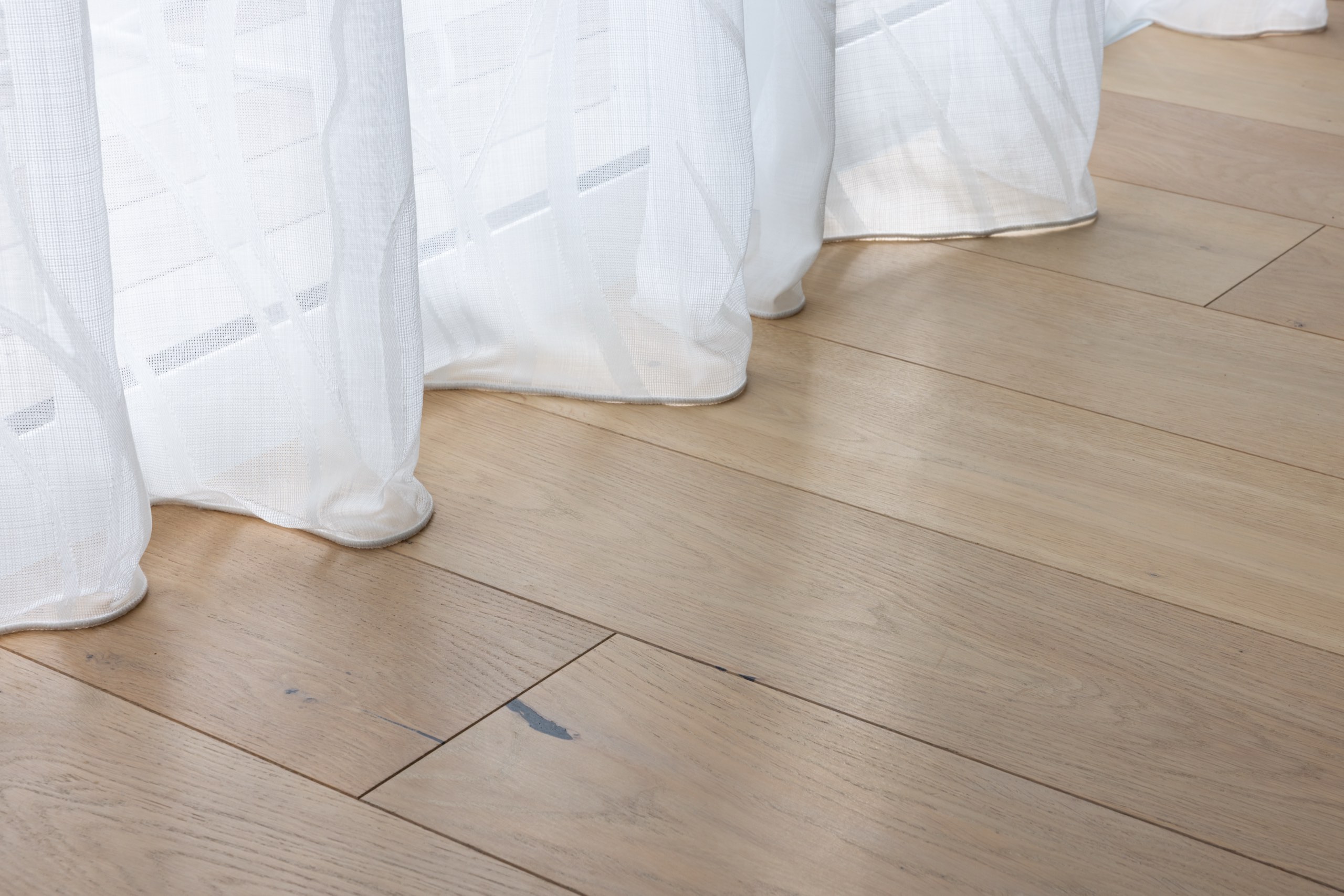
Vienna Woods engineers its own engineered timber flooring in European oak, to a premium modern spec. Our Petit Château range is a good example: a 15mm board with a generous 4mm European oak wear layer over a multi-ply core, protected by a Sherwin-Williams UV lacquer. Sherwin-Williams is the American coatings company founded in 1866 and, by revenue, the world’s largest paint and coatings maker. The oak is European; the board is engineered overseas to Vienna Woods’ specification. A 4mm wear layer leaves plenty of real oak to live on, and to refinish if a floor ever needs it.
| Spec | Petit Château |
|---|---|
| Board thickness | 15mm |
| Wear layer | 4mm European oak |
| Core | Multi-ply engineered |
| Finish | Sherwin-Williams UV lacquer (USA) |
| Standard plank | 190 x 1900mm, Feature grade, in stock |
| Formats | Standard, Noble, Grande, Chevron, Herringbone |
European oak, engineered overseas to Vienna Woods’ specification. As a natural timber product, some variation between boards is normal.
Common questions
What is engineered timber flooring?
A floorboard built in layers: a real timber wear layer bonded to a multi-ply or plywood core, with the layers running in alternating directions. You walk on genuine wood, and the layered base is engineered to keep the board flat.
How old is engineered timber flooring?
The core idea goes back to the early 1900s, borrowed from the cross-laminated plywood used in ships and aircraft. Plywood-based floors appeared in the 1930s, and the precision-milled oak boards sold today are the result of decades of refinement.
Is engineered timber flooring better than solid timber?
Neither is simply better. Solid can be sanded more times over a very long life; an engineered board’s cross-layered core is designed to move less with moisture, which suits many New Zealand homes, slabs and underfloor heating. Our engineered vs solid guide walks through the trade-offs.
What is Vienna Woods engineered flooring made from?
European oak wear layers over a multi-ply core. The oak is European; the boards are engineered overseas to Vienna Woods’ specification, then finished with a Sherwin-Williams UV lacquer on the Petit Château range.
Take the next step
Order free samples
Feel the oak, the wear layer and the finish in your own light before you decide.
Order samples →Engineered vs solid
The honest trade-offs between engineered and solid timber for a New Zealand home.
Compare them →What it costs
A plain guide to what engineered timber flooring costs per square metre in NZ.
See the pricing →Order a sample of engineered European oak
A century of engineering, in a board you can hold. Order free samples, or ask us for a quote for your project.