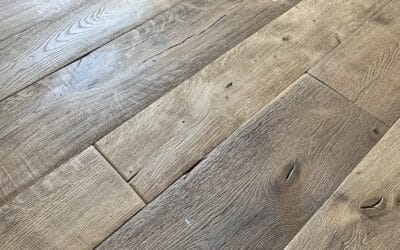
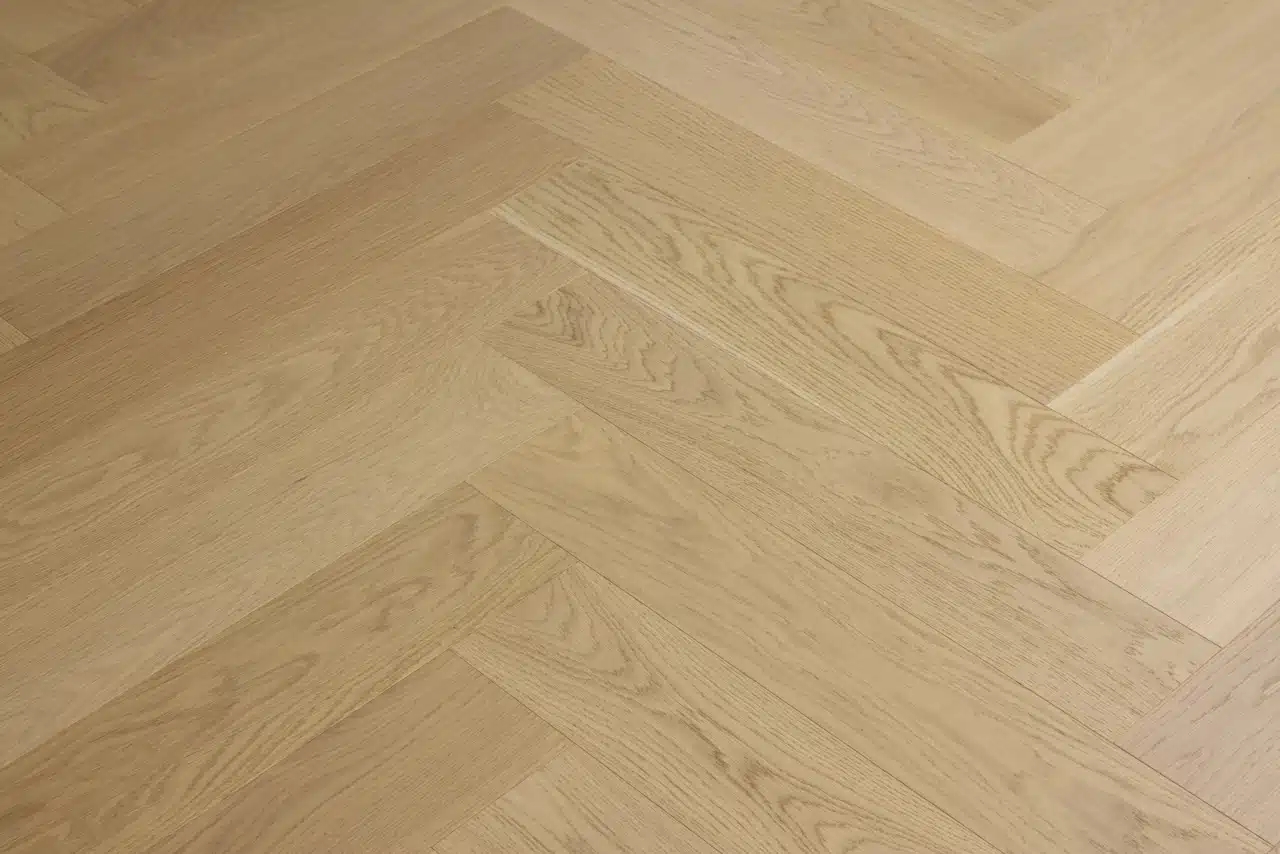
Oiled vs lacquered wood flooring: which finish should you choose?
Feel, wear, care and repair, side by side.
An oiled floor soaks the finish into the timber, so you touch wood and can usually freshen worn areas in place. A lacquered floor carries a clear coat on top, so it asks for less routine care but a worn patch is harder to fix on its own. That’s the whole trade-off. Everything below is what it means in a real house.
The quick answer
Choose lacquered if you want the lower-maintenance option and a surface that resists wear better. That usually makes it the easier choice for a busy hallway, or a house with kids or a dog. Day to day it’s a sweep and a damp mop with a cleaner made for lacquer.
Choose oiled if you want the floor to feel like bare timber underfoot, you like a finish that deepens in colour as it ages, and you’re happy to do a bit more routine care in exchange for being able to freshen worn areas without sanding the whole room. An oiled floor can work in a busy house too, if you’re happy to top up worn areas as they show.
Near a kitchen sink, either finish has to go in as a sealed system. See “Kitchens, wet areas” below.
Still split? Order samples of the same colour in both finishes and live with them for a week. Most of our range is lacquered. Our oiled floors include Hinterland (hard wax oil) and Flamingo, including Raftwood. The full list is further down.
| Where the finish sits | Oiled: Soaks in and cures in the timber | Lacquered: A clear coat cured on top of the boards |
| Feel underfoot | Oiled: Close to bare timber | Lacquered: You touch the coating (some matt lacquers feel very close to timber) |
| Resisting wear | Oiled: Lower | Lacquered: Higher |
| Routine care | Oiled: More: a soap made for oiled floors, plus top-up oil when the finish wears | Lacquered: Less: sweep and damp mop, with a refresher coat when it looks tired |
| Fixing a worn patch | Oiled: Usually re-oiled in place, no full sand | Lacquered: Harder to fix in one spot |
Table rows are general to each finish type. They vary with the product, the texture and how the floor is used and looked after, and they aren’t a performance guarantee.
What each finish actually is
Lacquer
Lacquer is a clear coating that cures into a continuous film over the boards. Most of our lacquered floors are factory-finished with UV-cured lacquers, which means the coating is hardened under ultraviolet light in the factory before the boards are packed. The timber’s colour and grain show through, but what your foot, your mop and your dog’s claws touch is the coat.
Oil
Oil soaks into the timber and cures there by reacting with oxygen in the air. Most modern oiled floors, including our Hinterland range, use a hard wax oil: it soaks in and cures in the timber, leaving a thin hard wax layer at the surface rather than the separate sealed film a lacquer forms. The surface stays slightly open, which is why an oiled floor feels like wood and why it can be topped up in place.
Neither word tells you the sheen. You can buy glossy oils and extra-matt lacquers. Several of our lacquered ranges are extra matt, so on the floor the difference is often in the feel more than the shine.
Durability and wear
This is where the two genuinely differ, and it’s worth being straight about it.
ATFA, the Australasian Timber Flooring Association, is the industry body whose standards we work to. It rates the oil and hard-wax-oil family low to medium for resisting wear. It rates a two-pack solvent-borne polyurethane lacquer very high. Most of our lacquers are factory UV-cured, a different product from the site-applied two-pack that chart describes, so read it as the direction of the difference rather than a rating for any one board.
The reason people still choose oil is what happens after the wear. ATFA names easy repair of worn areas as the advantage of oils, and says that with a regular rejuvenation coat an oiled floor may never need sanding back to bare timber. A lacquered floor keeps its film intact for longer, but once that film has worn through, the fix is usually a bigger job.
Two limits travel with the oil advantage:
- Worn and damaged are different jobs. A worn area takes a maintenance coat with no sanding. A gouge, a deep scratch or a mark that has gone into the timber has to be sanded out before it’s re-oiled, on either finish.
- A repair isn’t guaranteed to disappear. A patch can read slightly different from the floor around it, especially on dark or heavily tinted oils, where getting the colour to match needs the exact original product and some skill. On a near-black floor, plan on a professional.
Whichever you choose, the long-term backstop is the wear layer. On an engineered floor that’s the top layer of solid timber, and it’s what lets the whole floor be sanded back and refinished. Most of our floors have a 4mm oak wear layer; Foundation and Blackbutt have 3mm.
Look and feel
Oiled floors read as timber: the grain and any brushing or saw marks stay open to the touch. ATFA rates the oil family high for darkening with age, so an oiled floor warms and deepens in colour noticeably over the years.
Lacquered floors read cleaner and more even, board to board. A good matt lacquer is hard to pick from oil by eye; you notice it more under bare feet.
Feel isn’t a perfect guide, though. Our Distilled range is lacquered as standard, yet its coating is so dry and natural that it barely feels coated, while Petit Château’s extra-matt lacquer feels like what it is.
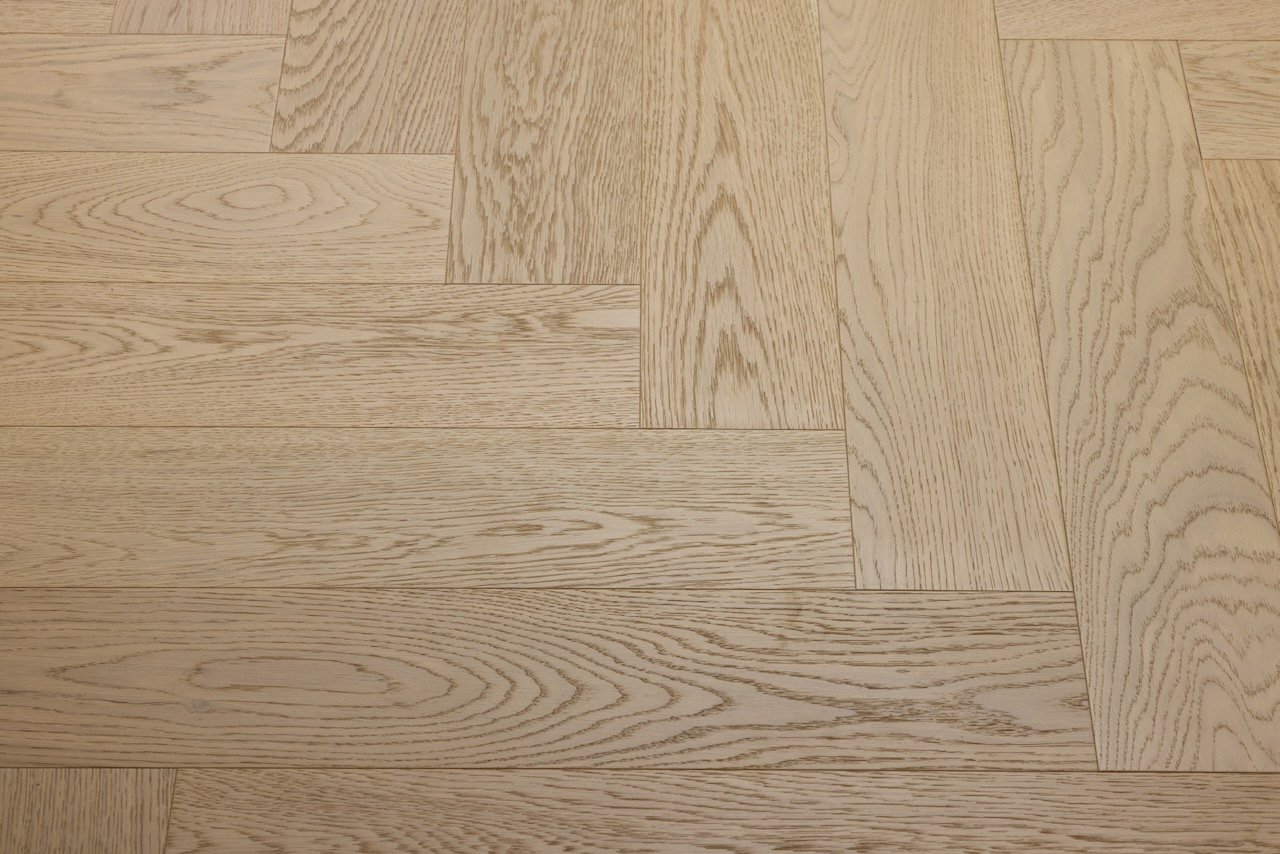
Brushed and oiled, a common search, just means the board was wire-brushed before finishing, which pulls out the softer grain and leaves a textured surface, and then oiled. Brushing is a texture, not a finish, so you’ll also find brushed lacquered floors. Our floor finishes guide covers textures in more detail.
Maintenance and repair
Looking after a lacquered floor
- Sweep or vacuum first. Grit is what scratches a finish.
- Damp mop with a pH-neutral cleaner made for lacquered timber. Wring the mop well; never flood the floor.
- Avoid harsh detergents, abrasive cleaners, methylated spirits and vinegar.
- When it looks dull or tired, deep clean it and lay a maintenance or refresher coat over the top, using the product your floor’s care guide names. ATFA confirms every coating type can be recoated with refurbishment coats. Do it before the lacquer wears through to bare timber: once the timber is exposed, a refresher coat won’t even it out, and the usual fix is to sand and refinish.
What we’d use: FirstFloor Wood Floor Cleaner for regular mopping, FirstFloor GrainGuard Lacquered Floor Protection (Matt) to refresh a dull surface, or the Care Kit for Lacquered Floors (mop, pad and wood soap). See care for lacquered floors.
Looking after an oiled floor
- Sweep, then damp mop with a soap or cleaner made for oiled floors. A lacquer cleaner is the wrong product, and a harsh general-purpose cleaner can attack the oil finish.
- Wipe spills up promptly.
- Top up the oil when the floor tells you to, not on a calendar. The test: put a few drops of water on a high-traffic spot. If they bead, the finish is fine and just needs cleaning. If they soak in after a few minutes and the timber darkens, it’s time to re-oil that area.
- Use the maintenance oil your floor’s care guide names. Our oiled floors are factory-finished, so the board maker’s instructions come first, and an extra coat on a factory-oiled board goes on very thin and gets buffed in. If the care guide doesn’t name an oil, ask us before you buy one.
- Oily rags can catch fire on their own as they dry. Lay used cloths and pads flat outdoors to dry, or put them in water in a sealed metal container.
What we’d use: a soap made for oiled floors for the regular clean, FirstFloor Maintenance Oil (Matt) for top-ups where your care guide allows it, or the Care Kit for Oiled Floors. See care for oiled floors.
Can you switch finishes later?
Usually, at the point of a full refinish. The floor is sanded back to bare timber, which uses some of the wear layer, and then the new finish goes on. It’s a job for a professional, and it’s easier to choose the right finish up front, which is what samples are for.
Cost over the life of the floor
Across our range, the price of a floor is set by the collection, format and grade rather than by the finish. The cost difference shows up after it’s laid.
- Oiled: more frequent, smaller jobs. Regular cleaning product plus a top-up oil on high-wear areas when the water test says so. Much of it you can do yourself, though large areas and dark tints are better done by a professional.
- Lacquered: less routine work and product, plus a refresher coat when it looks tired. If the surface is left to wear through, the fix is a larger one-off job over a whole room.
For numbers, see our timber floor maintenance cost guide.
Kitchens, wet areas, underfloor heating and pets
Kitchens and bathrooms. The NZ Building Code (clause E3) treats rooms with sanitary fixtures, and the splash zone at a kitchen sink, as wet areas. Timber is no longer a ready-made “acceptable solution” there, so a timber floor in those spots goes in as a specified system, for example glued down and sealed at the edges, with a surface that keeps water out and can be maintained. Our moisture tests are on assembled joints, and a result is specific to the coating and the joint that were tested, so a result for a lacquered floor doesn’t cover an oiled one, or the other way round. We hold moisture test reports for both lacquered and oiled floors, and each product’s statement says which finish and joint it covers. Not every range has one, so ask before you specify timber at a sink.
Underfloor heating. ATFA’s guidance for floors over underfloor heating sets its limits on the board and the heat rather than the finish: engineered boards generally no thicker than 20mm, and a floor surface no hotter than 27 °C.
Pets. Claws and grit will mark any finish. On an oiled floor, general wear from a dog can usually be re-oiled; a claw mark that has dug into the timber is damage, and on either finish that means sanding the spot before refinishing. Felt pads under furniture and a mat at the door cut the grit down.
How to tell which finish you have
- Check the paperwork. Your invoice or quote names the product, and every product page on our site lists its finish.
- Don’t rely on feel alone. Some matt lacquers feel almost bare, as our Distilled range shows.
- Ask us. Send the product name, or a photo and roughly when it went down, and we’ll tell you the finish and the right care.
If you’re not sure, don’t use an oil, a wax or a strong cleaner on it until you know. The wrong product on the wrong finish is an easy way to dull a good floor.
Which Vienna Woods floors come in which finish
| Finish | Range | Detail |
|---|---|---|
| Lacquered | Petit Château | Sherwin-Williams UV lacquer, extra matt |
| Icons | UV lacquer | |
| Château | UV lacquer | |
| Excess | UV lacquer | |
| Patina Collection | Extra-matt UV lacquer, a Finnish coating system | |
| Foundation | Air-dried, natural-feel lacquer | |
| Distilled | Lacquer as standard, with a very dry, natural feel; hard wax oil to order | |
| Blackbutt | Extra-matt, light-brushed lacquer | |
| Oiled | Hinterland | Hard wax oil |
| Flamingo, incl. Raftwood | Natural oil | |
| Your choice, finished on site | VW Unfinished, Heritage | Supplied raw; your installer applies the oil or lacquer you pick |
We also carry Admonter and Antique Floors. Their finish varies by product, so ask us about the one you like.
Browse them together on the oiled floors and lacquered floors pages, then order samples of the two or three you like in your own light.
Common questions
Is oiled or lacquered better for engineered wood flooring?
Neither is better for the board itself; the engineered construction is the same underneath. Choose on how you want the floor to feel and how much routine care you’ll do: lacquered for lower upkeep and a surface that resists wear better, oiled for a timber feel and in-place repair of worn areas.
Which is more durable, oiled or lacquered?
On ATFA’s rating the lacquer family resists wear better. An oiled floor wears sooner but is easier to freshen in worn areas without sanding the whole floor.
Is oiled or lacquered better in a kitchen?
Lacquer asks for less routine care, which suits a room that gets cleaned a lot. Around the sink, though, the Building Code treats the splash zone as a wet area whichever finish you choose, so the floor has to be specified as a sealed system. Talk to us before you commit.
How often does an oiled floor need re-oiling?
There’s no fixed interval. Re-oil when the water-drop test shows the finish has worn, which happens sooner in a hallway than in a bedroom.
Can you wax a wood floor?
Not with a paste wax. A hard wax oil is a different thing: it’s the finish itself, put on at the factory, and it’s topped up with the maintenance oil your care guide names. Paste wax isn’t part of the care routine we recommend for either finish, so use an oiled-floor soap and maintenance oil on an oiled floor, and a lacquer cleaner on a lacquered one.
Can you change a lacquered floor to oiled, or oiled to lacquered?
Yes, at a full refinish: the floor is sanded back to bare timber and the new finish applied, provided enough wear layer remains.
Not sure which finish is right for your home?
Order samples of the same colour in both finishes and live with them for a week.