
Engineered timber, hybrid, SPC or laminate: what’s actually different
Four floors that can look alike in a photo and behave quite differently once they’re down. What each one is made of, how it handles water and wear, and how to choose between them.
Engineered timber has a real hardwood top layer, so a worn surface can be sanded back and refinished. Hybrid, SPC and laminate carry a printed image of wood under a clear protective layer, on a vinyl, stone-plastic or fibreboard core.
That one difference drives most of the others: what the floor reacts to, how its wear is rated, and whether a tired surface gets refinished or replaced.
Vienna Woods sells timber floors, so you know where we stand. Everything below about those three is general and drawn from the published tolerance guides of the Australasian Timber Flooring Association (ATFA) and the European product standards each type is tested to. Individual products vary, so the maker’s own specification and warranty always come first.
Four floors, and what each one is made of
The names overlap, which is half the confusion. Here’s what sits under each label.
A real hardwood top layer, called the wear layer, bonded over a multi-layer timber core (plywood on most of our collections). Most of our oak floors carry a 4 mm wear layer. Foundation carries 3 mm, and we can supply a 6 mm wear layer on some boards. The layered core is what keeps the board stable as the seasons change.
Engineered timber flooring →A name makers use for a rigid-core plank: usually a vinyl or stone-plastic core with a printed wood-look film and a clear wear layer on top, clicked together and floated. What goes into the core varies between brands, so read the specification.
SPC stands for stone plastic composite, a rigid vinyl core. Many floors sold as hybrid have one. Flexible vinyl plank (LVP or LVT) belongs to the same family, and “composite” gets used loosely for all of them.
A high-density fibreboard core under a printed decor paper and a hard resin overlay. The core is made from wood fibre, but the surface you see is a photograph of timber.
The comparison
Ratings and tolerances are the general published figures. A specific product can sit anywhere in its range.
| Engineered timber | Hybrid, SPC & vinyl plank | Laminate | |
|---|---|---|---|
| Top surface | Real hardwood (mostly oak, on our floors) | Printed wood-look film under a clear wear layer, around 0.3 to 0.5 mm on most products | Printed decor paper under a resin overlay |
| Core | Multi-layer timber core, usually plywood | Rigid vinyl or stone-plastic composite | High-density fibreboard |
| How wear is rated | No wear class. Judged on wear-layer depth and the timber’s hardness | Use class (tested under EN 16511), most products class 32 to 34 | AC class under EN 13329, AC1 to AC5 |
| What it reacts to | Humidity. The cross-laminated core holds back the movement, which shows a little in both width and length | Temperature rather than humidity | Humidity, in both directions, because fibreboard has no grain |
| Usual installation | Glued to the subfloor (how we install) or floated | Floated, with click joints | Floated, with click joints |
| Subfloor flatness (ATFA) | Within 3 mm under a 3 m straight edge, glued | Within 4 mm under a 2 m straight edge | Within 3 mm under a 1.5 m straight edge |
| When the surface wears | Can be sanded back and recoated. A deeper wear layer leaves more timber to work with | The image layer can’t be sanded, so worn boards are replaced | The image layer can’t be sanded, so worn boards are replaced |
Sources: ATFA tolerance guides for engineered, hybrid and laminate flooring; EN 14342 (the wood flooring product standard), EN 13329 (laminate), EN 16511 and EN ISO 10874 (use classes).
Water, spills and wet rooms
Timber isn’t waterproof, and we’d never describe it that way. A spill wiped up promptly is fine on a finished floor. Standing water, a slow leak or damp that runs for weeks are what damage it. If you’re weighing timber for a kitchen, bathroom or laundry, each has its own guide.
Hybrid and SPC floors react to temperature rather than humidity, and makers often market them for wet areas. What a particular warranty actually covers (standing water, the joints, the subfloor underneath) differs between brands, so read it before you rely on it.
Laminate’s fibreboard core is the part to keep dry. ATFA’s guidance is that a floating laminate floor that has been covered by water will generally need replacing, and it says the same of floating engineered and bamboo floors, so this is about the installation as much as the material.
Wear, scratches and refinishing
The wear ratings aren’t on one scale, so you can’t compare an AC4 laminate with a 4 mm oak wear layer number for number. Laminate and vinyl are rated by how their top layer stands up to abrasion tests. Real wood is judged on the depth of the wear layer and the hardness of the species.
Oak marks the way wood does: it can dent, and a lacquered or oiled surface will show scratches over time. What you get in return is a surface you can look after. Worn areas of an oiled floor can usually be cleaned and re-oiled without sanding the whole floor, and a lacquered floor can be recoated, following the floor maker’s care instructions. When the finish is worn through, the wear layer can be sanded back and refinished. Our guides on scratches and dents and board and wear-layer thickness go further.
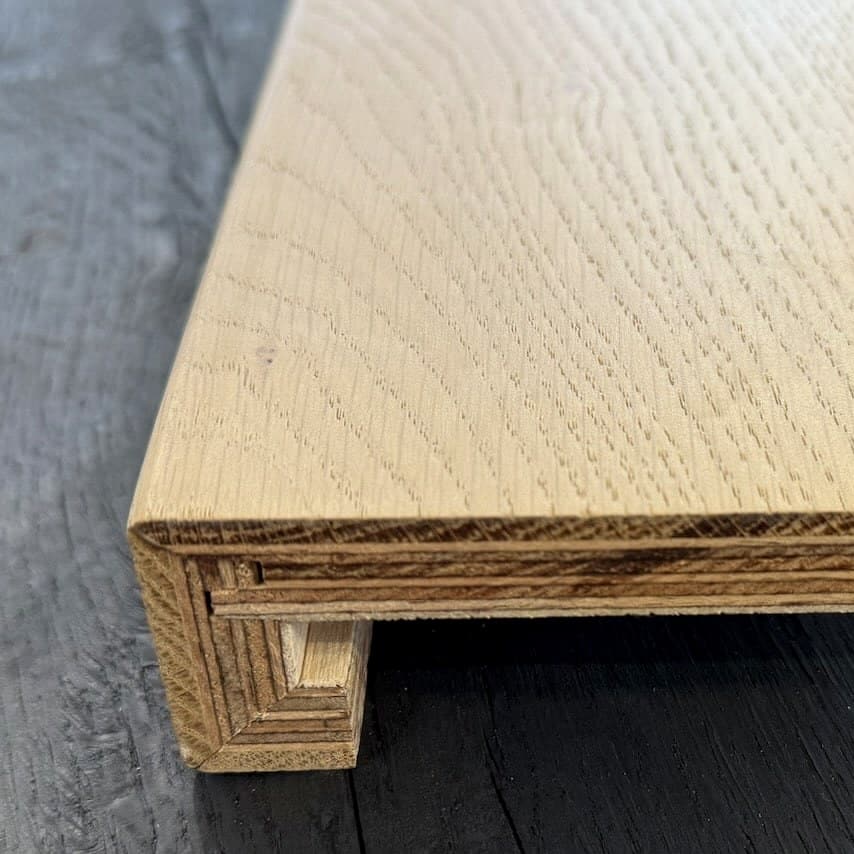
Printed floors carry a limited number of image variations, and the number differs by maker, so on a large floor you may spot the same board twice. Every oak board is cut from a different piece of tree, which is why no two read quite the same.
Which one suits your project
Worth a look if the budget leads, the room sees a lot of water, or it’s a rental you expect to refloor rather than refinish. Check the maker’s warranty for wet areas.
Usually the lowest outlay for a wood look in a dry room, where you’re happy to replace the floor rather than refinish it.
Real wood underfoot, one floor that can run through the house, and a surface you can repair and refinish. It usually costs more to buy than the other three.
Put a sample of each on the floor where it will go and look at them morning and evening. Photographs flatten the difference that daylight shows.
If engineered timber is on your list, our timber flooring cost guide sets out what it costs supplied and installed, and engineered vs solid covers the other comparison people ask us about.
Hybrid, SPC, laminate and timber: common questions
Is hybrid flooring better than engineered timber?
They suit different jobs. Hybrid is a rigid vinyl or stone-plastic plank with a printed wood-look surface, it reacts to temperature rather than humidity, and worn boards are replaced. Engineered timber has a real hardwood top layer that can be sanded back and refinished. Choose on what the room needs and how long you plan to keep the floor.
Is engineered timber waterproof?
No. Timber is not waterproof. A spill wiped up promptly is fine on a finished floor, but standing water, leaks and long-running damp will damage it. For kitchens, bathrooms and laundries, see our room guides before you decide.
Is SPC the same as hybrid flooring?
Often. SPC means stone plastic composite, a rigid vinyl core, and many floors sold as hybrid have one. The names are used loosely, so check what the core is made of in the product specification.
Can you sand hybrid or laminate flooring?
No. Their wood look is a printed layer under a clear protective coat, so there is no timber to sand. A worn or damaged board is replaced. An engineered timber floor can be sanded back and refinished because its top layer is real wood.
Is laminate flooring real wood?
Laminate has a core made from wood fibre, but the surface you see is a printed image of timber under a resin overlay. Its wear is rated by AC class under EN 13329, a different scale from the one used for wood floors.
Does the Vienna Woods range include hybrid or laminate?
No. The Vienna Woods range is engineered timber flooring, mostly European oak, and we install it glue-down. We still give a straight answer on how the alternatives compare.
See real oak next to the alternatives
Order a free sample pack and put it beside whatever else you’re considering, in your own light. Or come and see our display panels at the Newmarket showroom.