
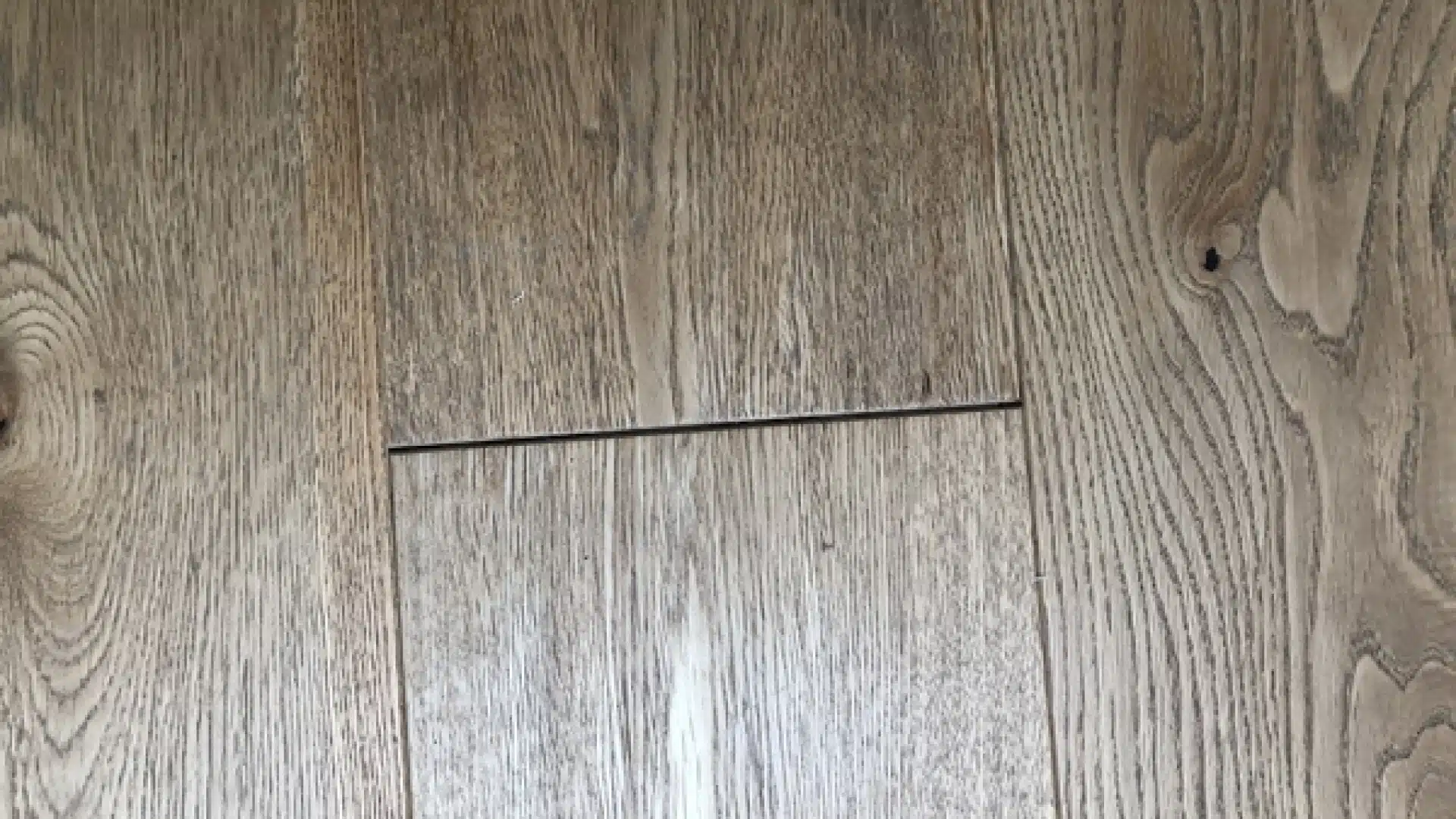
Gaps between floorboards: what’s normal, and should you leave one?
None between the boards, 10–15 mm at the edges, and which winter gaps are normal.
Short answer. When a floor is laid, there’s no gap between the boards. Tongue-and-groove boards go together tight. There is a gap around the edge: we leave 10–15 mm at every wall and fixed object, and the skirting covers it.
Once the floor is down, fine gaps that open when the air is dry and close again when it’s humid are normal timber behaviour. Our warranty treats minor shrinkage and seasonal movement as natural characteristics of timber, not defects. Gaps that stay open all year, sit in one patch, or come with lifting or movement are worth a proper look.
Should you leave a gap when laying a timber floor?
Between the boards: no. Timber flooring is dried to a tight moisture range and the boards are laid in direct contact.
Around the edges: yes, always. Timber takes on moisture and gives it off with the air around it, so the floor needs room to move at the walls. On the glue-down floors we install, our installation guide sets a 10–15 mm expansion gap around the perimeter and every fixed object: walls, kitchen islands, hearths, posts and pipes. Skirting and trims are fixed to the wall, never to the floor, so they don’t pin it.
Floating floors need it too, at every edge. A floating floor moves as one piece, so it needs room at every edge and around anything fixed through it. Where the board maker’s instructions are silent, ATFA sets a minimum of 10 mm in rooms averaging about 55% relative humidity or below, and 14 mm in humid rooms or where seasonal movement is bigger. Most of our range is tongue and groove, which we lay glued down, never floated, so this applies to click boards. See floating vs glue-down.
Size the gap to what the floor needs, then pick the skirting or scotia that covers it. Never shrink the gap to suit a thin skirting.
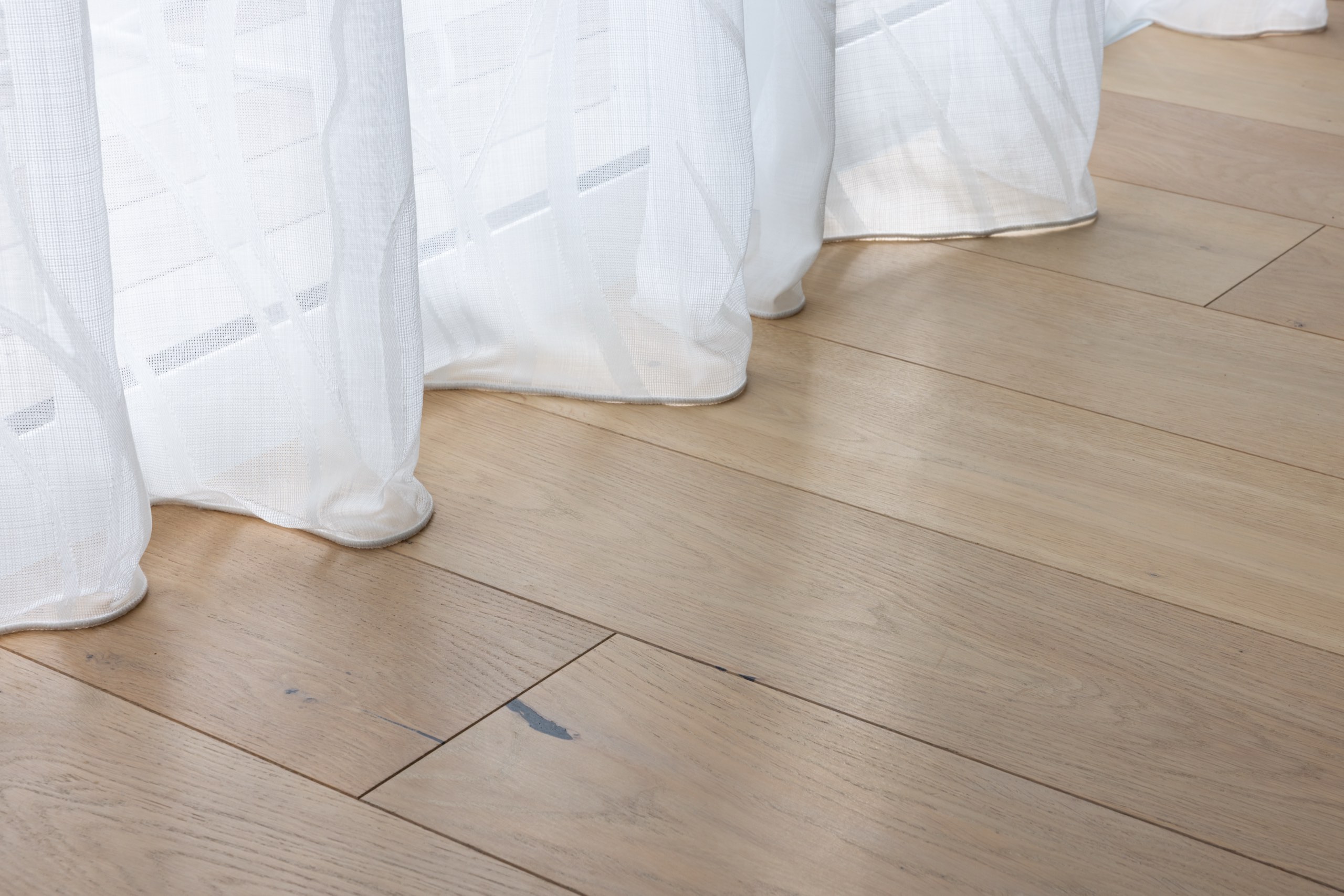
Why gaps open once the floor is down
Timber settles to a moisture content set by the temperature and humidity of the room. At 20 °C, air at 40% relative humidity brings timber to about 7.7% moisture content; at 65% it’s about 12.0%. As the moisture content falls, boards shrink across their width, and the joints show it as fine gaps.
Heating dries the air, so gaps are most likely when the heating’s running. Heat pumps, underfloor heating and a sunny room all push the same way.
Engineered boards move less than solid timber, because the layers of the core are laid across each other and hold the width in check. They still move, and unlike solid timber they move a little along their length as well, so a gap can show at the board ends. ATFA’s working figure for an engineered board is about 0.25 mm of movement for every 1% change in moisture content.
Normal or a problem?
| Usually normal: Fine, even gaps across the whole floor | Worth checking: Gaps in one part of the room only |
| Usually normal: They open in the dry, heated months and close again when it’s humid | Worth checking: Gaps that stay open all year |
| Usually normal: Small gaps where the joints are still sound | Worth checking: Gaps with boards that cup, lift or rock |
| Usually normal: A few fine surface checks after laying | Worth checking: Widespread checking across many boards |
| Usually normal: A board that sounds hollow but sits solid | Worth checking: Hollow boards that move at the edges |
ATFA, the industry body we use as our benchmark, accepts smaller gaps in an engineered floor, and says they may be filled if the joints are sound. Under extreme conditions such as underfloor heating, it accepts gaps up to 1 mm. It accepts minor, occasional surface checking after laying but not major checking across many boards. A glued board can sound hollow over up to a quarter of its length and still be within tolerance, as long as it isn’t spread over groups of boards and the edges don’t move.
The warranty on our engineered flooring says the same thing in plain terms: minor cupping, shrinkage or seasonal movement are natural characteristics of timber and not defects, and minor gaps or movement from seasonal humidity changes aren’t covered. What it does cover is the board’s structure: the layers staying free of delamination or bond failure, for 20 years in a home and 5 years commercially, when the floor is installed and looked after as the warranty sets out. It doesn’t limit your rights under the Consumer Guarantees Act. You can read our warranty in full.
What causes gaps, and how to tell which one you’ve got
Dry indoor air. The gaps are fine, even and spread across the floor, and they follow the seasons. Check: put a hygrometer in the room for a week. Our warranty asks for indoor relative humidity between 40% and 65%. If the room sits below that, you’ve found it.
In a dry area, winter is the season to watch. Cold southern air holds little moisture. Heat it and indoor humidity drops, often below 40% in a well-heated home.
- Put a hygrometer in the room. A cheap digital one tells you when you’ve dropped below 40%.
- If it stays below 40% for weeks, add moisture back. A room humidifier helps, or simply don’t run extractor fans longer than you need to in a heated, closed-up room.
- Keep dry heat off the floor. Put a hearth pad or rug in front of a log burner, and don’t point a heat pump or fan heater at the boards.
- Change the heating gradually. Underfloor heating should go up no more than 2 °C a day, with the floor surface kept under 27 °C.
- Draw blinds or curtains across big sunny windows.
- Expect a little winter gapping. Minor gaps from seasonal humidity are a natural characteristic of timber. They usually close again in spring, so judge the floor across the seasons.
Timber laid wetter than the room it lives in. If the boards went down at a higher moisture content than the room settles to, they shrink afterwards and the gaps open in the first dry season, wider than you’d expect. Check: ask your installer for the moisture readings they recorded before laying. Our installation guide requires them.
Underfloor heating run too hot, or turned up too fast. Gaps show over the heated area. Check: the floor surface must stay at or below 27 °C, and the heating should be brought up slowly. Our underfloor heating guide covers the numbers.
Local heat or sun. Gaps and fine surface checks in one zone, by a fire, a heat-pump outlet or a big north-facing window. ATFA notes that major checking is often caused by conditions in the home, like wood-fired heaters and intense sun. Check: whether the problem area lines up with the heat source.
Checking, not gapping. Fine splits along the grain in the surface, rather than gaps at the joints. ATFA finds this more often in glued floors, because a glued board takes its own movement rather than passing it across the floor. A few is normal; many is not.
A subfloor or bond problem. Gaps that come with boards that rock, dip or move at the edges when you stand on them. That points to the subfloor or the adhesive rather than the air. Check: get it looked at. This one doesn’t fix itself.
What to do, and when to call someone
- Bring the humidity back into range. If the room is dry, a humidifier, less heating or a lower underfloor setting usually closes seasonal gaps as the timber takes moisture back up.
- Give it a season before calling it a fault. A gap that opened in winter should be judged against what it does in the humid months, not on the driest day of the year. That’s about judging the gap, not about when to tell us: if you think something is wrong, our warranty asks for written notice within 30 days of noticing it.
- Fill only with advice. ATFA allows smaller gaps to be filled where the joints are sound. Ask us or your installer first, and wait until you know the gap isn’t seasonal.
Call us, or the installer who laid the floor, if:
- gaps keep widening, or stay open right through the humid months
- the gaps are in one area only
- boards cup, lift, rock or dip underfoot
- checking is spreading across many boards
Tell us in writing within 30 days of noticing the problem. Our warranty claim process asks for proof of purchase, the installation details, the batch code from the packs and photos of the issue; dated photos and a note of the room’s humidity reading help.
How to keep gaps small
- Acclimatise the timber in the room. Our installation guide stores the packs flat and unopened in the room for at least 48 hours before laying. ATFA’s point is that timber should be acclimatised to the moisture content it will live at, not just left for a set number of days.
- Lay in normal living conditions. Building closed in, wet trades finished. Before and during installation, the room should be at 18–25 °C and 40–60% relative humidity, and as close as practical to how the home will be lived in. If the house will be heated, run the heating beforehand. Follow the product’s own instructions where they differ.
- Test the subfloor. A concrete slab is moisture-tested before anything goes down: our installation guide sets a maximum of 70% relative humidity by in-situ probe, or the adhesive maker’s figure. Our adhesive, Parabond 440, is not a damp barrier; a damp slab gets a primer first, chosen from a carbide (CM%) test. A timber subfloor should read within 4% moisture content of the new floor.
- Keep the room in range. We recommend indoor relative humidity between 40% and 60%, and a floor surface under 27 °C. Our warranty's own condition is 40% to 65%.
The other way round: boards that cup or lift
Gaps are timber drying out. When it takes on too much moisture, particularly from underneath, the edges rise and the board cups. That’s a different diagnosis with a different fix; see our guide to cupping in timber floors. For a leak or a flood, start with water damage. And for day-to-day care that keeps water off the joints, see how to clean wood floors.
Common questions
Should you have a gap between floorboards?
Not between the boards. They’re laid tight. There should be a gap around the edge: we leave 10–15 mm at every wall and fixed object on a glued floor, covered by the skirting.
How big should the expansion gap be around a timber floor?
On the glue-down floors we install, 10–15 mm. For a floating floor where the maker gives no figure, ATFA’s minimum is 10 mm in drier rooms and 14 mm in humid ones. The board maker’s instructions come first.
Are gaps between floorboards normal?
Fine, even gaps that open in dry months and close in humid ones are normal, and our warranty treats minor seasonal movement as a natural characteristic of timber. Gaps that stay open all year, or come with lifting or movement, are worth checking.
Why do gaps get worse in winter?
Heating dries the air, and timber gives off moisture and shrinks as it does.
Should I fill gaps between floorboards?
Only once you know they aren’t seasonal, and only where the joints are sound. ATFA allows smaller gaps to be filled on that basis. Ask us or your installer first.
Do engineered floors get gaps?
Yes, less than solid timber, but they still move, and a little along the length as well as the width.
Why is my laminate or click floor separating?
Laminate isn’t timber, so follow your floor maker’s own guidance. The usual thing to check on any floating floor is whether it’s been pinned: a floating floor needs room at the edges and around anything fixed through it.