
Cupping in timber floors: causes, diagnosis and how to fix it
How to tell cupping from crowning and peaking, find the moisture, and fix it.
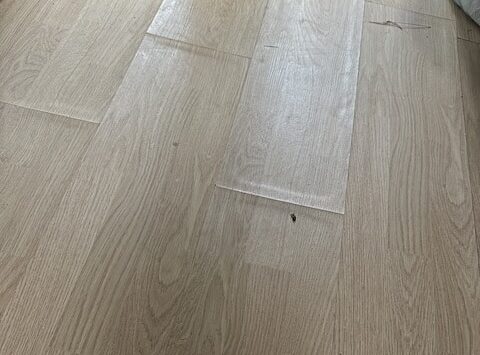
Short answer. A cupped board has edges that sit higher than its centre. It happens when the underside of the board is wetter than the top, so the bottom swells and pushes the edges up. Find the moisture and stop it first. In our experience, once the board’s top and bottom even out, mild cupping often settles. Don’t sand until the floor has stabilised: a floor sanded while it’s still cupped can turn out crowned months later.
Cupping, crowning and peaking: which one is it?
Run a straight edge across a few boards and look at the shape.
| Cupping | What you see: Edges higher than the centre, a shallow dish across each board | What it usually means: The underside is wetter than the top |
| Crowning | What you see: Centre higher than the edges | What it usually means: Often a cupped floor that was sanded before it dried out |
| Peaking or lifting | What you see: Boards pushing up off the subfloor, often along a line or at the walls | What it usually means: The floor has swollen with nowhere to go |
Cupping and gaps are the two ends of the same thing. Gaps are timber drying out; cupping is timber taking on moisture from one side. If your floor has gaps rather than raised edges, see our guide to gaps between floorboards.
How much cupping is normal?
Some. Timber is a natural material and it responds to moisture. Our warranty treats minor cupping, shrinkage and seasonal movement as natural characteristics of timber, not defects.
ATFA, the industry body we use as our benchmark, sets a limit for engineered boards at the time they’re installed: cupping no more than 0.1% of the board’s width. On a 130 mm board that’s 0.13 mm, and cupping you can see from standing height still counts as acceptable at installation if it measures under 0.1%. That figure is about how a floor goes down. It isn’t a measure of how flat a floor stays through every season, which depends on the moisture around it. ATFA accepts crowning in an installed floor up to 0.2% of the width. These are small numbers, so an eye or a hand is a poor judge. A straight edge and a feeler gauge are how it gets measured.
What ATFA doesn’t accept at all is delamination, where the layers of an engineered board come apart; it treats that as a manufacturing fault. That’s what our warranty covers: the structural layers staying free of delamination or bond failure, for 20 years in a home and 5 years commercially, when the floor is installed and looked after as the warranty sets out. It doesn’t limit your rights under the Consumer Guarantees Act.
What causes cupping, and how to find it
Cupping is a symptom. The cause is moisture getting into the underside of the board faster than it leaves the top. These are the usual sources, and how to tell them apart.
A damp concrete slab. New slabs hold water for months: ATFA puts about three months as the practical minimum for a typical house slab to dry, and an old slab isn’t automatically a dry one. Clue: cupping across the whole slab-laid area. Check: an in-slab humidity or carbide test. Our installation guide sets a maximum of 70% relative humidity by in-situ probe before a floor goes down. Our adhesive, Parabond 440, is not a damp barrier. A damp slab needs a primer laid first.
A damp crawl space. On a suspended timber floor, moisture comes up from the ground underneath. ATFA gives the warning sign: a subfloor space running at 80% relative humidity puts the timber at around 16% moisture content if it stays that way. Clue: cupping across a whole suspended floor, often worse in the damp months. Check: the ventilation. NZS 3604 asks for 3,500 mm² of vent opening per square metre of floor, with no part of the subfloor more than 7.5 m from a vent. A ground cover of polythene sheet makes a big difference.
A leak. Clue: cupping in one patch, near a dishwasher, fridge, sink, laundry or shower. Check: the plumbing, before anything else. If there’s been a flood or a burst pipe, start with our water damage guide.
Too much water from above. Steam mops and wet mopping push moisture into the joints. Steam is the most common cause of cupping and whitened joints that we see. Clue: cupping and pale joints in the areas that get cleaned most. See how to clean wood floors for what to use instead.
Humid rooms. A bathroom or laundry drives the humidity up and down every day. Clue: cupping in that room only. Our guides to timber in bathrooms and laundries cover what works there.
In a humid area, the risks are at installation and in a wet spell.
- Lay the floor last, into a dry building. The house should be weather-tight, with wet trades finished and dried out first.
- Lay boards at the right moisture content. They should be close to what the home will average, or the board edges can lift (peaking).
- Keep the full expansion gap around the edges.
- In a humid spell, ventilate, or use a heat pump’s dry or cooling mode. It takes moisture out of the air.
- Under a suspended floor, the subfloor should be ventilated and bare ground covered.
- Very humid sites (within a few hundred metres of the sea, shaded gullies, near streams) need the product checked against its maker’s range before it’s chosen.
Timber laid before it settled. Boards laid drier than the room they live in take up moisture after they’re fixed down. Check: the moisture readings your installer recorded before laying. Our installation guide requires them.
Wide boards. ATFA notes, in its guidance on solid floors, that cupping is more likely to show on boards wider than 100 mm. That doesn’t make a wide board faulty. It makes the moisture control above matter more.
Reading a moisture meter. Useful, with care. A capacitance meter has to be set for the species’ density, and ATFA puts individual readings out by 3% to 6%. Meters also read plywood and particleboard high. Take several readings, compare wet areas with dry ones, and get a professional reading before you spend money on a fix.
Peaking and lifting: when the floor has nowhere to go
If boards push up off the subfloor rather than dishing, the floor has usually swollen and run out of room. The usual reasons are a perimeter gap that was too small, filled, or pinned by a skirting or cabinet fixed through the floor. That’s why the perimeter gap is there for peaking and won’t fix cupping: cupping happens through the thickness of each board, not across the floor. A floating floor is the most exposed, because it moves as one piece; see floating vs glue-down.
A glued floor can also lift if it was laid very dry. ATFA finds adhesive failures cluster where flooring is laid at around 9% moisture content or below, in rooms averaging 35% relative humidity or lower, and then swells when the seasons bring the timber back to about 12.5%.
How to fix a cupped floor
- Stop the moisture. Fix the leak, dry the slab, ventilate the crawl space, stop the steam mop. Nothing else works until this is done.
- Let it even out. Once the source is gone, the top and bottom of the board move back towards the same moisture content, and in our experience mild cupping often flattens. Keep the room’s humidity steady while it settles. After a flood, a subfloor can take around four months to dry naturally.
- Sand only once it’s stable. Sanding a floor that’s still cupped takes the raised edges off. When the board then dries flat, the centre ends up proud, and the crowning doesn’t show until months later. On an engineered board, sanding also uses up wear layer, so check how much you have before anyone sands.
- Replace what can’t recover. Boards that have delaminated, split, or stayed badly deformed after drying get replaced. ATFA’s flood guidance says a floating engineered floor that has been covered by water will generally need replacing.
Call us, or the installer who laid the floor, if:
- the cupping is getting worse, or is new and sudden
- you can’t find the moisture source
- boards are lifting, loose or delaminating
- the floor is over underfloor heating (the surface must stay at or below 27 °C; see our underfloor heating guide)
Tell us in writing within 30 days of noticing the problem. Our warranty claim process asks for proof of purchase, the installation details, the batch code from the packs and photos of the issue; dated photos and a note of the room’s humidity help.
How to prevent cupping
- Test before you lay. Slab: in-situ probe, 70% relative humidity maximum, or the adhesive maker’s figure. Timber subfloor: within 4% moisture content of the new floor. Crawl space: ventilated to NZS 3604.
- Acclimatise the boards in the room they’ll live in, packs flat and unopened, for at least 48 hours, and to the moisture content they’ll live at.
- Lay in normal living conditions: before and during installation, the room should be at 18–25 °C and 40–60% relative humidity, and as close as practical to how the home will be lived in. If the house will be heated, run the heating beforehand. Follow the product’s own instructions where they differ.
- Leave the expansion gap: 10–15 mm on a glued floor, trims fixed to the wall.
- Keep the room in range: we recommend relative humidity between 40% and 60%, and a floor surface under 27 °C. Our warranty's own condition is 40% to 65%.
- Keep water off it. Wipe spills, no steam mops, and a mat you hang up after the shower. Oiled and lacquered floors are cleaned differently; see oiled vs lacquered.
Common questions
What is cupping in wood?
A board whose edges sit higher than its centre, because the underside has taken on more moisture than the top.
What causes cupping in a timber floor?
Moisture from below or one side: a damp slab, a damp crawl space, a leak, steam or wet mopping, or timber laid before it settled to the room.
Will a cupped floor go back to flat?
In our experience, mild cupping often settles once the moisture source is fixed and the board evens out. That can take weeks to months, and a badly cupped floor may not fully recover. Fix the cause first, and don’t sand while it’s still moving.
How do you fix a cupped wood floor?
Stop the moisture, let the floor even out, and sand only once it’s stable. Replace boards that have delaminated or stayed deformed.
What’s the difference between cupping and crowning?
Cupping has the edges high; crowning has the centre high. Crowning is often what a cupped floor turns into if it’s sanded before it’s dry.
Can engineered timber floors cup?
Yes. Engineered boards move less than solid timber, but no timber floor is immune to moisture coming up from underneath.
Is cupping covered by the warranty?
Our warranty treats minor cupping as a natural characteristic of timber, not a defect, and doesn’t cover damage from moisture intrusion, flooding or plumbing failures. What it covers is the board’s structure: the layers staying free of delamination or bond failure, when the floor is installed and looked after as the warranty sets out. It doesn’t limit your rights under the Consumer Guarantees Act. If you think there’s a fault, tell us in writing within 30 days of noticing it.
Does laminate or vinyl cup the same way?
Laminate and vinyl aren’t timber, so follow your floor maker’s guidance. Hybrid and vinyl plank react to temperature rather than humidity, so the cause is usually different.