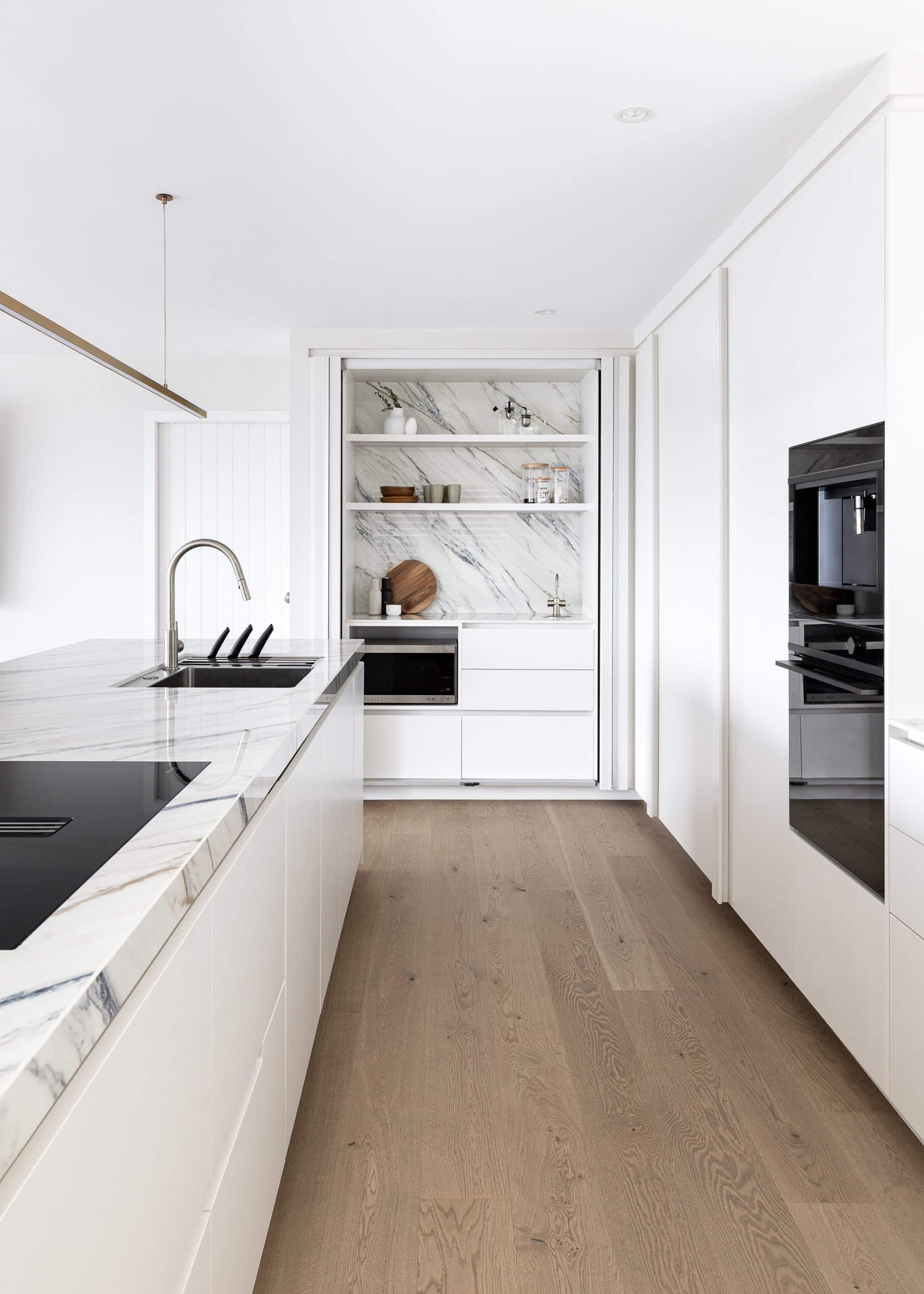
Timber Flooring with Underfloor Heating NZ: Complete Guide

Timber Flooring with Underfloor Heating NZ: Complete Compatibility & Install Guide

Quick answer: Engineered European oak is the only timber flooring suitable for underfloor heating in New Zealand. Keep the floor surface temperature under 27°C, glue the planks down for best heat transfer, and choose a multi-ply construction with the right thickness-to-width ratio. Solid timber, bamboo and most softwoods will cup or gap. Vienna Woods supplies UFH-rated engineered oak from $99/m² supplied, with installation expertise across Auckland.

This guide covers everything that matters: surface temperature limits, hydronic vs electric systems, glue-down vs floating installation, plank-width rules, subfloor commissioning, finish choice, and the failure modes to avoid. Written for NZ conditions, NZBC compliance, and the specifiers and homeowners who actually have to live with the result.
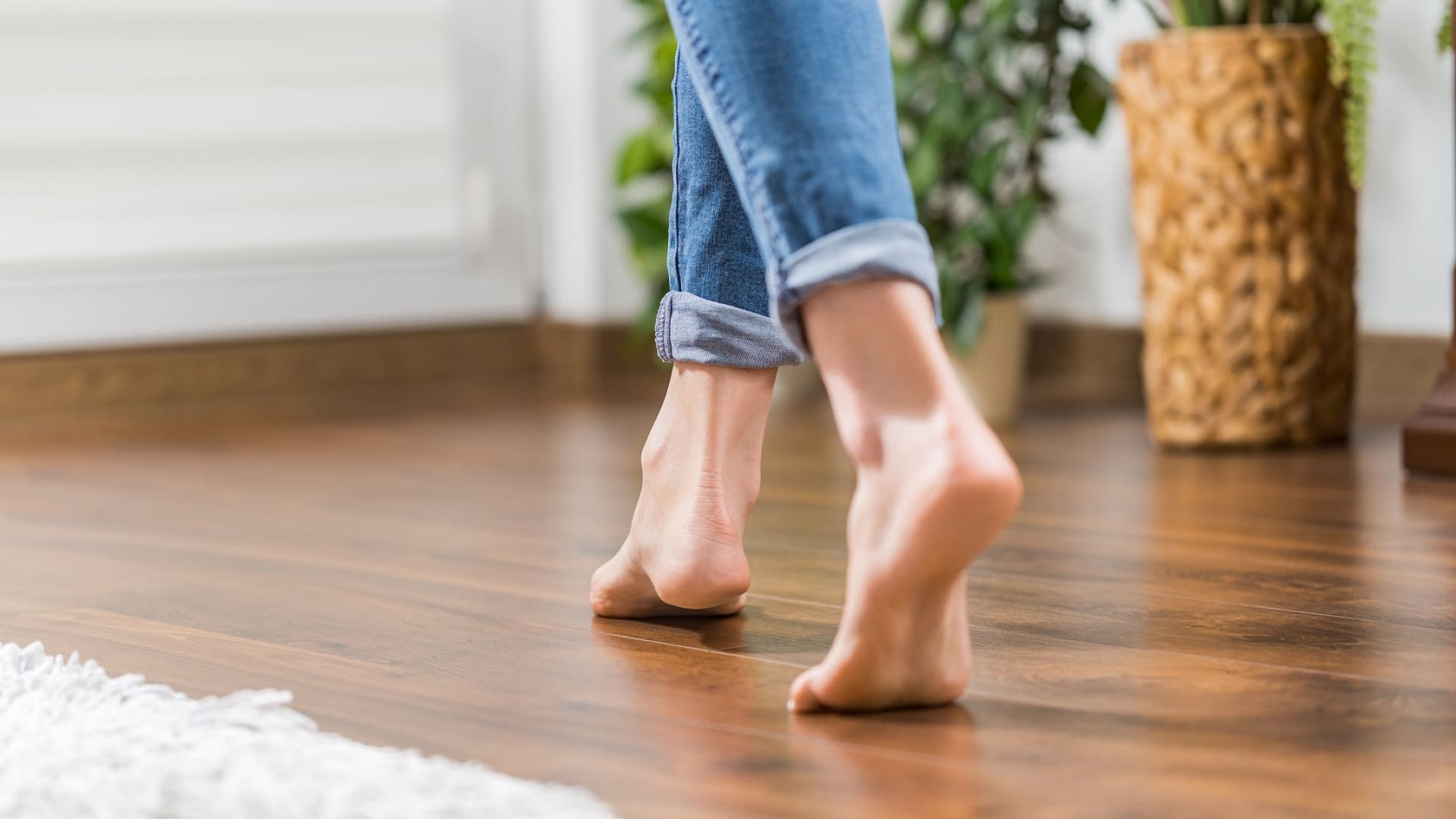
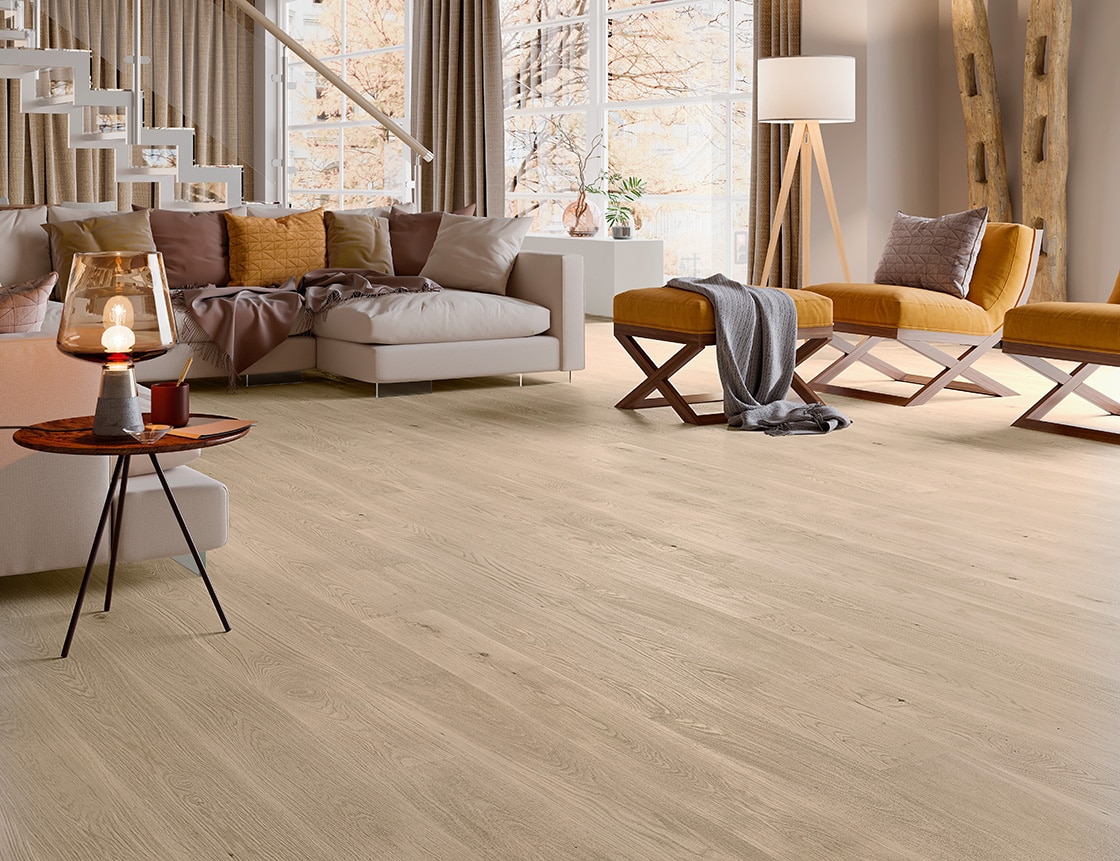
Wide-plank engineered European oak flooring in an Auckland living room with hydronic underfloor heating

Why engineered timber is the only safe choice over underfloor heating

Underfloor heating cycles a floor through 15–25°C of temperature swing, day after day, year after year. That cycling is what kills the wrong kind of timber. Solid hardwood, bamboo, softwoods, and most reclaimed boards expand and contract with every heating cycle. Within a season or two you get cupping along the board edges, hairline gaps between planks, finish cracking around joints, and in severe cases delamination of the wear surface from the substrate.

Engineered European oak solves this with multi-ply construction. A typical Vienna Woods board is 15mm with a 4mm sawn oak wear layer bonded across a cross-laminated plywood or HDF core. Each ply runs at 90° to the next, so when one layer wants to expand sideways, the adjacent ply mechanically restrains it. The result is a board that moves roughly 70% less than equivalent solid timber under the same humidity and temperature swing — the difference between a floor that lasts 30 years over UFH and one that fails inside two winters.

This is the same reason engineered is the standard call for NZ apartment, commercial and architect-spec work. Read the construction details on our Engineered Timber Flooring NZ guide, or compare construction types on the Engineered vs Solid Timber Flooring NZ deep-dive.

What does NOT belong over UFH

  • Solid hardwood (19mm+ oak, ash, walnut) — moves too much, voids most warranties when installed over heating.
  • Bamboo — manufacturers’ UFH suitability claims vary widely; many strand-woven bamboos cup unpredictably.
  • Reclaimed timber boards (non-engineered) — beautiful but dimensionally unstable; reclaimed engineered options exist and are a different conversation.
  • Softwoods (pine, rimu, matai) — even when sourced as solid boards, the moisture cycling will open joints within a heating season.
  • Laminate marketed as “wood” — not actually timber; thermal performance and longevity over UFH is poor.

The 27°C rule: maximum floor surface temperature

The single most important number in this entire guide is 27°C. That’s the maximum permitted floor surface temperature for engineered timber over underfloor heating. Not the room air temperature on the thermostat — the actual surface of the timber, measured by a sensor probe between the substrate and the board.

The 27°C cap exists because above that temperature, the moisture content of the wear layer drops below the level the board was milled at, and you start getting visible movement: hairline gaps, finish stress, edge curling. Below 27°C, expansion and contraction stays within the tolerance the multi-ply core can absorb. Some premium European oak ranges are tested and warranted to 29°C — useful in cold-climate parts of the South Island — but 27°C is the safe NZ default and the figure most warranties hinge on.

Practically, this means:

  • The UFH system needs a floor sensor probe (separate from the room air thermostat), wired to a controller with a hard temperature limit.
  • The water flow temperature in a hydronic system is usually capped around 45–50°C — well above 27°C surface, because the screed and floor finish are heat sinks that dissipate the differential.
  • Avoid covering heated areas with thick rugs, full-coverage furniture pads or insulated furniture bases. They trap heat locally and push the timber surface above the limit even when the system is running normally.
  • Avoid placing built-in cabinetry directly over heated zones. The cabinet acts as an insulator; the timber under it overheats and warps.

Floor surface temperature is non-negotiable. Every engineered timber warranty over UFH is conditional on it being respected.

Hydronic vs electric underfloor heating: which is better with timber?

Both work with engineered timber if specified correctly. They have different strengths.

Factor Hydronic (water) Electric (resistance mat)
Temperature profile Lower, smoother — easier on timber Higher peak, faster swings — needs careful limiting
Best for Whole-home, 80m²+, new builds Single rooms, retrofits, bathrooms, kitchens
Install in concrete slab Yes — embedded loops in screed Yes — mat under tile bedding or in topping screed
Install over timber subfloor Yes — spreader plates between joists Yes — thin mat above subfloor with self-leveller
Running cost (NZ) Lowest, especially with air-to-water heat pump Higher per kWh; mitigated by smaller heated zones
Install cost Higher upfront — pumps, manifolds, screed Lower upfront — simpler hardware, faster install
Response time Slow (hours) — relies on thermal mass Fast (30–60 min) — direct radiant
Timber compatibility Excellent — gentle, even heat Good — provided floor sensor and limit are set correctly

For new-build NZ projects with engineered timber across the main living area, hydronic is the default architectural call. The slow, even, low-temperature delivery is exactly what timber wants. Pair with an air-to-water heat pump and the running-cost gap over electric typically pays back the install premium within 3–5 years.

For renovations, single-room upgrades or bathroom-and-ensuite zones, electric makes sense. The key is a properly commissioned floor sensor with a 27°C hard limit programmed at the controller — not a software setting the user can override.

One bias worth flagging: if your installer wants to put electric mats in a 60m² open-plan living area, ask why they’re not quoting hydronic. The running cost difference at that scale is significant and the smoother temperature profile is better for the floor.

Glue-down vs floating installation over UFH

For UFH, glue-down is the recommended install method in almost every case. The reasons are physical, not commercial:

  • Thermal conductivity. A glued board is in direct, gap-free contact with the substrate. Heat passes through the adhesive layer and into the board with minimal loss. A floating floor sits on a foam or rubber underlay — that underlay is, by design, a thermal insulator. You lose 10–25% of the heat output before it ever reaches the room.
  • Dimensional control. A glued board cannot move independently of the substrate. The adhesive resists the small daily expansion and contraction cycles that would otherwise widen joints over time.
  • Wider planks possible. Glue-down opens the door to 180mm+ wide-plank specifications over UFH. Floating restricts you to narrower boards because the board can move under foot.
  • Acoustic performance. Glue-down with a flexible polyurethane adhesive over a thin acoustic underlay can hit IIC 50+ for apartment work. Floating systems can match this but at the cost of further reducing heat transfer.

The adhesive matters. Use a flexible, UFH-rated polyurethane (silane-modified MS or pure PU) such as Parabond 440 or equivalent — never a hard-set epoxy or PVA-based glue, which will crack under thermal cycling. Trowel coverage should give 100% transfer to the back of the board with no voids.

When floating still makes sense

  • Renovation projects where lifting the existing floor would damage the slab or trigger asbestos compliance work.
  • Click-system engineered floors with a manufacturer-certified UFH underlay (the underlay must be specifically rated — generic 3mm foam will trap heat and overheat the board).
  • Short-term tenancies or stage-set installs where the floor is intended to be lifted and reused.

For any permanent installation over UFH, glue-down is the right call.

Plank dimensions that actually work over UFH

Width matters more than thickness. The industry rule is the thickness-to-width ratio: for stable performance over UFH, the ratio should sit between 7 and 11. Some examples:

Construction Width Ratio UFH suitability
14mm engineered 140mm 10 Excellent — sweet spot
14mm engineered 180mm 13 Good with high-quality multi-ply core
14mm engineered 220mm wide-plank 16 Possible with certified product + glue-down only
15mm engineered 220mm 15 Good with European-grade construction (e.g. Admonter)
20mm engineered 260mm wide-plank 13 Premium specifications — works with verified installer
19mm solid oak 120mm 6 Not recommended over UFH (any width)

The number to focus on: anything above ratio 11 needs the manufacturer’s explicit UFH certification, and a glue-down install. Vienna Woods’s wide-plank ranges from Admonter and the Distilled Collection are tested and warranted for UFH at the widths shown. Read more on wide-plank flooring and the technical limits.

Format: straight plank, herringbone, chevron

All three work over UFH in engineered oak, but with different cautions:

  • Straight plank — the easiest case. Joints run with the board length and tolerate small movement well.
  • Herringbone parquet — works well with engineered blocks (typically 90mm × 600mm or similar). The block-on-block geometry actually distributes thermal stress better than long planks. Allow a 15% wastage rather than the 10% used for straight lay.
  • Chevron parquet — works, but is the most demanding. The mitred ends are the most movement-sensitive joints in any timber floor; UFH cycling will reveal poor adhesive choice or rushed acclimatisation. Use only with experienced installers and tested adhesive systems.

Subfloor preparation and UFH commissioning before timber goes down

This is the step most cowboy installs skip and most failures trace back to. The UFH system has to be fully commissioned before the timber arrives on site. Skip it and you’ll be lifting the floor at year two.

The commissioning protocol

  1. Wait for the screed to cure. Cementitious screed needs roughly 1mm per day of curing for the first 40mm and 2mm per day above that — call it 4–6 weeks for a typical 65mm UFH screed. Anhydrite (calcium sulphate) screed cures faster.
  2. Initial heat-up. Start the system at a flow temperature of 25°C (or the screed manufacturer’s specified starting temperature). Hold for 3 days.
  3. Ramp. Raise flow temperature by no more than 5°C per day until you reach the maximum design temperature.
  4. Hold at maximum. Run at maximum design flow temperature for at least 3 days, ideally a full week.
  5. Cool down. Reduce by 5°C per day back to ambient.
  6. Dry off and test. Switch the system off for at least 48 hours, then test screed moisture content. Concrete should read ≤2% CM (carbide method) or ≤75% RH for engineered timber installation. Anhydrite should read ≤0.5% CM.

This cycle does two things: it relieves the thermal stress in the screed (so it doesn’t crack later under timber), and it drives out the residual construction moisture that would otherwise migrate up into the boards.

Vapour barrier and DPM

NZ Building Code clause E3 covers internal moisture. Over a ground-bearing concrete slab, a damp-proof membrane (DPM) is required to prevent slab moisture wicking into the timber. The DPM goes between the slab and the timber, with seams taped and dressed up the perimeter. Many UFH systems already include this layer — confirm with the system installer.

Acclimatising the timber

Once the screed is dry and the UFH commissioned, the timber needs to acclimatise on site at a steady 18–22°C and 35–55% RH for 5–7 days before installation. Run the UFH at a low setting (around 18°C floor surface) during this period to keep conditions stable.

Lacquered or oiled finish over UFH?

Both work. They behave differently.

Lacquered (UV-cured polyurethane): a hard, sealed surface. Very tolerant of UFH because the finish itself doesn’t move with the timber underneath. Easy to clean, durable for high-traffic areas. The trade-off is that when it eventually wears through, you’ll need to sand and re-lacquer the whole floor; spot repair is difficult.

Oiled (natural hardwax oil): the oil penetrates the wood rather than sealing the surface. Spot-repairable — scratches and worn patches can be re-oiled in place without sanding the whole floor. Needs maintenance re-oiling every 12–24 months in high-traffic zones. Slightly more sensitive to UFH because oxidative finishes can dry out faster under heat — keep humidity ≥35% to compensate.

For most NZ kitchens and family living areas with UFH, lacquered is the easier specification. For heritage spec work, designer projects and rooms where the natural matt look matters more than ease of care, oiled is fine over UFH provided the floor surface temperature limit is honoured. The full breakdown is on our Oiled vs Lacquered Timber Flooring NZ guide.
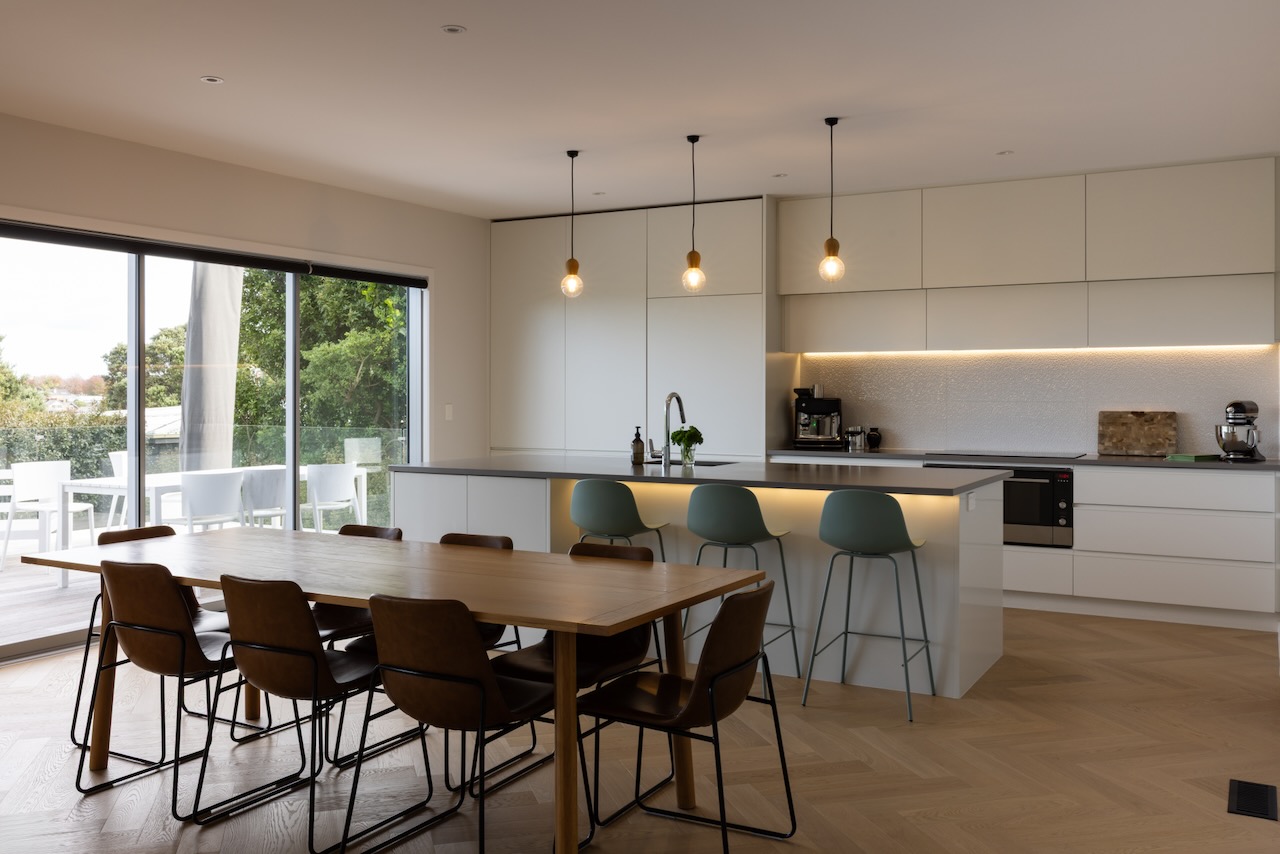
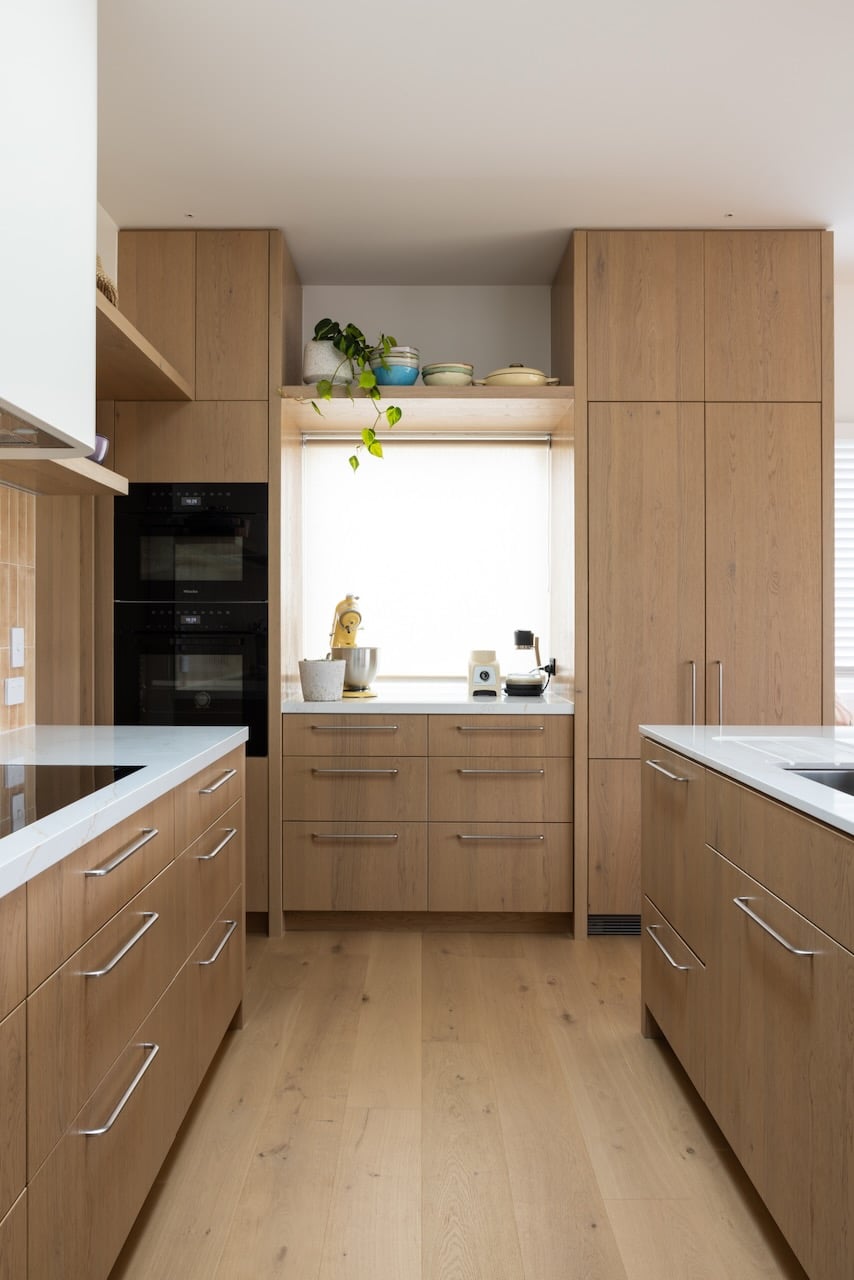
Engineered European oak flooring with lacquered finish in a heated NZ kitchen

What goes wrong over UFH — and how to avoid it

Most UFH-timber failures fall into one of five categories. All are preventable.

Cupping

The board curls at the edges, leaving a concave surface. Caused by moisture imbalance between the bottom and top of the board — usually because the screed wasn’t fully dry at install or the DPM is missing/damaged.

Avoid by: insisting on a CM moisture test before installation, never installing onto a screed that hasn’t completed the commissioning cycle, and using a correctly specified DPM.

Gapping between boards

Hairline (or worse) gaps appear between planks during heating season, sometimes closing again in summer. Caused by surface temperature exceeding 27°C, low ambient humidity drying out the boards, or boards installed without proper acclimatisation.

Avoid by: floor sensor with a hard 27°C limit, ambient humidity managed to 35–55% (a humidifier may be needed in dry winters), and on-site acclimatisation before install.

Finish cracking or delamination

The lacquer or wear surface separates from the timber underneath, usually along board edges. Caused by repeated overheating cycles or use of a finish not rated for UFH.

Avoid by: using a UFH-rated finish system (any reputable European engineered floor will be), and again, respecting the surface temperature limit.

Squeaks and clicking

Floating floors over UFH that develop popping or clicking when the heating cycles. Caused by friction between the board underside and the underlay as the floor expands and contracts.

Avoid by: glue-down installation. This failure mode mostly disappears with a properly glued floor.

Adhesive failure

Boards lift or develop hollow spots. Caused by using the wrong adhesive (hard-set, non-flexible) or by trowelling at insufficient coverage.

Avoid by: specifying a UFH-rated flexible polyurethane adhesive, full-coverage trowel, and an installer who routinely works with engineered timber over heating.

NZ-specific considerations

UK and European UFH guides translate directly to NZ in most respects. A few things are different here:

  • Auckland humidity cycling. Indoor humidity in Auckland can swing from 70%+ in summer to under 30% in winter when central heating is running. Engineered oak handles this if the surface temperature is controlled, but it’s why solid timber over UFH in NZ fails faster than the same product would in central Europe.
  • NZBC E3 (internal moisture). Concrete slabs over ground require a DPM regardless of UFH; with UFH, the DPM is doubly important because the heating system will accelerate any moisture migration.
  • Acoustic compliance. Apartment and multi-residential work often requires IIC 50+ impact insulation. Glue-down engineered oak with a thin acoustic underlay (e.g. Mapesonic 2) hits this rating without sacrificing UFH heat transfer.
  • Heat-pump dominance. NZ’s hydronic UFH systems are increasingly powered by air-to-water heat pumps rather than gas or electric boilers. The lower flow temperatures these systems run at (typically 35–45°C) are gentler on timber than legacy boiler-fed systems.
  • South Island vs upper North Island. South Island UFH systems generally cycle more often and run longer. Specify products warranted to 29°C surface temperature where the design heat output requires it.

Commercial and architectural specifiers should also be aware that all Vienna Woods engineered ranges are FSC Chain of Custody certified and MasterSpec listed — UFH compatibility plus sustainable specification credentials in one product. See the Commercial Timber Flooring NZ guide for fit-out and Green Star context.

Vienna Woods UFH-rated flooring: collections and pricing

Every engineered range Vienna Woods supplies is rated for underfloor heating when installed glue-down per manufacturer specification. Indicative pricing for UFH-rated supply (NZ, incl GST):

Range Construction Width range Supply price (NZD)
Foundation Collection (European-made, 2-ply) 14mm × 3mm wear 140–180mm $99–$150/m²
Mid-range European oak 15mm × 4mm wear 180–220mm $150–$220/m²
Distilled Collection (FSC slow-grown) 15mm × 4mm wear 220–260mm $220–$320/m²
Admonter (Austrian engineered) 14–20mm × 3–4mm wear 180–260mm wide-plank $220–$320+/m²
Engineered walnut 15mm × 4mm wear 180–220mm $280–$350+/m²

Installation extra: glue-down ~$85–$110/m² + GST. Acoustic underlay (where required) ~$50/m² + GST. See the full pricing breakdown on the Timber Flooring Cost NZ guide.

Every UFH-rated specification we issue includes the manufacturer’s surface-temperature certification, recommended adhesive, acoustic underlay options where applicable, and guidance on commissioning sequencing for your project.

Frequently asked questions

Can I install solid timber flooring over underfloor heating?
Generally no. Solid timber moves too much under the temperature and humidity cycling that underfloor heating creates. Even narrow, quartersawn solid oak boards specifically certified by the manufacturer for UFH carry strict installation conditions and reduced warranties. For all but heritage-restoration edge cases, engineered European oak is the right specification — roughly 70% more dimensionally stable, with full UFH warranty cover.
What is the maximum floor surface temperature for engineered oak over UFH?
27°C is the industry-standard maximum and the figure most warranties hinge on. Some premium European oak ranges (and certain Admonter products) are tested and warranted to 29°C for cold-climate applications. The temperature is measured at the floor surface itself by a sensor probe — not the room air temperature shown on a thermostat. The UFH controller must have a hard limit programmed; software-only limits the user can override are not enough.
Do I have to glue the timber down or can it float over UFH?
Glue-down is the recommended method for UFH and is the only option for wide-plank specifications above 180mm. Floating installations work for narrow click-system engineered floors with manufacturer-certified UFH underlay, but they reduce heat transfer by 10–25% and limit board width. For any permanent installation, glue-down with a flexible polyurethane adhesive (such as Parabond 440) gives better thermal performance, dimensional stability, and acoustic results.
How long should I run the heating before installing the timber?
Follow a full commissioning cycle: cementitious screed needs 4–6 weeks to cure for a typical 65mm UFH layer; then run the UFH starting at 25°C flow temperature, hold 3 days, ramp +5°C per day to maximum design temperature, hold at maximum for 3–7 days, cool back down 5°C per day, then switch off for 48 hours and test screed moisture (≤2% CM concrete, ≤0.5% CM anhydrite). Only then should the timber go down. Skipping this step is the leading cause of cupping at year two.
Is hydronic or electric underfloor heating better for engineered timber?
Both work if specified correctly. Hydronic is gentler on timber — lower flow temperatures, slower response, smoother heat profile — and is the default call for new-build whole-home applications, especially over 80m². Electric systems are simpler and cheaper to retrofit and work well in single rooms, bathrooms and ensuites, but require a properly programmed floor sensor with a 27°C hard limit. For large open-plan living areas with engineered timber, hydronic is the better long-term choice.
Can wide-plank engineered oak (180mm+) be installed over UFH?
Yes — but only with manufacturer UFH certification and glue-down installation. The thickness-to-width ratio matters: 14mm × 180mm (ratio 13) is fine with quality multi-ply construction; 15mm × 220mm (ratio 15) is widely used in European specifications including Admonter; 20mm × 260mm wide-plank works in premium projects. Floating installations are not suitable above 180mm width over UFH. The CAB Residences project in Auckland CBD uses 700m²+ of UFH-rated wide-plank engineered oak as the reference example.
Is herringbone or chevron parquet OK over underfloor heating?
Both work in engineered oak. Herringbone is the easier of the two — the block-on-block geometry actually distributes thermal stress better than long planks. Allow 15% wastage instead of the standard 10% straight-lay figure. Chevron is more demanding because the mitred joints are the most movement-sensitive joint in any timber floor; specify only with experienced installers and tested adhesive systems, and budget 20% wastage. Both should be glue-down and never floating over UFH.
Will my timber floor crack or gap with seasonal heating cycles in NZ?
A correctly specified engineered European oak floor with a 27°C surface limit, glue-down installation, and ambient humidity managed to 35–55% will not develop visible gaps or cracks across normal seasonal cycling — including Auckland’s swing from humid summers to dry winters. Hairline gapping during winter is usually a sign of overheating (sensor or limit issue) or very low ambient humidity (a humidifier may be needed). Solid timber over UFH, by contrast, will gap noticeably most winters in NZ conditions.

Related Vienna Woods guides

Ready to specify timber flooring with underfloor heating?

Order free samples to test colour and grade in your space, book a Newmarket showroom consultation to talk through UFH compatibility for your project, or request a project quote — we’ll match the right engineered oak specification to your heating system and substrate.

Order samples   Book consultation

Vienna Woods — Auckland’s specialist supplier and installer of engineered European oak timber flooring. FSC Chain of Custody certified. MasterSpec listed. Trading since 2009.
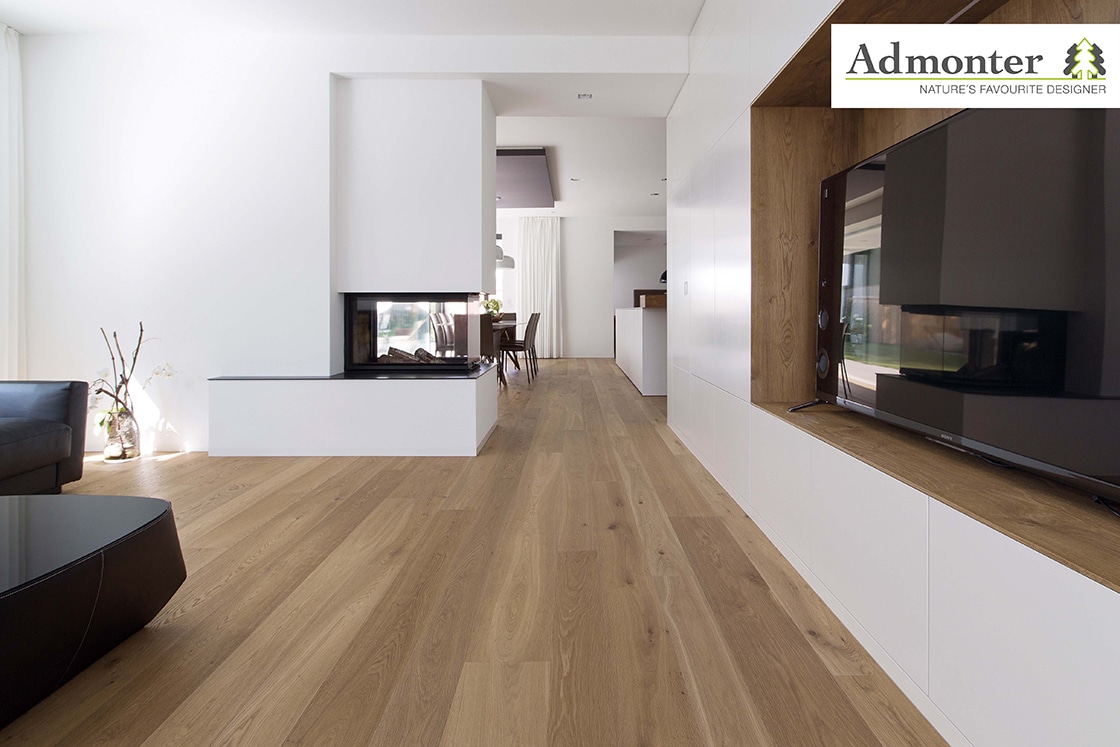
Latest Timber Flooring Trends

COLOUR TRENDS / AGED WOOD / TEXTURES / FINISHES

COLOURS

Almost anything goes these days in terms of fashionable wood flooring colours; here are some of the trends we’re seeing on a consistent basis:

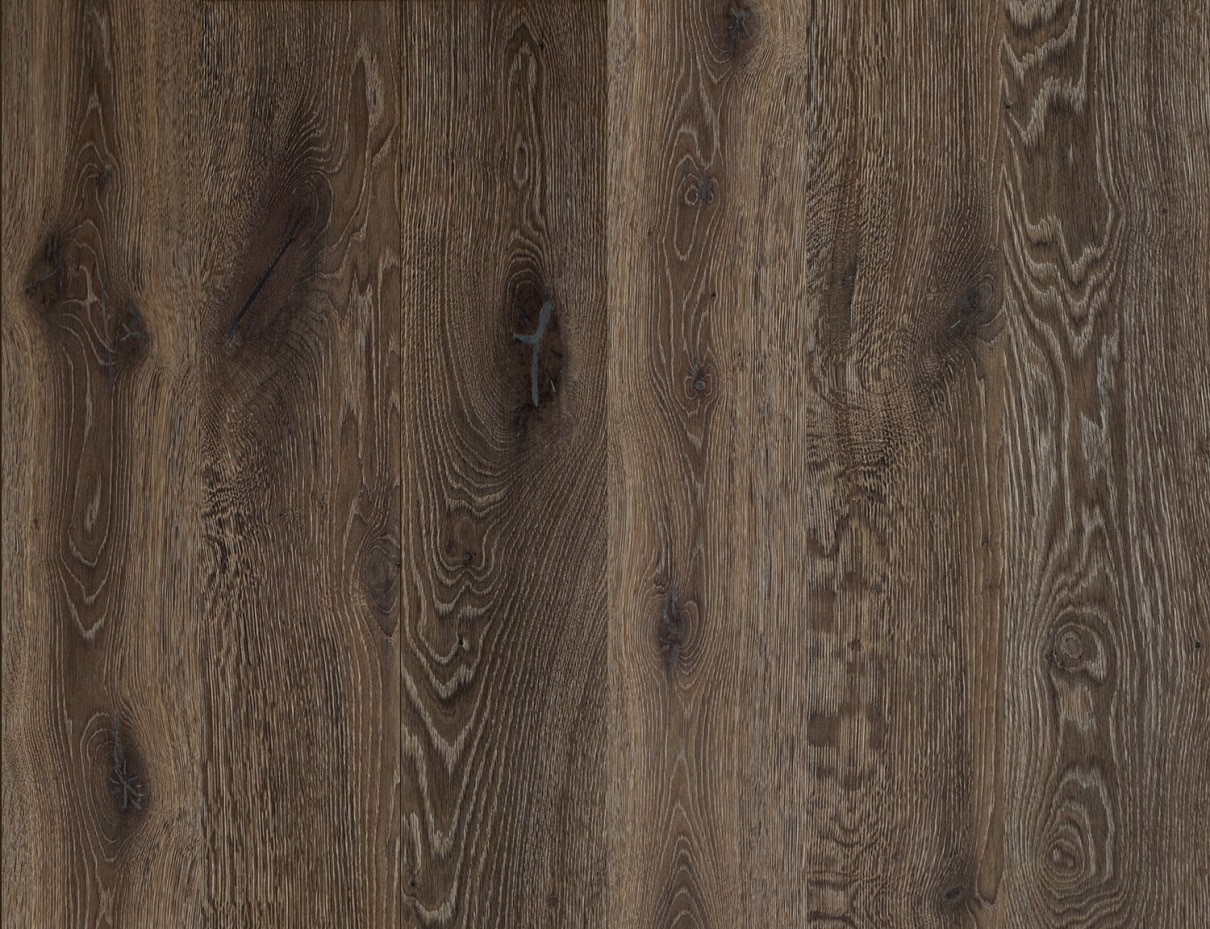
Light beige or light brown colours with grey under tones are popular; also mid-brown/grey, especially in smoked oak which brings a unique depth of colour to the flooring. See Imperial Oak, or Empire Oak, for example.

Smoked Oak – Admonter Oak Seta

Colours suitable for a Scandi-inspired interior are still popular; such as off-whites, cream and natural tones without too much yellow. Oak Cashmere is a good example of a neutral ‘Natural’ tone.

Nordic Inspired – Oak Cashmere

Dark and moody flooring has definitely made a strong return. An example of this is Oak Moonlight which is an oiled finish featuring dark hues and an attractive aged appearance. See also, Oak Onyx if you love extra wide boards.

Dark & Moody – Oak Moonlight

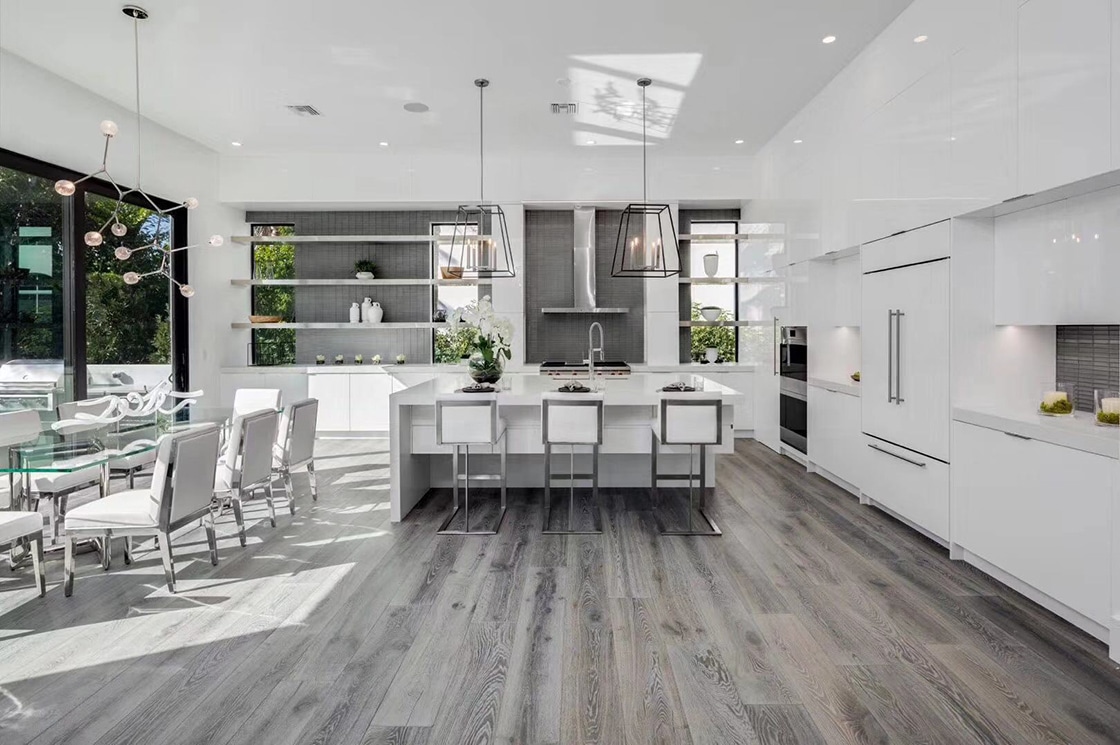
Grey tones continue to be popular, as it works exceptionally well with most other decors and provides a sophisticated foundation to your interior. Popular grey colours include Oak Karkula, Oak Constance and Admonter Oak Grey.

Sophisticated Grey – Chateau Oak Constance

AGED WOOD

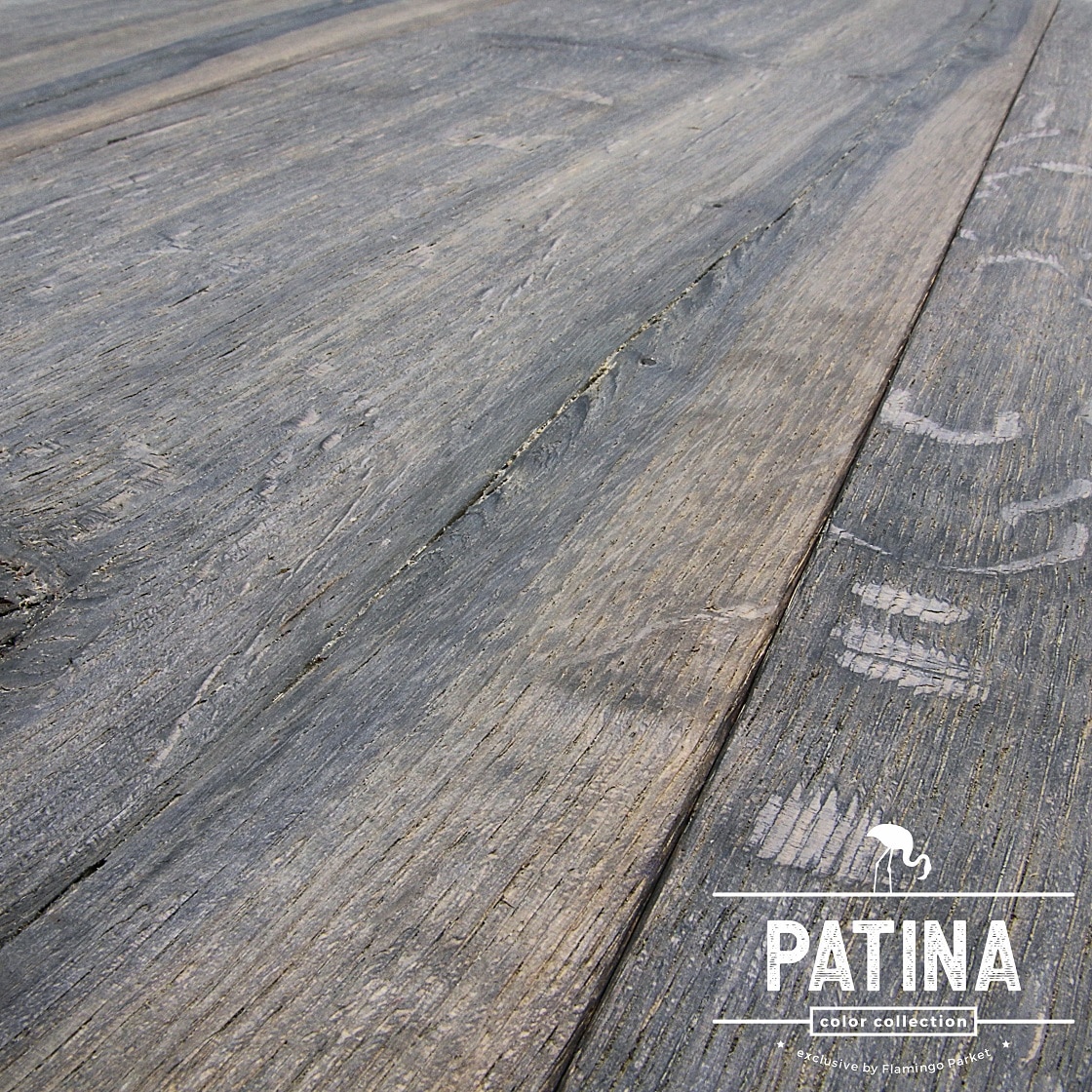
There are a range of methods used to age the wood; speciality wood stains that react with the tannin to subtly age the wood are very popular. See our Chateau or Raftwood Patina ranges for examples.

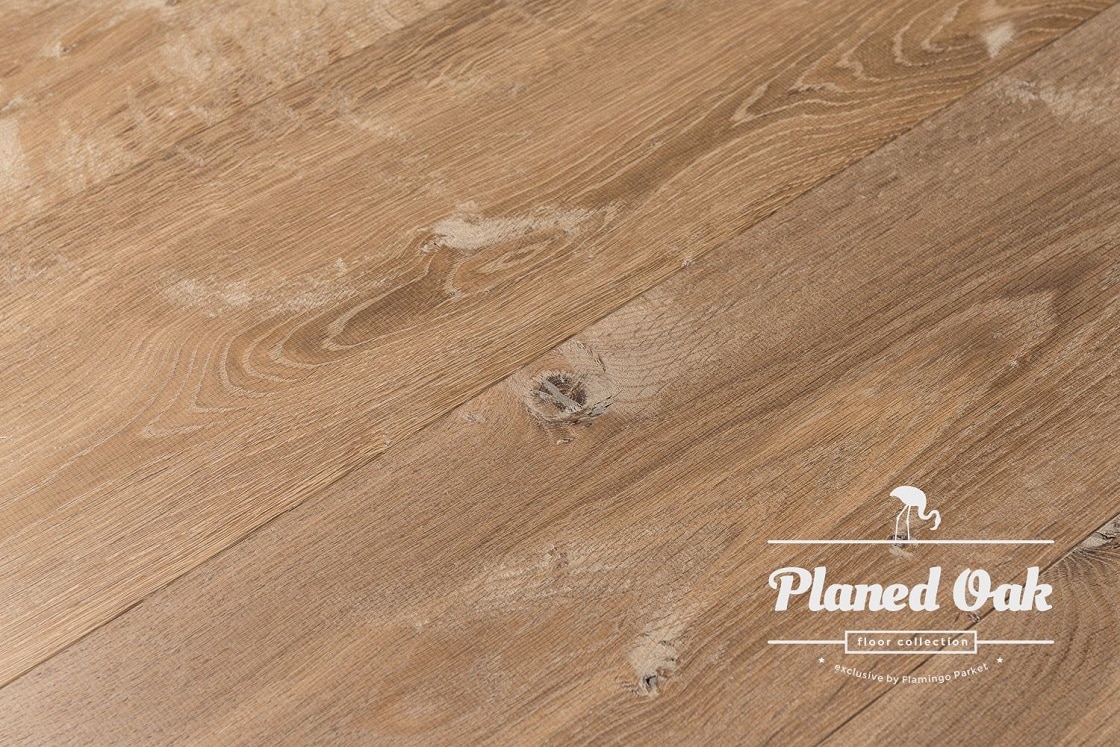
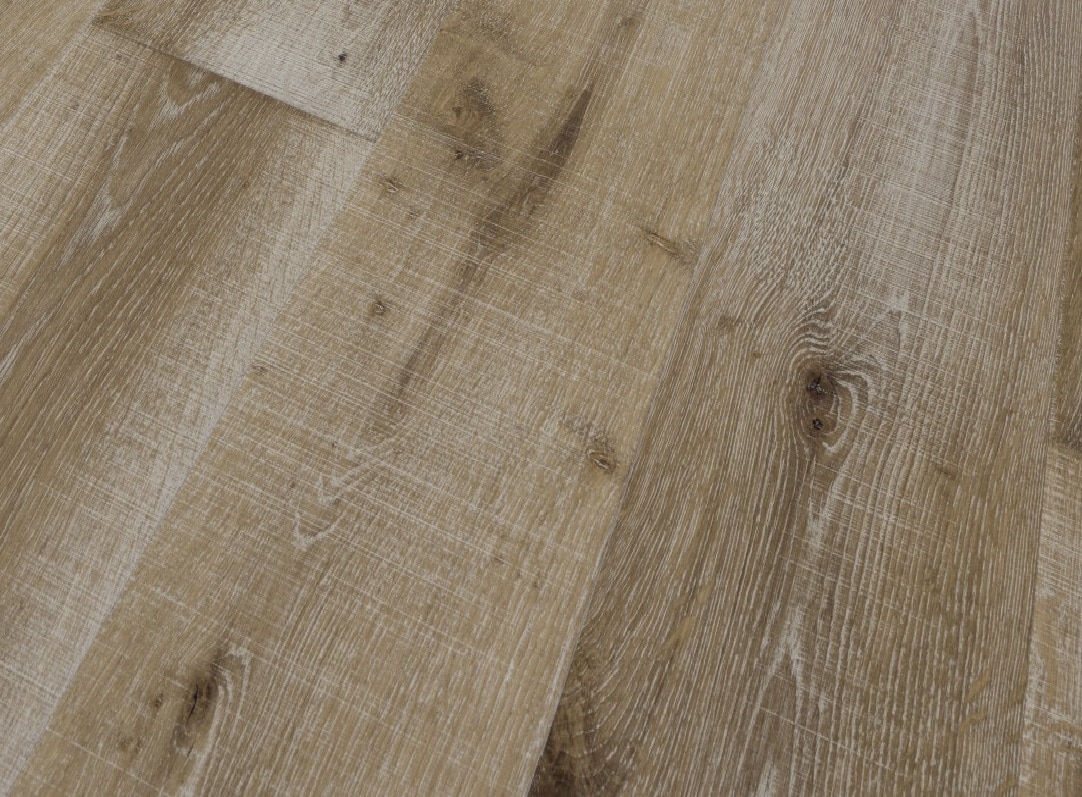
Other ways of aging the wood include scraping, planing, smoking, distressing, variable band saw such as the ‘used’ texture, or sourcing reclaimed wood.

Aged ‘Reactive Stain’ oak – Patina Old Barn

Subtle Aged Effect – Planed Oak Oeral

APPEALING TEXTURES

Texture brings an interesting, natural element to the interior.

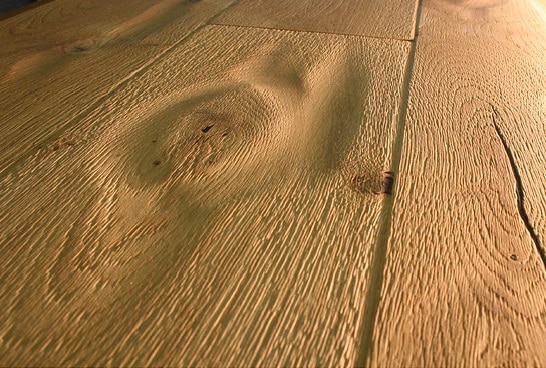
Lengthwise brushing that subtly highlights the woodgrain will always be popular, however we’re seeing more demand for unique textures such as the ‘Used’ texture, which is a subtle variable bandsaw available in Oak Prairie, Oak Marshall or Oak Whisky.

Variable Bandsaw – Oak Prairie Used Texture

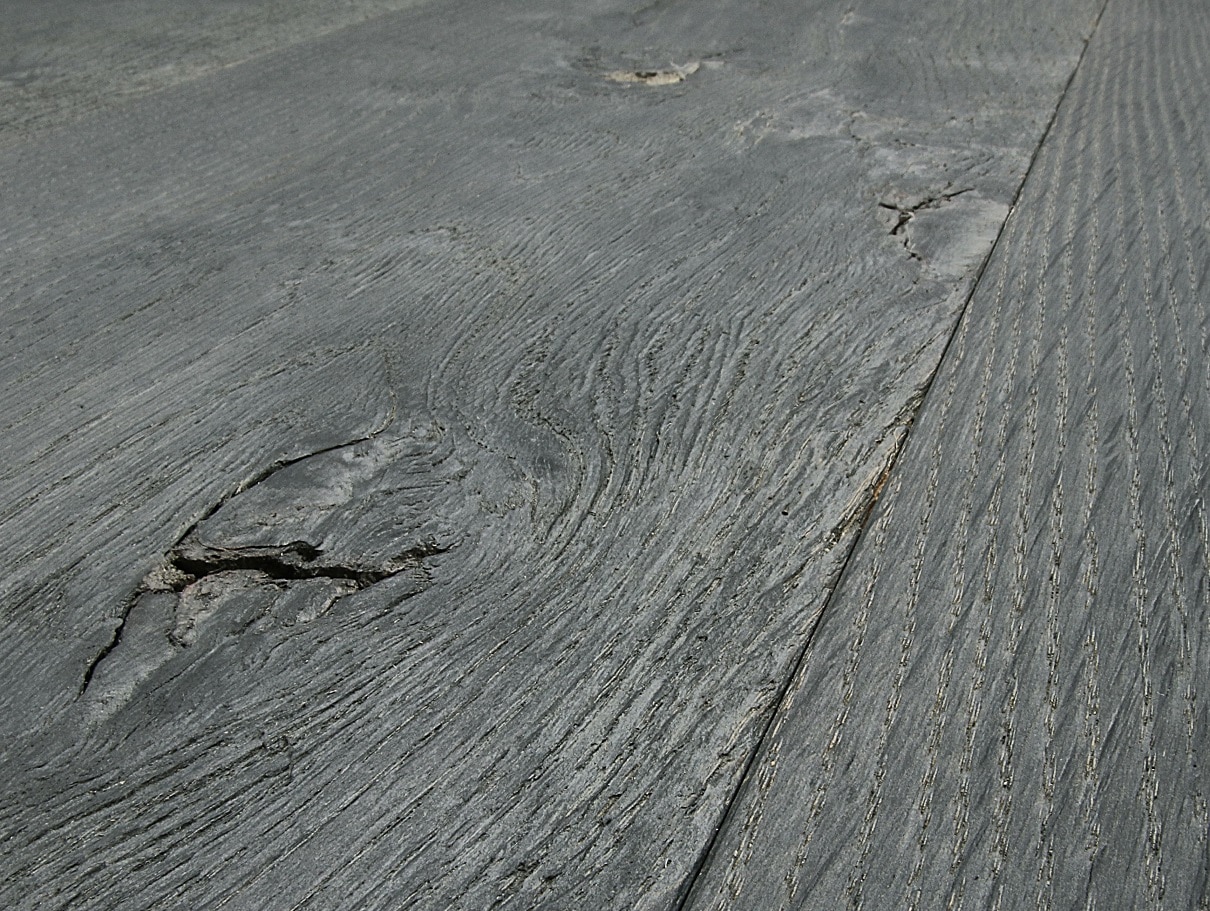
The Authentic texture from Admonter is a real head turner. The wood surface mimics the organic structure of the tree itself. Authentic is available in both oak and larch.

Oak Authentic

Alternatively, reclaimed wood such as Raftwood reclaimed Dutch railway sleeper oak flooring, features a very natural and distinctive texture.

Reclaimed Dutch Railway Sleeper Oak – Raftwod Patina The Brick

EXTRA NATURAL APPEARANCE

Every year we see new releases from our suppliers, in more and more natural finishes. The aim is to provide oil and lacquer finishes so natural that you cannot see any visible finish.

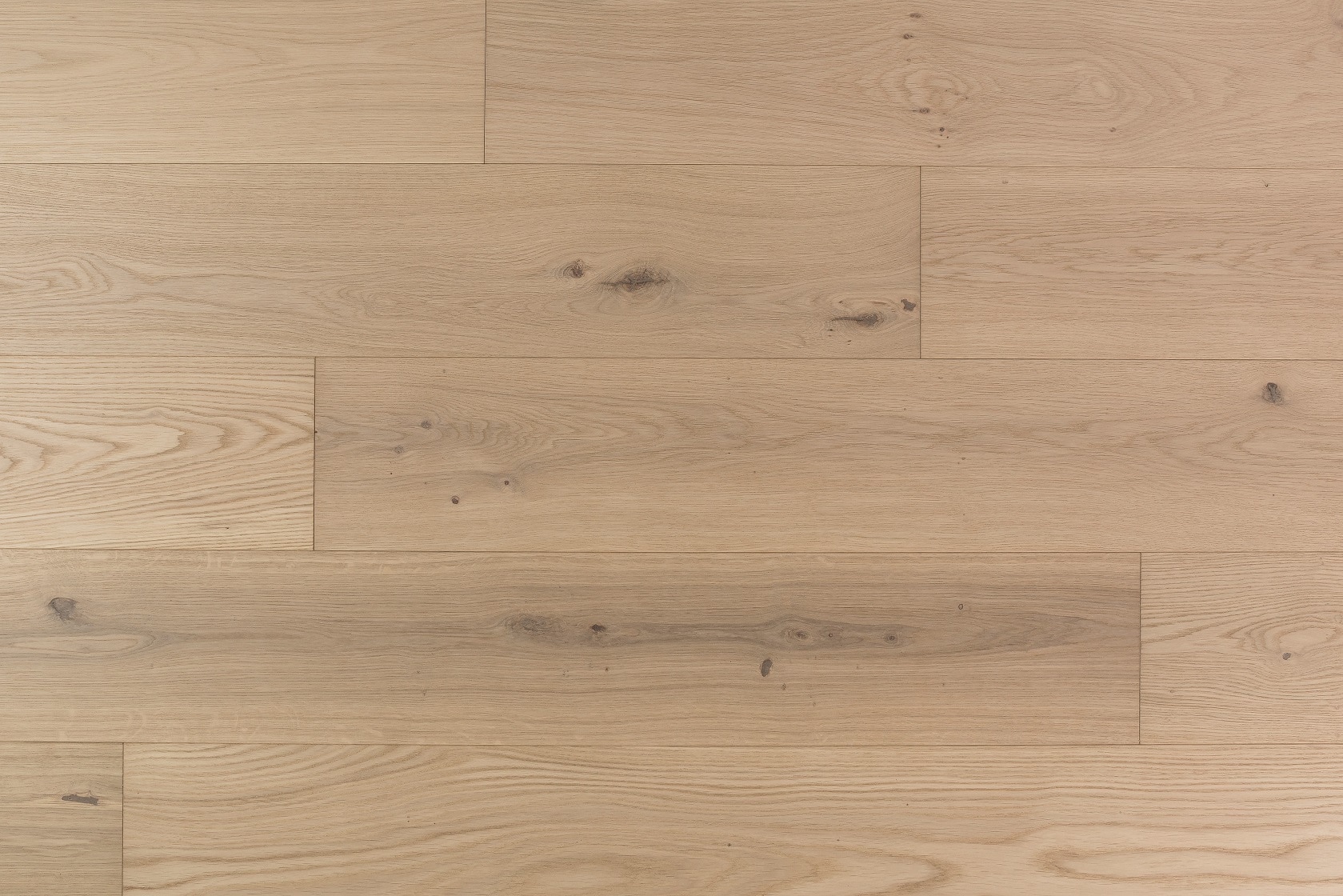
A great example is Oak Natura from Admonter which captures a raw wood optic.

The Admonter Natura finish is available in two options, Oak Natura and Oak Smoke Natura.

Admonter Oak Natura

Another popular, extremely natural looking wood floor is American Oak Pureline from ESTA Parket. This is finished with an invisible Supermatt lacquer.

American Oak Pureline

Sustainable Timber Flooring

Quick answer: The most sustainable timber floor available in NZ is engineered European oak with credible certification. An engineered board uses a 4mm oak wear layer over a fast-grown ply core, so the same slow-grown oak goes four to five times further than in a 19mm solid board — and a quality floor lasts 25–30+ years. Vienna Woods holds FSC Chain of Custody certification, and the Distilled Collection is FSC-certified with forest-to-floor traceability. Here is what those claims actually mean, and how to verify them on any flooring quote.

Managed European forest — the source of slow-grown oak for sustainable engineered timber flooring

Why engineered construction is the sustainable choice

Sustainability in timber flooring is mostly a resource-efficiency question. A solid 19mm oak floor is 19mm of slow-grown hardwood; an engineered board carries a 4mm oak wear layer bonded to a multi-ply core of fast-growing softwood. From the same oak log, engineered construction produces roughly four to five times more flooring — with better dimensional stability in NZ conditions as a bonus, not a trade-off.

Longevity compounds the gain. A 4mm wear layer takes two to three re-sands over a 25–30+ year life, and an oiled floor that gets regular maintenance oil top-ups may never need a full sand. A floor you refinish instead of replace is the most under-rated sustainability feature there is.

FSC Chain of Custody — what it actually certifies

“FSC certified” gets used loosely. The claim that matters is Chain of Custody (CoC): an unbroken, independently audited chain of certificate holders from the forest to the company that sells you the floor — forest manager, sawmill, flooring factory, importer. If any link in the chain lacks its own certificate, the claim breaks. Vienna Woods holds FSC Chain of Custody certification, which is what allows FSC-certified product — like the Distilled Collection of slow-grown European oak — to be sold in NZ with the claim intact.

How to verify any supplier’s claim, ours included: ask for their FSC CoC certificate code and check it on the FSC public database (info.fsc.org), and confirm the FSC claim appears on the sales invoice for your specific product line. A showroom poster is not a chain of custody.

Green Star — where certified timber earns credits

For Green Star projects in NZ, timber must carry credible third-party certification (FSC or PEFC) to contribute toward responsible-products credits — uncertified timber doesn’t qualify, whatever its origin story. This is why FSC traceability is increasingly a hard requirement in commercial tenders, not a nice-to-have. Vienna Woods is MasterSpec listed with NZBC-compliant technical and acoustic documentation, so specification and evidence paperwork is straightforward for project teams — see our commercial timber flooring page for the full specifier picture.

At CAB Residences — the Category A heritage tower on Aotea Square — FSC traceability and European-made specification were non-negotiable conditions of the 700m²+ wide-plank spec. That is the direction commercial procurement is moving.

A note on NABERSNZ: it rates a building’s operational energy performance, so flooring doesn’t directly affect a NABERSNZ score. Where certified timber counts is Green Star, embodied-carbon assessments and tenant ESG reporting.

Embodied carbon — timber’s quiet advantage

Growing timber absorbs CO₂, and that carbon stays locked in the boards for the life of the floor. Timber stores roughly 0.9 tonnes of CO₂ per cubic metre, so a 15mm engineered oak floor holds in the order of 13kg of CO₂ per square metre in the material itself — before comparing the manufacturing footprint against energy-intensive alternatives like ceramic tile or vinyl. For project teams running embodied-carbon assessments, environmental product declarations (EPDs) are available for our European manufacturing partners on request.

Where our oak comes from

Every Vienna Woods floor starts as slow-grown European oak from managed Central European forests, where harvest is regulated below regrowth and European Union timber legality rules (EUTR, transitioning to EUDR) apply to the supply chain. The Admonter collection is engineered and finished in Austria by a mill that runs on its own biomass energy; the Distilled Collection is the FSC-certified line. More detail on the species itself is in our European oak flooring guide.

What we don’t claim

Honest sustainability has edges. Our oak crosses the world by sea freight — that footprint is real, though small per m² relative to the floor’s decades of service life. Not every collection is FSC-certified — certified lines are identified explicitly, and we won’t put the claim on product that doesn’t carry it through the chain. And finishes matter: our floors use UV-cured lacquers and natural oils rather than site-applied solvent coatings, but “zero impact” flooring doesn’t exist. If a flooring pitch sounds like it has no trade-offs, ask for the certificate codes.

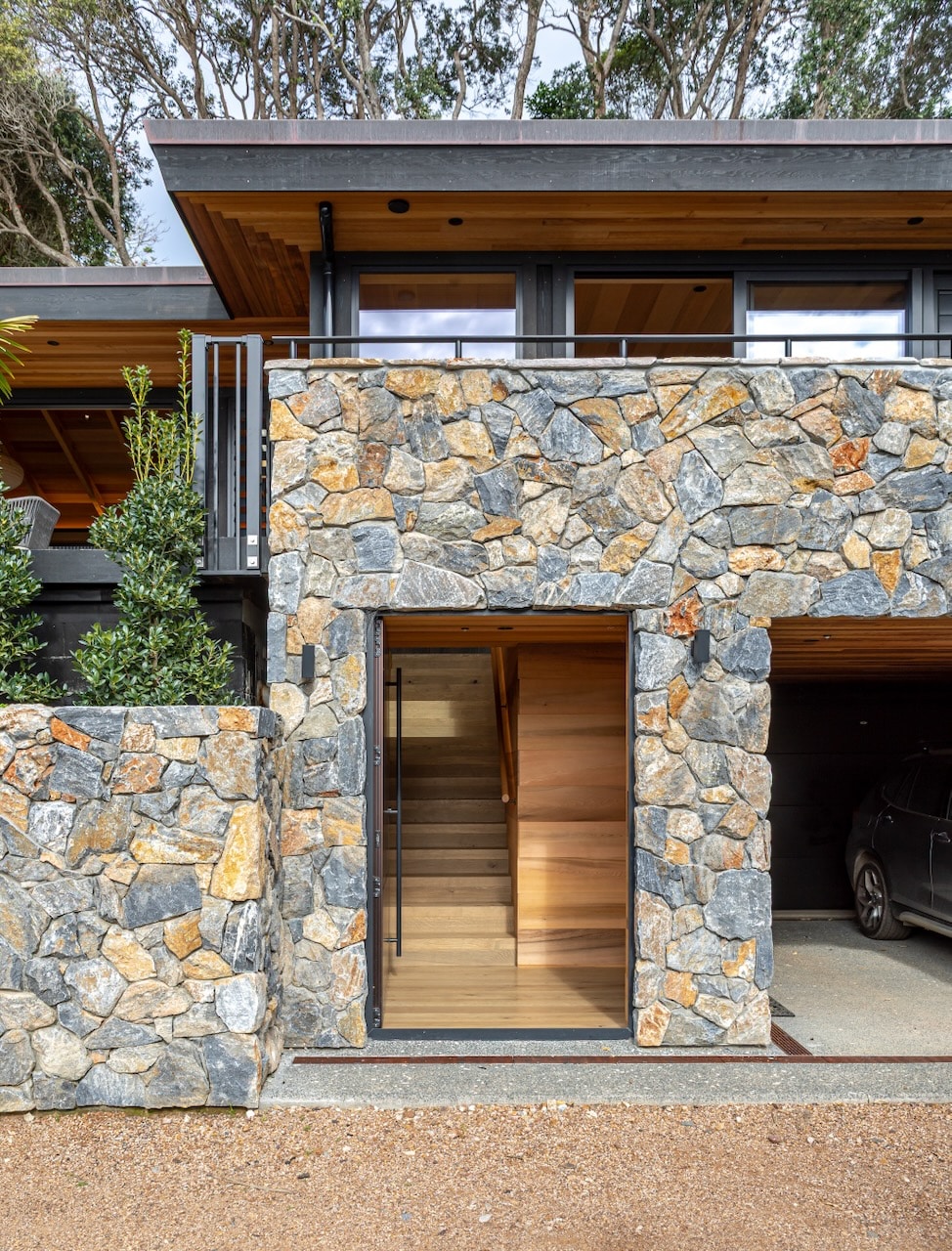
Light-filled interior with FSC-certified Distilled Collection engineered oak flooring, Waiheke Island project

Sustainable timber flooring — frequently asked questions

Is engineered timber flooring more sustainable than solid timber?
Yes, on resource efficiency. An engineered board uses a 4mm oak wear layer over a fast-grown ply core, so the same slow-grown oak produces roughly 4–5 times more flooring than 19mm solid boards — and it performs better over concrete slabs and underfloor heating in NZ conditions.
What does FSC Chain of Custody mean?
An unbroken, independently audited chain of FSC certificate holders from forest to seller — forest manager, mill, factory, importer. If any link lacks its own certificate, the claim breaks. Verify any supplier’s claim by checking their certificate code on the FSC database and confirming the FSC claim appears on your sales invoice.
Does timber flooring count toward Green Star credits in NZ?
Yes — timber with credible third-party certification (FSC or PEFC) can contribute toward Green Star responsible-products credits. Uncertified timber doesn’t qualify. Vienna Woods holds FSC Chain of Custody certification and is MasterSpec listed with NZBC-compliant documentation for project evidence.
How much carbon does a timber floor store?
Timber stores roughly 0.9 tonnes of CO₂ per cubic metre, so a 15mm engineered oak floor holds in the order of 13kg of CO₂ per square metre in the boards themselves, locked away for the floor’s 25–30+ year life.
Is all Vienna Woods flooring FSC certified?
No — and we say so. Vienna Woods holds FSC Chain of Custody certification, and certified lines like the Distilled Collection carry the claim through the full chain. Collections that aren’t certified are never sold with the claim. Ask us for certificate codes and invoice claims on any line you’re specifying.

Related Vienna Woods guides

Specifying a certified floor?

Order samples from the certified lines, or talk to us about FSC documentation, Green Star evidence and acoustic data for your project.

Order samples   Book a consultation

What Goes First – The Kitchen or the Flooring

Kitchen or flooring first? The short answer.

It depends on the installation method. If your timber floor is being floated, install the kitchen first and run the floor around (and slightly under) the cabinet end panels and kick boards. If the floor is being glued down to the subfloor, install the floor first and sit the kitchen on top.

This is the most common renovation-sequencing question we field at our Newmarket showroom — and it’s the detail most often missed in a build programme. Get it wrong and you’ll see lifting boards, scribed end panels, or extra flooring needed the next time the kitchen layout changes.

Installation method Order Why
Floating Kitchen first, then floor The floor must be free to expand and contract — fixed weight on top can cause boards to lift.
Glued down Floor first, then kitchen Cleaner finish at the cabinet base, no scribing on site, full coverage if the kitchen ever changes.

Why does the order matter?

Three things change depending on whether the floor or the cabinets go down first:

  • Movement. Engineered timber floors expand and contract with the seasons. A floating floor needs an unbroken expansion gap around the entire perimeter — including under the kitchen cabinets — to move freely.
  • Finish quality. Running the floor under the cabinets (glue-down) gives a continuous timber line at the kick board, with no on-site scribing or visible board ends.
  • Future flexibility. If the kitchen changes layout in five or ten years, a floor that runs wall-to-wall doesn’t need patching. A floor that stops at the original cabinet footprint usually does.

For most renovations using engineered European oak, we recommend the glue-down approach for these reasons — it’s the spec used in most of our commercial fit-outs and in higher-end residential projects.

Floating installation: install the kitchen first

If you’re floating your timber floor (or installing laminate), install the kitchen cabinets first and lay the floor around them.

A floating floor relies on the boards being free to move as a single sheet. Anything heavy and fixed sitting on top — kitchen cabinetry in particular — anchors that section of the floor and stops it moving with the rest. The result is buckling, gapping, or boards lifting at the joins, especially through the first summer-to-winter cycle.

The standard approach:

  1. Install the kitchen cabinets onto the bare subfloor, with end panels undercut by the floor thickness plus underlay (typically 16–20mm).
  2. Run the floating floor up to the cabinet line and slide it under the undercut end panels for a clean finish.
  3. Leave the kick boards off until the floor is laid, then fit them last so they sit on top of the floor.
  4. Maintain a 10–12mm expansion gap at all hard edges — walls, columns, doorways — concealed by skirting or scotia.

Free-standing appliances (ovens, dishwashers, fridges) sit on top of the floor — pull-out access stays clean.

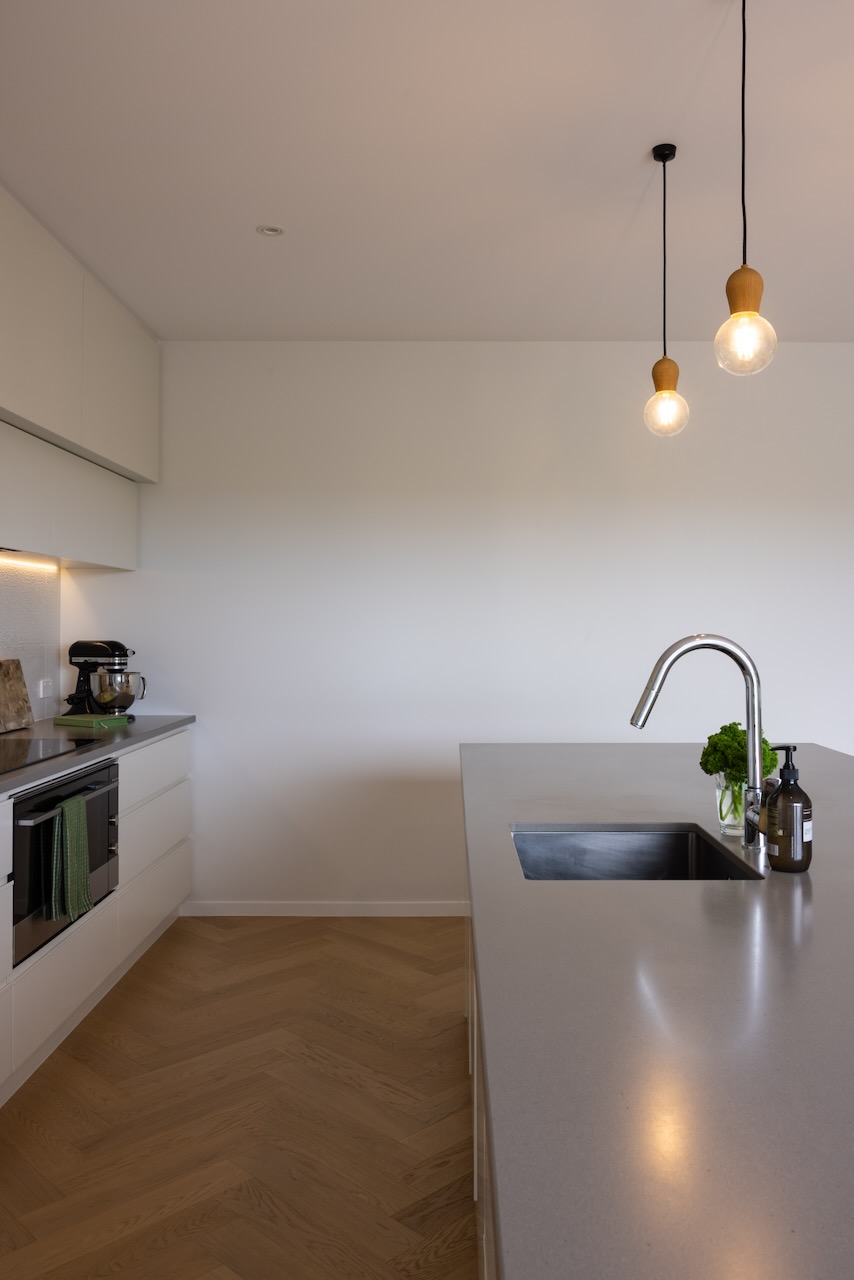
Kitchen sink and island over Bordeaux herringbone oak flooring in Westmere home

Glue-down installation: install the floor first

If your timber floor is being glued directly to the subfloor, we strongly recommend installing the floor first and letting the kitchen cabinets sit on top.

Three reasons:

  • Cleaner cabinet base. The cabinet end panels finish on the floor surface, not against it — no on-site scribing, no compromise on the line.
  • Full timber coverage. Boards run wall-to-wall. If you change the kitchen layout in future, you’re not patching the floor.
  • No expansion conflict. A glued-down floor is bonded to the subfloor and doesn’t need free movement, so kitchen weight on top is irrelevant.

Some builders prefer to install the kitchen first and butt the floor against the cabinet base — usually for programme reasons. It works, but you lose the clean finish and the wall-to-wall coverage. We’d push back on this unless there’s no other option.

Get the subfloor right before either approach

The single biggest cause of failed kitchen flooring installs isn’t the order of work — it’s a subfloor that wasn’t checked properly before the floor went down.

For engineered timber flooring in New Zealand, the working tolerances are:

  • Flatness: within 3mm over a 3m straight edge.
  • Moisture content: concrete subfloors below 75% RH (BS 8203) or below 4.5% by weight; timber subfloors at 8–14% MC.
  • No active rising damp. If you’ve had a leak or a slab pour in the last 90 days, test before specifying.

A subfloor that’s outside tolerance shows up as:

  • Hollow or springy spots underfoot, particularly in front of the dishwasher and ovens.
  • Boards that creak as you walk past the island.
  • Visible unevenness against kitchen joinery, skirtings or door frames.

This is why the installer matters. We’ve seen plenty of beautiful timber compromised by a subfloor nobody checked — and the fix after the fact is always more expensive than the prep would have been.

Bordeaux European oak timber flooring in Auckland open plan kitchen

Renovation sequencing checklist

The right order of operations for most kitchen renovations involving engineered timber flooring:

  1. Demolition — strip back to the subfloor.
  2. Plumbing and electrical rough-in — done before anything closes up.
  3. Subfloor preparation — level, moisture-test, repair where needed.
  4. Cabinet template / set-out marking on the subfloor.
  5. Then the order branches:
    • Glue-down floor → install the floor, then cabinets on top.
    • Floating floor → install the cabinets (end panels undercut), then run the floor around them.
  6. Skirtings, scotia and kick boards — fitted last in both cases.
  7. Benchtops, splashbacks, appliances — once the floor and joinery are protected.

Plan the floor delivery to allow at least 5–7 days of acclimatisation on site (in the room it will be installed) before the install date. Engineered European oak ships kiln-dried, but it still needs to settle to the room’s humidity.

What to specify for a kitchen floor

Kitchens are the highest-wear room in most homes — water spills, dropped pots, dragged stools, sun-warmed tile through bifolds, and constant foot traffic. The flooring spec needs to handle all of it.

Three things matter more than the rest:

  • Engineered, not solid. An engineered board is dimensionally stable across humidity swings; solid timber is not, and a kitchen has more moisture variation than any other room. More on engineered timber flooring NZ.
  • A hardwearing finish. A UV-cured lacquered finish is the most practical for kitchens — it shrugs off spills, doesn’t need re-oiling, and is the easiest to keep clean. See our lacquered finish options.
  • Format that suits the layout. Wide planks (180mm+) suit open-plan kitchen-living rooms; herringbone parquet works in smaller, formal kitchens where the pattern becomes part of the design.

Wear layer matters too — anything below 3mm is too thin for a kitchen. We supply a 4mm wear layer as standard across our engineered range, which gives at least one full sand-and-refinish over the life of the floor.

Where the order affects the cost

Sequencing affects the cost of a kitchen flooring install in three ways:

  • Extra timber, glue-down + floor first: covers the area under the cabinets too. Adds roughly 2–4m² depending on kitchen size, but you only do it once.
  • Cabinet undercutting, floating + kitchen first: the joiner needs to undercut end panels and leave kick boards off until the floor is in. Usually a fixed labour add, $200–$400.
  • Subfloor remediation: if it’s not flat or dry, that’s fixed before the floor goes down — typically $30–$80/m² depending on what’s needed.

For full pricing across engineered oak supply, installation methods, and format premiums, see our timber flooring cost guide for NZ.

Empire Oak wood flooring mid colour brown timber in galley kitchen MARAETAI_Kitchen

FAQ — kitchen and flooring sequencing

Should I install timber flooring under kitchen cabinets?

If the floor is glued down, yes — run it wall to wall and let the cabinets sit on top. If it’s floated, no — install the cabinets first and run the floor around them, with end panels undercut to take the floor underneath.

Do I need to install the flooring before the dishwasher?

Yes for both methods. Free-standing appliances (dishwashers, ovens, fridges) sit on top of the finished floor so they can be pulled out for cleaning or replacement without lifting boards.

Will I need to replace the floor if I change the kitchen layout later?

Not if it was glued down — the floor runs underneath, so a new layout fits straight on top. With a floating floor that stopped at the original cabinet line, you’ll need to patch in new boards wherever the new layout extends past the old one. Colour matching after a few years is rarely perfect, so this is a real cost to plan for.

What height should the cabinet kick boards be?

Typically 100–150mm, but more importantly the joiner needs to leave them off until the floor is laid (floating method). Kick boards are then fitted on top of the finished floor so the line runs cleanly across both.

Can the floor and the kitchen joinery be the same colour?

They can, but matching exactly is hard — different timber species, finish chemistry and grain direction read differently. Most designers we work with deliberately contrast the two: a warm engineered oak floor against a painted or stained joinery, or vice versa.

How long should the timber acclimatise before installation?

At least 5–7 days in the room it will be installed, in the boxes, with HVAC running at normal occupancy levels. Engineered European oak is more stable than solid, but it still needs to settle to the site’s humidity before it’s nailed or glued in place.

Plan your kitchen flooring with us

We supply and install engineered European oak across Auckland. If you’re sequencing a kitchen renovation and want to get the order right, the install method right, and the spec right — talk to us.