
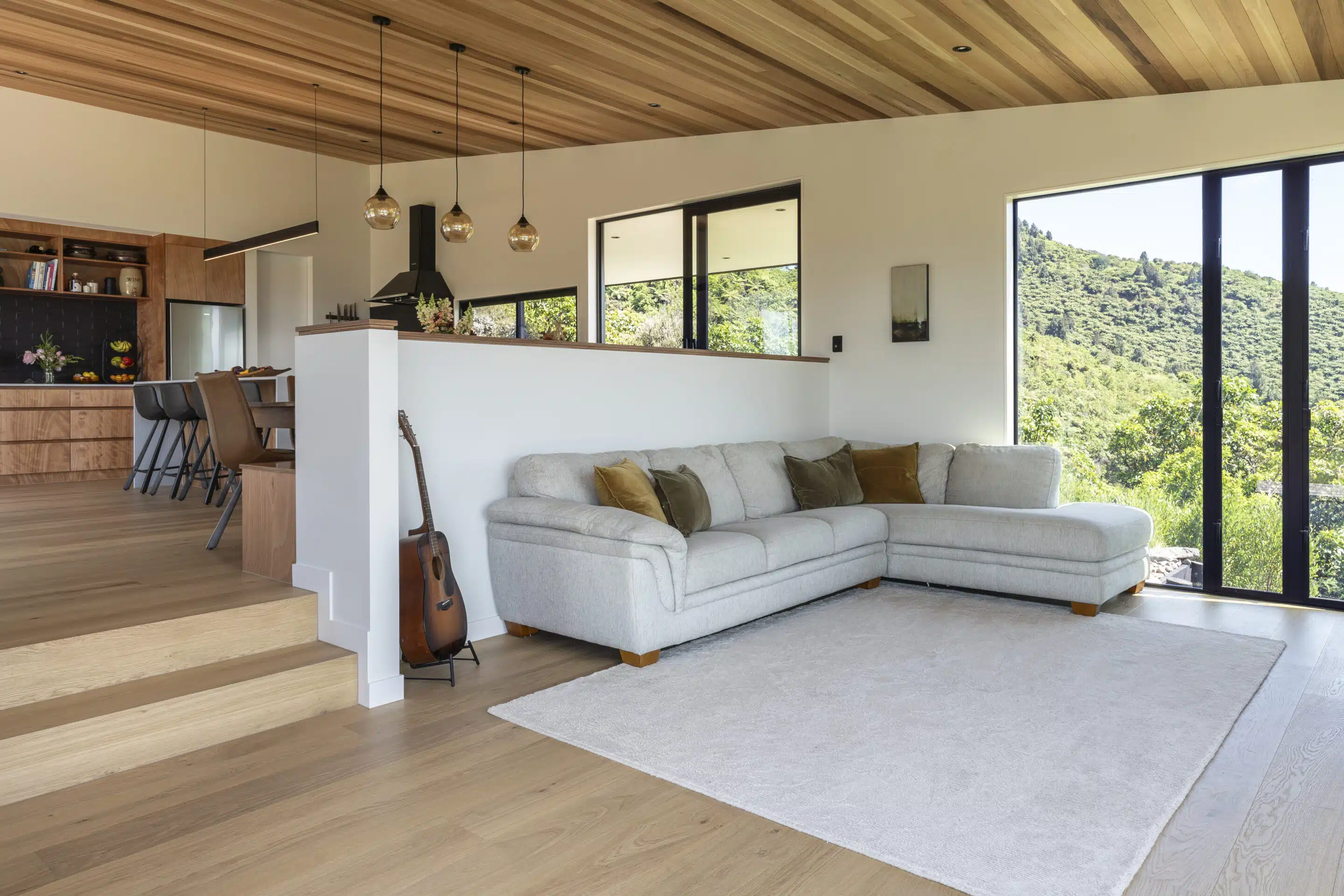
Engineered Timber Flooring NZ: Ranges and Prices
A European oak wear layer over a stable core, built for New Zealand’s humidity and underfloor heating.
Vienna Woods supplies engineered European oak flooring across New Zealand, in wide plank, herringbone and chevron, from our Newmarket showroom and through regional partners. This page sets out what it costs supplied and installed, how it compares with solid timber and laminate, and the ranges you can order free samples from.
Engineered oak is the standard specification for New Zealand commercial projects. See commercial timber flooring for offices, hospitality and retail.
Why engineered timber flooring is NZ’s default specification
It is the default in New Zealand for one reason: the same oak surface as solid timber, with far less seasonal movement in our humidity.
That construction minimises seasonal movement, allows wider plank formats, and improves compatibility with underfloor heating when correctly specified. It is used across residential architecture, apartments and commercial interiors throughout the country.
We supply European oak in wide plank and herringbone parquet. Explore our engineered timber flooring options, visit the Vienna Woods Auckland showroom to see full-size displays, or read about engineered timber flooring in Auckland.
What is engineered timber flooring?
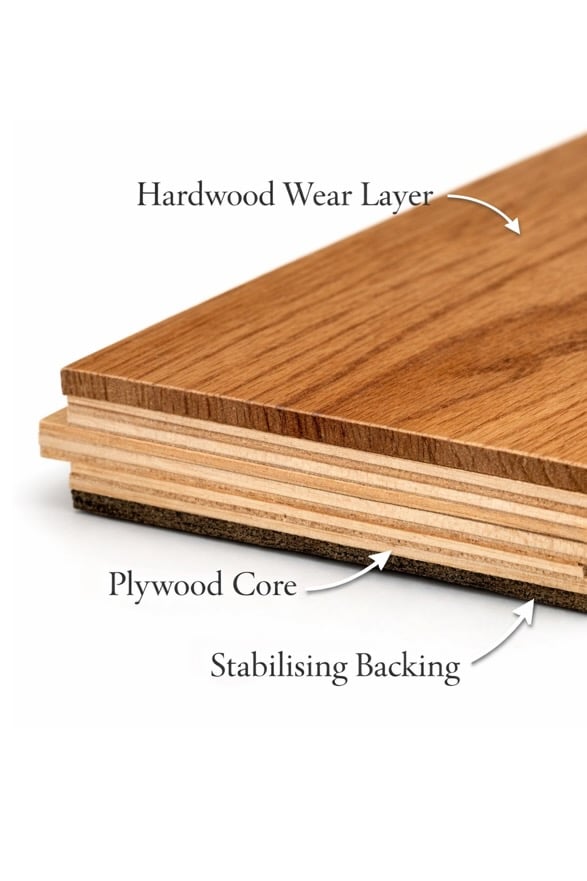
Engineered timber flooring is a real hardwood wear layer bonded to a multi-layer timber core. The layered structure keeps the appearance and texture of solid wood while giving greater structural stability as conditions change.
The top layer is genuine oak, so the natural grain, colour variation and surface character stay visible. Beneath it, cross-laminated timber layers add strength and help minimise the expansion and contraction that seasonal humidity causes.
That stability is what allows wider boards, a concrete subfloor, and underfloor heating when correctly specified. Vienna Woods specialises in European oak engineered flooring for architectural interiors, in wide plank and traditional herringbone parquet formats.
Engineered timber flooring vs solid timber flooring
Both use real hardwood; the difference is construction. Solid timber is milled from a single piece of wood and can expand and contract noticeably as humidity changes, which is more pronounced in homes with heating or a concrete slab. Engineered timber combines a real oak wear layer with a stable multi-layer core, so it moves less while keeping the look and feel of genuine timber.
Engineered European oak
What we supply
- Real oak wear layer over a multi-layer core
- More dimensionally stable, less seasonal movement
- Can be glued directly to concrete
- Suits underfloor heating when correctly specified
- Suits wider planks, with less movement than solid timber of the same width
Solid timber
The traditional board
- One piece of hardwood through and through
- Moves more as humidity changes
- Best for heritage or traditional projects
- Over underfloor heating only within tight limits: 19mm boards, cover width no more than 130mm (80 to 85mm preferred) and 8 to 9% moisture content (ATFA)
- More sanding cycles over a very long life
For most NZ new builds and renovations, engineered is now the dominant specification. Available in both wide plank and herringbone parquet. For a fuller comparison, see engineered vs solid timber flooring NZ.
How much does engineered timber flooring cost in NZ?
Engineered timber flooring in New Zealand runs from about $99 to $320 per m² supplied, depending on construction quality, wear layer thickness, board width and finish system. Supply is incl GST, installation is quoted +GST.
Most quality engineered oak sits between $150 and $180 per m². Lower-priced options are usually thinner constructions or clearance lines; higher-end ranges offer wider planks, thicker wear layers and more advanced finishing systems. We will explain the structural differences clearly so you can balance durability and budget.
Installed cost sits higher once subfloor prep and fitting are added. For the full breakdown across formats and finishes, see our timber flooring cost guide.
Installation methods and applications
Engineered timber flooring can be installed glue-down, floating or secret-nailed, and the method should always be specified against moisture conditions, heating and the structural substrate. Vienna Woods installs glue-down only and does not recommend floating. Applications run from living areas and bedrooms through to kitchens, offices and retail spaces; for stairs and high-traffic zones, matching stair nosings and finish systems keep the look consistent and suited to high-traffic use.
Glue-down
Bonded directly to the substrate. The best thermal contact for underfloor heating and a solid underfoot feel. This is the method we install and stand behind.
Floating
Boards lock together over an underlay, not fixed to the subfloor. We explain it because you will read about it, but we do not install it or recommend it: a floated floor is held to a tighter flatness tolerance than a glued one (the Australian Timber Flooring Association's (ATFA) figure is 3 mm under a 1.5 m straight edge, against 3 mm over 3 m for a direct adhesive fix), and the tolerance, not the click system, is what decides whether the floor works.
Secret-nail
Fixed to a timber subfloor through the tongue. A traditional method where the substrate suits it.
Specification support
We help architects, designers and builders select board dimensions, wear-layer thickness and finishes, with moisture assessment and heating compatibility checked before product is confirmed.
See our full timber flooring installation guidance, or browse the full timber flooring catalogue to compare tones, grades and patterns.
Engineered timber flooring for stairs


Engineered timber flooring can be applied to stair treads, risers and landings where the product and detailing suit. Stairs bring extra considerations: stair nosings, substrate preparation, slip resistance and finish durability all matter.
For a detailed overview of timber stair options, compliance considerations and detailing methods, see our dedicated page: timber stairs and staircases in New Zealand.
Talk to a timber flooring specialist
Tell us about your project and we will give clear guidance on product suitability, specification and next steps. No obligation, straight answers.
To recommend the right floor, we will ask
- Where the project is (city or region) and whether it is a new build or renovation
- Subfloor type (timber joists, slab, existing floor)
- Approximate area (m²) and preferred style (plank, herringbone, parquet)
- Finish preference (oiled, lacquered, ultra matt)
- Any underfloor heating (hydronic or electric) or moisture considerations
Not sure yet? Share what you have and we will guide the next step.
Popular engineered timber styles

Engineered herringbone flooring for a classic look
Herringbone works well in entry halls, dining rooms and feature zones where you want pattern without sacrificing practicality. Engineered herringbone flooring keeps the classic layout with the added stability of a layered construction, in a range of tones and finishes to suit modern or traditional interiors.
See it in person or order samples NZ-wide
Prefer to see options in person? Visit our Auckland showroom. Outside Auckland, we send samples so you can confirm colour and finish before ordering. Request a quote or book a showroom consultation.
Engineered oak flooring in NZ
European oak remains the most specified engineered timber flooring species in New Zealand for its stability, grain consistency and versatility across modern and heritage builds. We supply wide plank, herringbone and custom parquet oak in oiled, lacquered and ultra-matt finishes. Read more about European oak flooring NZ.
Professional installation and project management
Correct installation determines long-term performance. Our Auckland team handles moisture testing, subfloor preparation and precise fitting for plank, herringbone and parquet systems, across new builds and architectural homes, renovations and extensions, and residential and light commercial projects. View recent timber flooring projects.
Engineered oak, hardwood, wooden, timber: what we supply and what the terms mean
"Timber flooring", "wooden flooring", "hardwood flooring" and "wood flooring" mostly describe the same thing in New Zealand searches: a real-wood floor for a home or commercial space. The terminology varies by industry, region and preference. Here is what each covers and where Vienna Woods fits.
Engineered oak flooring
Engineered oak flooring is what we supply: a real European oak wear layer bonded to a multi-layer plywood or HDF core. Petit Chateau, Icons, Chateau, Patina and Excess run 4mm; Foundation runs 3mm; the Distilled Collection runs 4mm on the 15mm board and 6mm on the 20mm board. At the surface it is identical to solid oak in look, feel, finish and refinishability. Underneath, the engineered construction is more dimensionally stable than solid oak, which is why it is the standard for kitchens, open-plan living and any space with underfloor heating. Our Distilled Collection and Admonter range cover entry-level through to slow-grown Austrian premium oak.
Hardwood flooring NZ: what "hardwood" really means
"Hardwood flooring NZ" usually means oak, walnut, ash, beech or other deciduous-tree timber, woods with a tight, dense grain that resists wear. "Softwood" refers to pines, firs and cedars, with a looser grain, typically used for framing or budget-grade flooring. Vienna Woods supplies hardwood floors exclusively: engineered European oak. We do not supply NZ native species (rimu, kauri, matai), pine or bamboo.
Engineered wood flooring vs solid wood flooring
"Engineered wood flooring" describes any wood floor where the visible top layer is bonded to a structural core rather than a single solid board. It is used interchangeably with "engineered timber flooring" or just "engineered flooring" here. The construction allows glue-down installation directly to concrete, compatibility with underfloor heating, wider planks (180mm and up) with less movement than solid timber of the same width, and consistent performance across humidity swings. Solid timber flooring is one piece of wood through and through and remains an option for traditional or heritage projects, but engineered is now the dominant specification for new builds and renovations.
Timber flooring vs wooden flooring: is there a difference?
No. "Timber flooring NZ" and "wooden flooring NZ" describe the same category, real-wood floors. "Timber" is the trade term used by architects, specifiers and the construction industry; "wooden" is the consumer-facing variant homeowners use most. The product is identical. We supply engineered European oak under either label.
Oak flooring NZ: what is available
Oak is the dominant species in residential and commercial timber flooring in New Zealand. European oak, the species we supply, is prized for its fine, even grain, which makes it a popular choice for premium specification. Plank widths run from 130mm narrow plank up to 220mm-plus wide plank, in straight-lay, herringbone and chevron formats, with lacquered and oiled finishes.
What our customers say
Real reviews from Vienna Woods customers across New Zealand.


Engineered vs solid vs laminate: the numbers side by side
Most NZ buyers comparing timber options weigh engineered against either solid hardwood or a high-end laminate. The headline trade-off is real-wood look plus long lifespan versus upfront cost. This table puts the three on one sheet so you can decide what matches your project rather than the marketing each category uses.
| Feature | Engineered European oak (what we supply) | Solid hardwood (oak or walnut) | Premium laminate |
|---|---|---|---|
| Surface material | Real oak wear layer (3 to 4mm) | Solid wood throughout (19mm) | Photographic image of wood under melamine |
| Stability in NZ humidity | High. Multi-ply core moves significantly less than solid | Low. Can cup or crack in dry winter heating | High. Synthetic, no movement |
| Compatible with underfloor heating | Yes (glue-down, up to 27°C surface) | Generally no. Movement risk | Yes |
| Refinishable | Yes. Industry guidance (ATFA) is at least two sand-and-recoat cycles on a properly installed engineered floor | Yes, more cycles than an engineered board | No. Replace when worn |
| Realistic lifespan | 30 to 40-plus years | 50 to 100-plus years | 10 to 15 years |
| Supply cost (NZ, mid-range, incl GST) | $150 to $220/m² | $220 to $400/m² (limited NZ availability) | $45 to $90/m² |
| Installed cost (typical, incl GST) | $250 to $415/m² | $320 to $520/m² | $130 to $200/m² |
| Made by an FSC-certified mill | Yes for the Distilled Collection (Vienna Woods holds no Chain of Custody itself) | Varies by mill | Not applicable, not real wood |
| Best for | Most NZ residential and commercial projects: a real-wood look without solid’s instability or cost | Heritage restoration where solid is specified, or projects with no underfloor heating and stable humidity | Tight-budget rentals and short-hold investment properties |
The honest summary: engineered oak makes sense for the vast majority of NZ projects. Solid is occasionally the right call for heritage restoration. Laminate is the right call when budget is the only constraint and the floor is not a long-hold asset. We supply solid on special order and we do not supply laminate, and we will tell you when one of those is a better fit than what we stock.
For the full pricing breakdown see our timber flooring cost guide; for parquet patterns see our herringbone flooring guide.
Engineered timber flooring FAQ
Common questions we field at our Newmarket showroom about engineered European oak flooring: suitability, specification, longevity and what to expect over the life of the floor.
Is engineered timber flooring suitable for NZ homes?
Yes. Engineered timber suits New Zealand's humidity swings better than solid timber. Its layered construction, a real European oak wear layer bonded to a stable multi-layer core, resists the seasonal expansion and contraction that affect solid boards. With correct subfloor preparation, moisture testing and acclimatisation, engineered European oak performs reliably across Auckland, Wellington, Christchurch and coastal sites alike.
What's the difference between engineered timber and solid timber flooring?
Solid timber is one piece of wood through and through. Engineered timber has a top layer of real European oak, the wear layer, bonded to a multi-layer plywood or HDF core. The engineered construction is more dimensionally stable, can be installed over underfloor heating, can be glued directly to concrete, and works in environments where solid timber would warp or cup. The wear layer itself is identical to solid in look, feel, finish and refinishability.
What wear-layer thickness should I look for in engineered timber flooring?
EN 13489:2017 Table 5 sets the minimum top layer for engineered flooring at 2.5mm. Petit Chateau, Icons, Chateau, Patina and Excess run 4mm; Foundation runs 3mm; the Distilled Collection runs 4mm on the 15mm board and 6mm on the 20mm board. For commercial fit-outs we recommend a 4mm wear layer, often paired with a UV-cured lacquered finish suited to high-traffic areas.
How long does engineered timber flooring last?
A well-specified engineered timber floor lasts 25 to 50 years. Lifespan depends on wear-layer thickness, finish system and maintenance. Vienna Woods supplies engineered European oak with a 4mm wear layer on most ranges and 3mm on Foundation and Blackbutt, which supports residential resandability and a long service life on a typical residential floor.
Can engineered timber flooring be sanded and refinished?
Yes. Our wear layers run 4mm on Petit Chateau, Icons, Chateau, Patina and Excess and 3mm on Foundation, which supports at least one full sand-and-refinish, restoring the floor to as-new condition. A lacquered finish is screened and re-coated when the surface wears; an oiled finish is topped up in place. Re-oil on the test, not the calendar. ATFA's test: a few drops of water on a high-wear area. If it beads the finish is intact; if it soaks in after a few minutes and the timber darkens, it is time to recoat.
Can engineered timber flooring be used with underfloor heating?
Yes, and this is one of the main reasons specifiers choose engineered over solid. Engineered boards are dimensionally stable enough to handle the gradual temperature changes underfloor heating creates. Choose a glue-down installation for better thermal contact than floating, bring the floor up by no more than 2 degrees C per day over about ten days once it is laid, and don't exceed a 27 degree C surface temperature. We can supply boards suitable for underfloor heating across much of our range, subject to correct specification.
What plank widths are available?
Engineered European oak is available from 130mm narrow plank up to 220mm-plus wide plank. Wide planks, 180mm and above, read as a more contemporary, open-feeling floor and suit larger rooms and open-plan layouts. Narrower boards work in heritage or smaller-room contexts. We carry both ends of the range and can match width to room scale.
Is engineered timber flooring sustainable?
It depends on the source. Vienna Woods's Distilled Collection is made by a mill holding current FSC certification, supporting legal harvest and responsible forest management. Engineered construction is also more efficient than solid: a single oak log yields much more flooring as wear layers over plywood cores than as solid boards. For commercial tenders requiring Green Star alignment, we can supply the mill's current FSC certificate for the relevant range, and low-VOC documentation where the range has it, on request.
For broader timber-flooring questions across formats, finishes and installation, see our full timber flooring FAQ. To see and feel the boards in person, order free samples or book a showroom consultation.
Trusted across the trade
With over a decade of experience, Vienna Woods is trusted by architects, designers and builders across New Zealand. Selected ranges are made by FSC-certified mills, giving a direct link to responsibly managed forests, with no sacrifice in design or performance required for today's demanding project work. Our own-brand European oak ranges carry a 20-year residential warranty, and we provide care and maintenance advice for the life of your floor. See our timber flooring finishes and maintenance guidance.



Explore engineered timber flooring
Browse the range
Every engineered European oak option in one place: tones, grades and formats.
Explore →All collections
Explore the Vienna Woods collections, from Petit Château to Foundation.
Explore →Free samples
See and feel the boards in your own light before you commit. Posted NZ-wide.
Explore →Cost guide
What engineered timber flooring costs in NZ, supplied and installed.
Explore →Petit Château
Seven European oak colours across five formats, our most-specified range.
Explore →Icons
Design panels and parquet, curated with NZ interior designers.
Explore →Château
Wide-plank European oak at 240mm for larger open-plan rooms.
Explore →Foundation
Fixed-length European oak boards, held in stock and ready to go.
Explore →Related Vienna Woods guides
- Engineered vs Solid Timber Flooring NZ: when each is right, with cost, stability and refinishing compared.
- Oiled vs Lacquered Timber Flooring NZ: a decision matrix by use case, scratch repair and NZ kitchen suitability.
- Timber Flooring with Underfloor Heating NZ: engineered oak compatibility, install methods and surface temperature limits.
- European Oak Flooring NZ: what makes European oak different: grades, colours, formats and prices.
- Timber Floor Maintenance Guide NZ: cleaning routines, re-oiling timelines and the products we use.
- Timber Flooring Installation: methods, subfloor prep and getting the floor down right.
- Timber Stairs and Staircases in New Zealand: options, compliance and detailing for engineered oak stairs.
- Westwood at a Westmere Harbour Home: wide-plank Icons oak across an open-plan home (MacFie Architecture and Spatial Studios case study).
See engineered European oak in your own light
Order a free sample pack and live with the colour in your rooms, or talk to our team about your project. Straight answers, no obligation.